
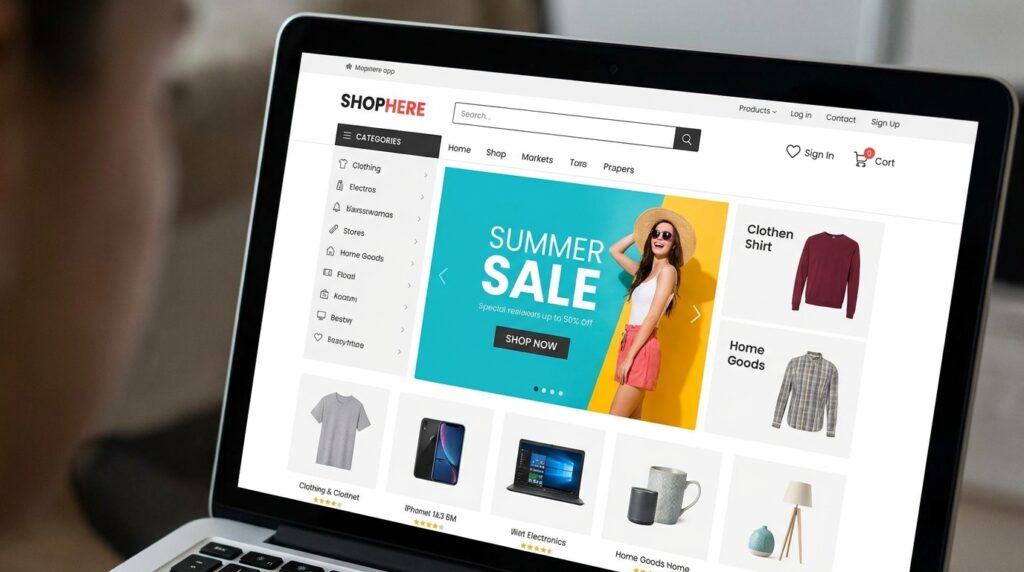

There is a conversation happening in Nigerian business circles right now, in markets, in offices, in WhatsApp group chats between entrepreneurs, and at business seminars across Lagos, Abuja, Port Harcourt, and every other commercial city in this country. And it goes something like this.
Someone asks a business owner if they have a website. The business owner laughs it off. “My customers know where to find me.” Or: “I have Instagram, that is enough.” Or the classic: “Nigerians do not really shop online like that.”
Then six months later, that same business owner watches a competitor, selling the same products, targeting the same customers, generate more revenue in a single week than they made in a month. The difference? The competitor had an e-commerce website.
This is not a hypothetical scenario. It is playing out in real time across every industry in Nigeria, from fashion and beauty to electronics, food, real estate, logistics, and professional services. The businesses that have embraced e-commerce are pulling ahead. The ones that have not are working harder for a shrinking slice of a market that is moving online, whether they move with it or not.
This article makes the case clearly, specifically, and with the kind of practical context that actually applies to businesses in Nigeria, for why your business needs an e-commerce website in 2026. Not someday. Not when conditions are perfect. Now.
The State of E-commerce in Nigeria Right Now
Let us start with the reality of the market you are operating in, because the numbers tell a story that no business owner can afford to ignore.
Nigeria had over 84 million internet users by the end of 2025, and that number is growing by millions every year. E-commerce transactions in Nigeria were valued at over $12 billion annually and are climbing. Mobile internet penetration has reached over 60 percent of the population, meaning hundreds of millions of Nigerians have the ability to discover and buy from an online business in their pocket at all times.
More significantly for your business, Nigerian consumer behaviour has shifted permanently. The experience of the COVID-19 pandemic accelerated online shopping adoption by years, introducing millions of Nigerians who had never bought anything online to the experience of browsing, ordering, and receiving products without leaving their homes. Many of those consumers never fully returned to their old shopping habits.
Today, Nigerian consumers research purchases online before making buying decisions, even when they intend to buy in a physical store. They compare prices online. They read reviews online. They discover new brands and businesses online. If your business is not visible in the places where these discovery moments happen, you are invisible to a growing segment of the market that is actively looking for what you sell.
An e-commerce website is not just about selling online. It is about existing in the digital space where your customers increasingly live and make decisions.
12 Compelling Reasons Why Your Business Needs an E-commerce Website in Nigeria
1. Your Business Stays Open 24 Hours a Day, Seven Days a Week
This is the most fundamental advantage of an e-commerce website, and it deserves to be said plainly. When you have an e-commerce website, your business never closes.
At 11pm on a Sunday, when your shop is locked, and your staff have gone home, and you are watching a movie, a customer in Kano can visit your website, browse your products, add items to their cart, pay via Paystack, and place an order that is waiting for you to fulfil when you wake up on Monday morning. Without you doing a single thing.
That is not a small thing. That is your business, generating revenue while you sleep.
Physical shops are constrained by opening hours. Social media pages can be browsed but not easily transacted on. An e-commerce website removes the time constraint from your sales entirely and makes your business available to customers at whatever hour they are ready to buy.
For Nigerian business owners who are already working extremely hard during business hours, the idea of your business continuing to earn money outside those hours is not just attractive. It is transformational.
2. You Reach Customers Across All of Nigeria, Not Just Your Neighbourhood
If your business only has a physical location, your customer base is largely limited to people who can physically get to you. In a country as large and geographically diverse as Nigeria, that represents a tiny fraction of your potential market.
An e-commerce website removes geography as a constraint on your growth. A fashion business in Surulere, Lagos, can sell to customers in Enugu, Kano, Ibadan, Warri, and Jos simultaneously. A food product business in Port Harcourt can supply customers across the South South, the South East, and beyond. A professional services firm in Abuja can serve clients in every state in Nigeria without maintaining a single additional office.
The Nigerian logistics ecosystem has matured enough to support this. GIG Logistics, Sendbox, Kwik Delivery, and dozens of other companies can move your products to customers across the country reliably and affordably. The infrastructure for nationwide e-commerce is there. All you need is the website to sell from.
For many Nigerian businesses, going nationwide through e-commerce represents a five to ten times expansion of their addressable market without a proportionate increase in costs. That kind of leverage is simply not available through physical retail alone.
3. Your Business Looks More Credible and Professional
In the Nigerian market, first impressions carry enormous weight. Customers make rapid judgments about whether a business is trustworthy based on how it presents itself, and in 2026, a business with a well-designed e-commerce website presents itself as significantly more established, professional, and trustworthy than one without.
Think about it from your own experience as a consumer. When you are considering buying from a business you have not used before, what gives you more confidence? A WhatsApp number and an Instagram page, or a proper website with product listings, clear pricing, a secure payment gateway, an about page, and customer reviews?
The website signals permanence, investment, and accountability. It says this business is serious enough to build a proper digital infrastructure. It says there is somewhere to go if something goes wrong. It says this is a real business, not someone selling from their bedroom with no accountability.
For Nigerian businesses targeting corporate clients, government agencies, NGOs, or international partners, this credibility differential is even more pronounced. Many corporate buyers and institutional clients in Nigeria now require a website as a minimum condition for considering a supplier. Without one, you are not even in the conversation.
4. You Collect Valuable Customer Data That Grows Your Business
Every visitor to your e-commerce website leaves behind data that a physical shop or social media page cannot capture with the same depth or reliability. Their location, the products they viewed, the items they added to their cart, the search terms that brought them to your site, the time they spend on each page, and whether they completed a purchase or abandoned it are all measurable, trackable insights that help you make better decisions.
This data is gold for a Nigerian business that wants to grow intelligently rather than just work harder. It tells you which products are most popular. It tells you where your customers are located. It tells you what your customers search for before they find you. It tells you at what point in the purchase process you are losing people, which you can then fix to increase your conversion rate.
Social media platforms give you some of this data, but they are selective about what they share, and they retain ultimate control over it. Your e-commerce website data belongs entirely to you, and it compounds in value over time as you accumulate more of it and learn how to use it to drive better decisions.
5. Your Marketing Becomes Significantly More Effective
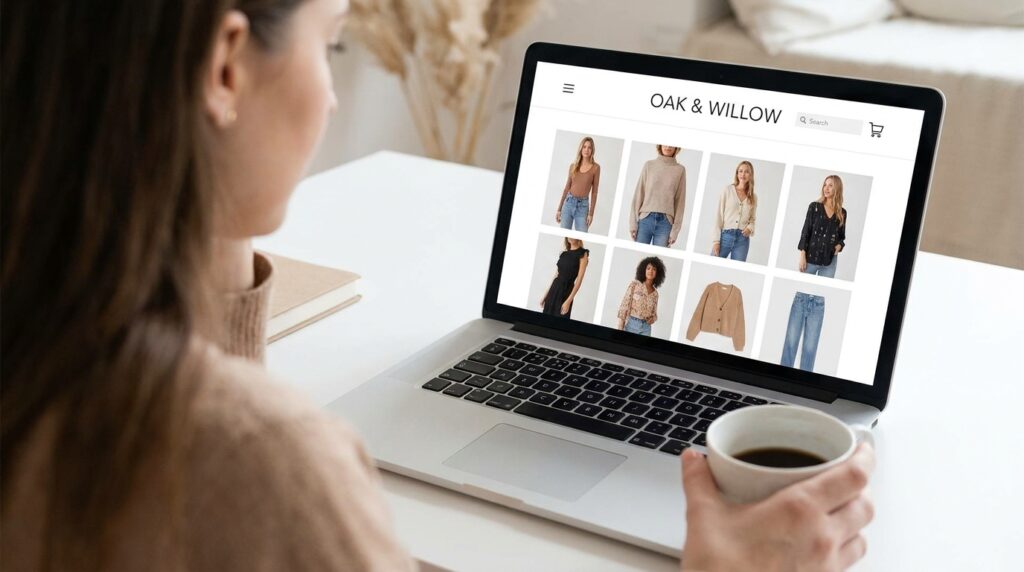
Every marketing activity you do for your Nigerian business, whether it is a social media post, a WhatsApp broadcast, a Google search ad, or a TikTok video, needs somewhere to send interested people. A destination. A place to go from the ad to the action.
Without an e-commerce website, that destination does not exist in a form that can efficiently convert interest into sales. You can send people to your Instagram page, but Instagram is not designed for transactions. You can send them to your WhatsApp, but WhatsApp requires a manual conversation for every purchase. Neither of these converts as efficiently as a well-designed e-commerce website that takes a visitor from product discovery to payment completion in a few smooth steps.
An e-commerce website makes every other marketing activity you do more powerful because it creates a destination that converts browsers into buyers. The social media post that generates interest, the WhatsApp broadcast that reminds existing customers of a new product, the Google ad that captures someone actively searching for what you sell, all of these work harder when they point to an e-commerce website with a clear path to purchase.
6. You Can Sell Multiple Products Without Multiple Conversations
Here is something that costs Nigerian business owners enormous amounts of time every single day. A potential customer messages on WhatsApp asking what you have available. You send a catalogue. They ask for prices. You send prices. They ask about delivery. You explain delivery. They ask if a specific size or colour is available. You check and reply. Twenty messages later, maybe they buy. Maybe they do not.
Multiply that by thirty potential customers a day, and you are spending hours every day on conversations that a well-built e-commerce website handles automatically.
Your website displays all your products with photos, descriptions, prices, variant options (sizes, colours, quantities), stock availability, and delivery information simultaneously, accessibly, and consistently for every visitor. A customer can browse your entire range, compare products, check delivery options for their location, and complete a purchase without requiring a single message from you.
That is not just more efficient. It is more professional, more scalable, and more likely to result in a sale because the customer can move through the decision-making process at their own pace without feeling pressure from an active sales conversation.
7. You Build a Brand, Not Just a Business
There is an important distinction between a business that sells products and a brand that customers are loyal to. Businesses compete on price. Brands compete on identity, trust, and relationship. And in the long run, brands win.
An e-commerce website is one of the most powerful brand-building tools available to a Nigerian business. Your website is the one place on the internet where your business is presented entirely on your own terms. Your colours, your typography, your photography style, your voice, your story, your values, and your customer experience are all under your control in a way that a marketplace listing or a social media profile never fully is.
When a customer buys from your branded e-commerce website rather than finding you listed anonymously on a marketplace, they associate the experience with your brand rather than with the marketplace. They are more likely to remember you, return to you, and recommend you to others, because the transaction felt like a relationship with your business rather than just another purchase on a platform.
Over time, this brand equity compounds into customer loyalty, word-of-mouth referrals, and the kind of premium pricing power that businesses known only through marketplaces rarely achieve.
8. You Reduce Your Dependence on Social Media Platforms
Here is a risk that many Nigerian business owners who rely entirely on Instagram or Facebook for their sales have not fully considered. Those platforms are not yours. They are borrowed spaces where you operate on someone else’s terms, subject to algorithm changes, account suspensions, policy updates, and platform outages that are entirely outside your control.
Nigerian businesses have experienced this risk in real, painful ways. Accounts get hacked. Platforms get temporarily blocked. Algorithm changes reduce organic reach dramatically overnight. A business that built its entire customer acquisition system on a single social media platform has built on a foundation it does not own.
An e-commerce website is a digital asset you own and control. It cannot be suspended by an algorithm. It is not affected by policy changes at Meta or TikTok. Its performance does not depend on whether you posted at the right time of day to please an ever-changing content algorithm.
When you combine your e-commerce website with social media rather than depending entirely on social media, you build a more resilient, more sustainable business model where your most valuable customer relationships are anchored to a platform that belongs to you.
9. You Can Automate Significant Parts of Your Business
The most time-consuming parts of running a Nigerian product business are often the most repetitive ones. Processing orders. Sending payment confirmations. Providing order status updates. Answering frequently asked questions. Sending delivery notifications.
A well-configured e-commerce website automates most of these tasks. Order confirmations go out automatically when payment is received. Customers receive tracking information automatically when their order is dispatched. Frequently asked questions are answered on your FAQ page without requiring a WhatsApp conversation. Payment receipts are generated and delivered automatically.
This automation does not just save you time. It creates a more consistent, more professional customer experience because automated systems do not make errors, forget to follow up, or give different answers to different customers on the same day.
For Nigerian small business owners who are already stretched thin managing operations, marketing, and customer service simultaneously, the automation that a proper e-commerce website enables is one of its most practically valuable benefits.
10. You Compete More Effectively With Larger Businesses
One of the most remarkable things about e-commerce is that it levels the playing field between large and small businesses in a way that physical retail never could. In a physical market, a large retailer with prime location real estate, a big marketing budget, and a well-known brand name has an enormous advantage over a small business. Online, the dynamics are different.
A small Nigerian business with a well-designed e-commerce website, strong product photography, clear descriptions, competitive pricing, fast delivery, and consistent marketing can compete directly with much larger businesses for the same online customer. The customer sees your product next to a competitor’s product and makes a decision based on quality, price, and trust signals, not on which business is bigger.
This is genuinely democratising. It means a small cosmetics brand in Enugu can compete with established brands for customers in Lagos. A small clothing business in Ibadan can win customers that a larger Lagos-based competitor is also targeting. E-commerce gives smaller Nigerian businesses a competitive edge they have never had before.
11. You Benefit From Search Engine Visibility
When a Nigerian consumer types “buy ankara fabric online” or “affordable skincare products Nigeria” or “logistics company in Abuja” into Google, something significant happens. Google returns a list of results, and the businesses with properly built, optimised websites appear in those results. Businesses without websites do not.
Search engine visibility is one of the most valuable and most sustainable forms of customer acquisition available to any Nigerian business because it captures people who are actively searching for exactly what you sell, at the precise moment they are ready to buy.
This is fundamentally different from social media marketing, where you are interrupting someone’s scrolling to show them something they may or may not be interested in. Search traffic is intent-driven. Someone who finds your e-commerce website by searching for a specific product is already motivated. All your website needs to do is give them confidence and a smooth path to purchase.
Building search engine visibility takes time and consistent content creation, but it creates a compounding asset that drives customer acquisition without ongoing advertising spend, making it one of the highest-return long-term investments a Nigerian business can make.
12. You Create Multiple Revenue Streams From One Platform
An e-commerce website is not just a shop. In the hands of a creative, entrepreneurial Nigerian business owner, it is a platform from which multiple revenue streams can flow simultaneously.
Beyond direct product sales, your e-commerce website can host subscription products that generate monthly recurring revenue. It can sell digital products like guides, templates, and courses alongside physical products. It can generate affiliate income by recommending complementary products from other businesses. It can attract advertising revenue as your traffic grows. It can sell consulting or service packages through an integrated booking system.
Nigerian businesses that maximise the revenue potential of their e-commerce websites treat them not as a single channel but as a digital business hub from which multiple income streams radiate. The website becomes the centre of an ecosystem rather than just an online shop.
How Queposts Amplifies the Benefits of Your E-commerce Website
Building your e-commerce website is one of the most important steps your Nigerian business can take in 2026. But your website works hardest when it is part of a broader digital presence that drives traffic to it from multiple directions simultaneously.
This is where Queposts plays a powerful supporting role.
Queposts is a next-generation business portal designed to help businesses, professionals, and consumers discover each other with ease. From company listings and classified ads to jobs, events, and industry content, Queposts connects people to opportunities locally and globally.
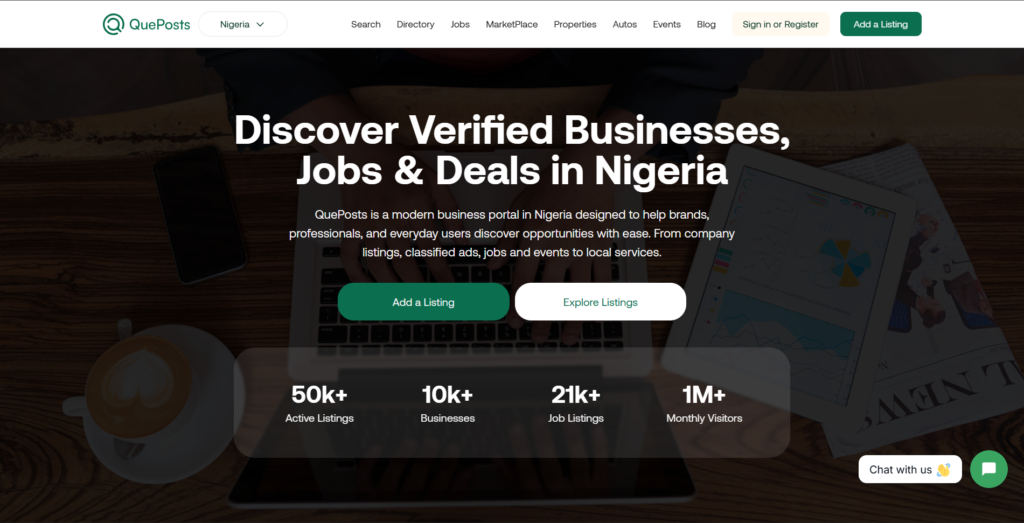
For a Nigerian business that has invested in building an e-commerce website, a complete Queposts business listing creates an additional discovery channel that funnels motivated buyers to your website. Your Queposts profile can link directly to your e-commerce website, meaning every consumer who finds your business on Queposts has a clear, immediate path to your online shop.
Think of your Queposts listing as a powerful referral source. When a buyer in your city or anywhere in Nigeria searches for your type of product or service on Queposts, your business profile appears with your website link visible. That is a motivated buyer, one who was already searching and is ready to act, being directed straight to your online shop.
Beyond discovery, Queposts allows you to list individual products, post classified ads, share industry content, and promote events, all of which drive traffic back to your e-commerce website and reinforce your business’s credibility and authority in your market.
The businesses that dominate their categories in Nigerian e-commerce in 2026 are not the ones that rely on a single channel. They are the ones that build strong e-commerce websites and then amplify those websites with a presence on every relevant platform, including Queposts, where their target customers are already looking.
What Is Stopping You and Why It Should Not Be
Let us address the objections directly, because most Nigerian business owners who have not yet built an e-commerce website have at least one of the following reasons for waiting.
“It is too expensive.” A functional Nigerian e-commerce website can be built for as little as ₦50,000 to ₦150,000 using platforms like Bumpa, Flutterwave Store, or Selar. Shopify starts at approximately $29 per month. The cost of not having one, in lost sales to competitors who do, is almost certainly higher.
“I am not technical enough.” Modern e-commerce platforms are designed for non-technical users. Bumpa, which is built specifically for Nigerian business owners, can be set up from a smartphone with no coding knowledge whatsoever. If you can use WhatsApp, you can build a basic e-commerce presence.
“My customers prefer to buy in person.” Some do. Many are shifting. And the ones who prefer to buy in person will still buy in person. But the growing segment who prefer to research and buy online will go to your competitor if you are not available to them digitally.
“I do not have enough products to need a website.” One product presented professionally on a well-designed e-commerce page converts better than ten products listed informally on a WhatsApp catalogue. You do not need many products. You need the right ones presented properly.
“I will do it later when the business grows.” This is the most costly mistake. The businesses that wait until they have grown to build their e-commerce website are competing against businesses that built theirs at the beginning and have spent years accumulating search engine visibility, customer data, brand authority, and online sales momentum. Start now. Grow into it.
Final Thoughts
The question is not really whether your Nigerian business needs an e-commerce website. In 2026, it does. The more useful question is how much it is costing you every day that you do not have one.
Every day without an e-commerce website is a day your business is closed from the moment you lock up until the moment you open again the next morning. It is a day that customers in other Nigerian cities cannot buy from you. It is a day that someone searching Google for what you sell finds your competitor instead. It is a day your brand is less visible, less credible, and less competitive than it could be.
The businesses that are winning in Nigerian commerce in 2026 are not necessarily the ones with the biggest budgets or the most staff. They are the ones who understood earliest that the internet is not a supplement to the Nigerian economy. It is increasingly the economy itself.
Build your e-commerce website. Get listed on Queposts. Show up consistently in the digital spaces where your customers are already looking. And watch what happens when your business stops being limited by geography, opening hours, and the reach of your personal network.
The Nigerian market is enormous. The online opportunity within it is real and growing. Your e-commerce website is how you claim your share of it.
Start building today.
Also Read: Where Can You Advertise Your Business for Free? 20 Platforms Worth Your Time