


Nigeria is one of the most entrepreneurial countries in the world. Walk through any street in Lagos, drive through Abuja, stroll through Onitsha Main Market, or visit any neighbourhood in Port Harcourt, and you will see it everywhere. People selling, people building, people hustling, people creating something from nothing with whatever they have at their disposal.
But not all businesses are created equal. Some small-scale businesses in Nigeria generate barely enough to survive on, while others, started with similar amounts of capital and similar levels of effort, produce profits that genuinely change lives. The difference is usually not luck. It is choosing the right business, in the right market, with the right approach.
That is exactly what this article is about.
We have put together a carefully researched list of the top ten small-scale businesses in Nigeria that are not just viable but genuinely, consistently profitable. These are businesses with proven demand in the Nigerian market, realistic startup costs, and the kind of profit margins that make the effort worthwhile.
Whether you are a fresh graduate looking for your first venture, a salary earner who wants to build something on the side, or someone who has been thinking about starting a business for years and just needs a push in the right direction, this list is for you.
What Makes a Small-Scale Business Profitable in Nigeria?
Before we get into the list, it is worth spending a moment on what separates a profitable small-scale business in Nigeria from one that merely survives.
Profitability in the Nigerian context comes down to a few key factors.
Consistent demand. The most profitable small-scale businesses in Nigeria sell things that people need regularly, not occasionally. A business that depends on one-off purchases is always one slow month away from crisis. A business with repeat customers and regular demand has a foundation that compounds over time.
Reasonable startup and running costs. A profitable business is one where the gap between what you spend and what you earn is wide enough to matter. High overhead costs eat into margins quickly, which is why the most profitable small-scale businesses in Nigeria tend to be lean by design.
Scalability. The best small-scale businesses are ones you can grow without having to rebuild everything from scratch. Adding more customers, more products, or more service capacity should be possible without a complete overhaul of how the business operates.
Strong local demand and limited formal competition. In many sectors of the Nigerian economy, large corporations and formal businesses have not fully penetrated the market, leaving significant space for small-scale operators to serve customers profitably.
With those factors in mind, here are the ten most profitable small-scale businesses in Nigeria in 2026.
1. Food Business (Cooking and Catering)
Estimated startup cost: ₦30,000 to ₦200,000 Profit potential: Very High
Food is the one business in Nigeria that never goes out of season. Nigerians eat every day, celebrate constantly, and gather regularly around food. Whether it is a small bukka serving office workers their afternoon rice and stew, a home-based catering operation handling weekend parties, or a small chops business supplying events across town, food businesses in Nigeria have a built-in, guaranteed market.
What makes food particularly attractive as a small-scale business is the variety of entry points. You do not need a restaurant with fifteen tables and a commercial kitchen to start earning. Many of the most profitable food businesses in Nigeria started from a domestic kitchen, a roadside stand, or a takeaway counter no bigger than a market stall.
The secret to profitability in the Nigerian food business is quality, consistency, and speed of service. Customers who find a food vendor they trust become some of the most loyal repeat buyers in any industry. That woman who makes the best ofada rice on your street probably has customers who have been buying from her for years without ever considering going elsewhere.
Highly profitable food business formats for Nigerian small-scale operators include:
- Home cooking and delivery for busy working professionals in urban areas
- Small chops production for events (puff puff, samosa, spring rolls, and so on)
- Chin chin, cookies, and packaged snack production for retail
- Buka or local restaurant in a high-traffic area
- Cake and pastry baking for celebrations
- Niche food products like zobo, kunu, and smoothies for health-conscious Nigerian consumers
2. Hair and Beauty Business
Estimated startup cost: ₦50,000 to ₦300,000 Profit potential: Very High
The hair and beauty industry in Nigeria is enormous and growing. Nigerian women, particularly in urban areas, spend a significant portion of their income on hair, skincare, makeup, and personal grooming. This spending happens regardless of the economic climate, which makes beauty one of the most recession-resistant small-scale businesses in Nigeria.
You can enter this market from multiple angles depending on your skills and starting capital.
If you are a trained hairstylist, starting a home salon or renting a chair in an existing salon requires minimal capital and can generate daily income almost immediately. A skilled hairstylist in Lagos or Abuja with a loyal clientele can earn anywhere from ₦100,000 to ₦500,000 per month, depending on the services they offer and the clientele they serve.
If you prefer the product side of the business, selling human hair bundles, wigs, and hair accessories is one of the most active e-commerce categories in Nigeria right now. Many successful hair vendors import directly from suppliers in China, Malaysia, or Cambodia, and sell exclusively through Instagram and WhatsApp with no physical store whatsoever.
Skincare and beauty product formulation and sales is another profitable angle, particularly as more Nigerian consumers shift toward natural, locally made skincare products. A well-branded shea butter moisturiser, black soap, or natural hair care product targeting Nigerian women can build a serious customer base with relatively modest starting capital.
3. Fashion Design and Tailoring
Estimated startup cost: ₦50,000 to ₦250,000 Profit potential: High
The Nigerian fashion industry is one of the most vibrant in Africa, and the demand for skilled tailors and fashion designers at every price point is enormous. Nigerians dress up for everything. Church every Sunday, owambes every Saturday, weddings virtually every weekend somewhere in the country, office wear five days a week. The market for well-made clothing is deep and consistent.
What makes tailoring and fashion design particularly attractive as a small-scale business in Nigeria is that the barrier to entry is primarily skill-based rather than capital-based. A good sewing machine, basic tools, and a dedicated workspace in your home are enough to start taking orders. As your reputation builds, you invest in more machines, bring in assistants, and expand your capacity.
The most profitable fashion businesses in Nigeria in 2026 are the ones that have developed a distinctive aesthetic and a strong social media presence. Instagram and TikTok have become the primary marketing platforms for Nigerian fashion designers, with customers discovering and patronising new designers based entirely on the quality of their content online.
A small-scale fashion business in Nigeria that combines genuine sewing skill with smart social media marketing can grow from a bedroom operation into a recognised brand faster than at any point in Nigerian fashion history.
4. Logistics and Dispatch Riding
Estimated startup cost: ₦150,000 to ₦500,000 Profit potential: High
The explosion of e-commerce in Nigeria over the past several years has created enormous demand for last-mile delivery services. Every product sold on Instagram, every order placed on Jumia, every package sent from a mini importer in Lagos to a customer in Ibadan needs someone to deliver it. That someone can be you.
Logistics and dispatch riding is one of the fastest-growing and most consistently profitable small-scale businesses in Nigeria right now, particularly in major urban centres where traffic conditions and the sheer volume of e-commerce activity create constant demand for reliable delivery services.
You can start with a single motorcycle or bicycle and gradually build a fleet as your revenue grows. Many of the established logistics companies in Nigeria, including some that now operate in multiple states, started with one person on one bike delivering parcels around a single neighbourhood.
The keys to profitability in Nigerian logistics are reliability, communication, and speed. Businesses and individuals who sell products online are willing to pay premium rates for a delivery rider who picks up on time, handles packages carefully, and communicates proactively with both the sender and the recipient. Building that reputation early creates a loyal client base that generates consistent income.
5. Mini Importation and Reselling
Estimated startup cost: ₦50,000 to ₦300,000 Profit potential: Very High
We mentioned mini importation as one of the cheapest businesses to start in Nigeria in our earlier guide on the Cheapest Business to Start in Nigeria with Little or No Capital, but it deserves its place on this list in its own right because of its profit potential.
The mini importation model, sourcing products from China at low prices through platforms like AliExpress and Alibaba and selling them in Nigeria at a significant markup, has made a lot of ordinary Nigerians very good money. The profit margins on well-chosen products can be extraordinary. Items that cost ₦2,000 to source and ship from China regularly sell for ₦7,000 to ₦15,000 in the Nigerian market, representing margins of 250 to 650 percent on cost.
What separates the highly profitable mini importers from the ones who struggle is product selection and marketing. Profitable importers choose products with clear demand, manageable competition, and strong price gaps. They market aggressively on Instagram, WhatsApp, TikTok, and classifieds platforms. And they build recognisable brands rather than just selling anonymous products.
The mini importation business is also highly scalable. Start with one product category, master it, build your customer base, and then expand into adjacent products once the income is coming in consistently.
6. Digital Marketing and Freelance Services
Estimated startup cost: ₦0 to ₦50,000 Profit potential: Very High
As more Nigerian businesses move online, the demand for digital marketing skills has grown substantially. Social media management, content writing, graphic design, search engine optimisation, email marketing, video editing, and paid advertising management are all skills that Nigerian businesses are actively paying for, and the supply of skilled practitioners has not kept pace with demand.
This creates a genuine opportunity for anyone willing to develop these skills and offer them as a service to Nigerian businesses. The startup costs are minimal because the primary asset is your knowledge and your ability to deliver results.
Freelance digital marketers and service providers in Nigeria who build strong portfolios and consistent client relationships can earn incomes that rival and often exceed what their counterparts in traditional employment are making. A social media manager handling five clients at ₦80,000 per month each is earning ₦400,000 per month. A skilled graphic designer charging ₦50,000 per logo project and completing three projects per week is earning ₦600,000 per month.
The path from beginner to profitable freelancer in Nigeria requires genuine skill development, a strong portfolio, and consistent marketing of your own services. But the ceiling on income in this category is genuinely high, and the startup cost is among the lowest of any business on this list.
7. Real Estate Agency and Property Management
Estimated startup cost: ₦50,000 to ₦200,000 Profit potential: Extremely High
Real estate agency in Nigeria is one of those businesses that looks complicated from the outside but is actually quite accessible once you understand how it works. A real estate agent in Nigeria earns a commission, typically between 5 and 10 percent of the value of a property transaction, for connecting buyers with sellers or landlords with tenants.
On a property renting for ₦500,000 per year in Lagos, a 10 percent agency fee is ₦50,000 earned from a single transaction. On a property selling for ₦20 million, a 5 percent commission is ₦1,000,000 from one deal.
You do not need to own properties to earn from real estate. You need to know your market, build relationships with property owners and developers, understand what tenants and buyers are looking for, and develop a reputation for trustworthiness in a market where trust is unfortunately not always a given.
Starting a real estate agency in Nigeria requires relatively modest capital for business registration, marketing materials, and transportation. The most important investments are time and relationship-building. Nigerians looking for properties rely heavily on referrals and word of mouth, so your network is your most valuable asset in this business.
8. Poultry Farming
Estimated startup cost: ₦100,000 to ₦500,000 Profit potential: High
Poultry farming is one of the most profitable small-scale agricultural businesses in Nigeria, with consistent demand for both eggs and chicken across every state in the country. Nigerians consume enormous quantities of chicken and eggs daily, and the demand has only grown as protein consumption increases alongside rising incomes in urban areas.
A small-scale poultry farm raising broilers (meat chickens) can turn a profit within six to eight weeks, which is the typical cycle from day-old chick to market-ready bird. Layer farming (for egg production) takes longer to set up but generates a more continuous, predictable income stream once the birds are in full production.
You can start a small poultry operation in your backyard or on a small plot of land with as few as 50 to 100 birds and scale up as your knowledge and capital grow. The key challenges in Nigerian poultry farming are disease management, feed costs (which represent the largest operating expense), and finding reliable off-takers for your birds and eggs. Solving these three challenges is what separates profitable poultry farmers from those who struggle.
9. Printing and Branding Business
Estimated startup cost: ₦200,000 to ₦800,000 Profit potential: High
Every business in Nigeria needs printed materials. Business cards, flyers, banners, branded t-shirts, customised caps, company letterheads, event programmes, and promotional materials are in constant demand from the millions of small, medium, and large businesses operating across the country.
A small-scale printing and branding business that serves local businesses, schools, churches, political campaigns, event organisers, and corporate clients can generate very consistent income throughout the year. The startup cost is higher than most other businesses on this list because printing equipment requires meaningful capital investment, but the profit margins and the volume of available work make it worth the investment.
An alternative entry point is to start as a print broker, taking orders from clients and outsourcing the actual printing to established print shops while charging a markup. This allows you to start with minimal equipment investment while building your client base and learning the business before committing to your own machinery.
10. Perfume and Fragrance Business
Estimated startup cost: ₦30,000 to ₦150,000 Profit potential: Very High
The perfume business is one of the most underrated, highly profitable small-scale businesses in Nigeria, and it deserves far more attention than it typically gets on lists like this. Nigerians love to smell good. Fragrance is a non-negotiable personal care item for millions of Nigerian consumers across every income level.
The most profitable model for a small-scale perfume business in Nigeria is the oil-based perfume blend model. You source concentrated fragrance oils from suppliers in Lagos, Kano, or through importation, blend them with carrier oils, bottle them attractively, and sell them at significant profit margins under your own brand name.
The markup on blended oil perfumes in Nigeria is extraordinary. A 30ml bottle that costs ₦800 to ₦1,200 to produce, including the bottle and label, regularly sells for ₦3,000 to ₦6,000 in the Nigerian market. Customers who find a scent they love become some of the most loyal repeat buyers in any product category.
Marketing a perfume business in Nigeria works extremely well on Instagram and TikTok, where visually appealing content, scent descriptions, and customer testimonials drive strong engagement and direct sales.
How Listing Your Business on Queposts Opens Doors You Did Not Know Were There
Starting one of these profitable small-scale businesses in Nigeria is one thing. Making sure the right people know you exist is another challenge entirely, and it holds back far too many Nigerian entrepreneurs who have genuine talent and quality products but struggle to reach beyond their immediate circle.
Here is something worth thinking about. Every day in Nigeria, thousands of people are actively searching for exactly the kind of business you are running. Someone in Lekki is looking for a reliable caterer for her daughter’s birthday party. A small business owner in Wuse is searching for an affordable graphic designer. A landlord in Enugu needs a trustworthy property agent. A fashion-conscious woman in Warri is looking for a perfume vendor with a good collection.
These people are searching. The question is whether they can find you.
This is the specific problem that Queposts was built to solve.
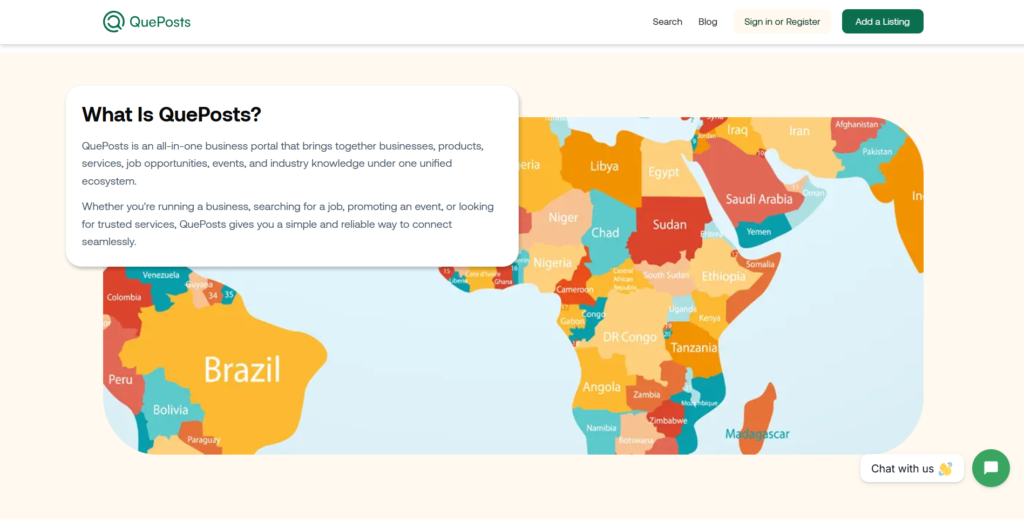
Queposts is a next-generation business portal designed to help businesses, professionals, and consumers discover each other with ease. From company listings and classified ads to jobs, events, and industry content, Queposts connects people to opportunities locally and globally.
Think of Queposts less like a social media platform and more like a living, searchable directory of Nigerian businesses that is actively used by people who are ready to buy, hire, or engage. When you list your business on Queposts, you are not posting into a feed that people scroll past. You are placing your business in front of people who are specifically looking for what you do.
For a small-scale food business in Lagos, a Queposts listing means that someone searching for a home caterer in Surulere finds your profile, reads about what you offer, sees your contact details, and reaches out directly. For a tailoring business in Abuja, it means a customer looking for a skilled fashion designer for their event finds your page with your portfolio and your phone number right there. For a mini importation business in Port Harcourt, it means buyers searching for specific product categories discover your listings and make enquiries.
Beyond simply being found, a well-set-up Queposts profile does something else that is quietly very powerful for a new or growing Nigerian business. It adds credibility. In a market where consumers are rightly cautious about who they trust with their money, a professional, complete business listing on a reputable platform signals that you are a legitimate operation worth dealing with. It is the digital equivalent of having a proper shopfront instead of selling from the boot of a car.
The businesses that grow consistently in Nigeria in 2026 are the ones that are visible across multiple channels simultaneously. Social media for engagement and storytelling. WhatsApp for direct customer relationships. Google Business Profile for local search visibility. And Queposts for discovery by an audience that is actively looking, not just passively scrolling.
Getting your small-scale business listed on Queposts costs you very little but positions you in front of an audience that is already motivated to find and engage businesses like yours. In a competitive market, that kind of targeted visibility is not a luxury. It is a genuine competitive advantage.
Practical Tips for Making Your Small-Scale Business Profitable in Nigeria
Choosing the right business is the beginning. Turning it into something genuinely profitable requires consistent effort in a few key areas.
Know your numbers from day one. Many Nigerian small business owners run their businesses entirely on instinct, with no clear picture of what they are actually earning or spending. Track every naira that comes in and every naira that goes out. Understand your cost per unit, your margin per sale, and your monthly breakeven point. You cannot grow what you cannot measure.
Build your reputation before you need it. In the Nigerian market, reputation travels fast in both directions. Deliver exceptional quality and service to your early customers, and word of mouth will bring you more business than any advertisement. Deliver disappointing experiences, and the same word of mouth will work against you just as powerfully.
Market consistently, not just when business is slow. One of the most common mistakes Nigerian small business owners make is only ramping up marketing activity when sales are slow. The most successful businesses market consistently during good periods and slow ones alike, which means they rarely experience the sharp downturns that catch less disciplined operators off guard.
Build multiple income streams within your business. The most profitable small-scale businesses in Nigeria rarely depend on a single product or service. A food business that sells ready meals also offers catering services and packaged snacks. A fashion designer who makes custom outfits also sells ready-to-wear pieces and fabric. Building complementary income streams within your core business makes it more resilient and more profitable.
Invest in your own visibility. Be present online consistently. Post on your social media pages. Update your WhatsApp status. Keep your Queposts listing current and complete. The businesses that stay visible are the businesses that stay relevant, and relevance is what drives sustainable profit in any market.
Final Thoughts
Nigeria is a country of extraordinary entrepreneurial energy, and the opportunities for profitable small-scale businesses have never been more diverse or more accessible than they are in 2026. The barriers that once made starting a business difficult, lack of visibility, limited access to markets, and high cost of reaching customers, are steadily being dismantled by digital platforms, mobile payments, and tools that put marketing and customer acquisition within reach of anyone with a smartphone and the willingness to show up consistently.
The ten businesses on this list are not theoretical possibilities. They are things that real Nigerians, in real cities and towns across this country, are doing right now and earning meaningful, life-changing income from.
Your job is to choose the one that fits your skills, your resources, and your circumstances. Then start. Not when the economy improves, not when you have saved up more money, not when conditions feel more comfortable. Start now, with what you have, and build from there.
The most profitable small-scale business in Nigeria is ultimately the one you actually begin.