
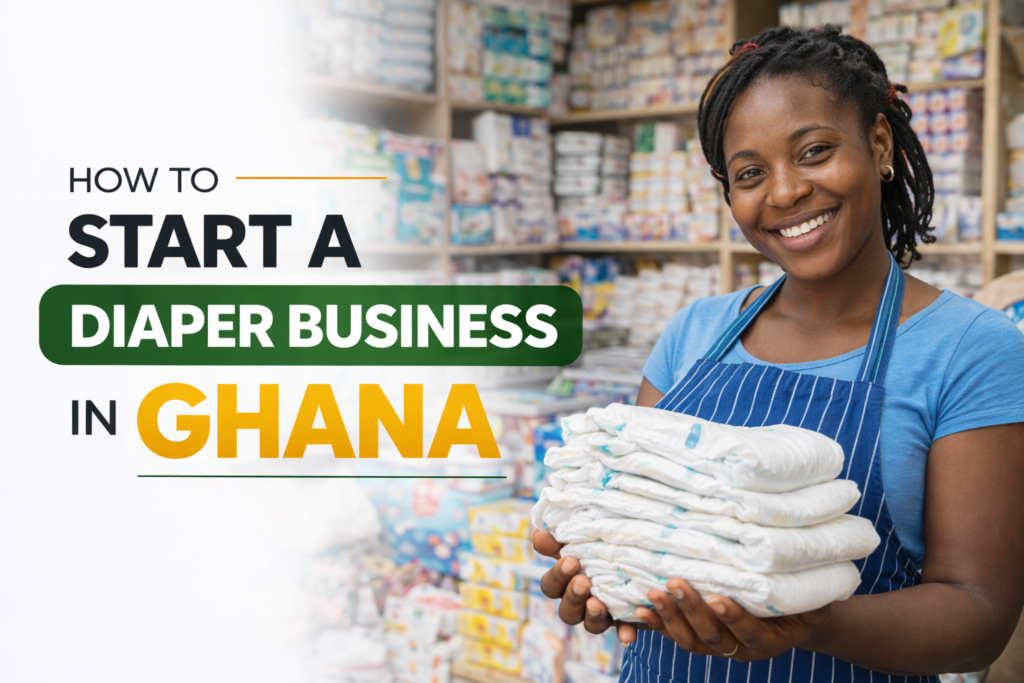

The diaper business in Ghana is quietly one of the most resilient consumer goods ventures available to an entrepreneur in this market. Babies arrive every day regardless of the economy, and parents across every income level in Ghana now include diapers in their household budget in a way that was not true a generation ago.
Urban middle-class parents have moved almost entirely away from traditional cloth nappies for daily use, and even in peri-urban and lower-income households, diapers have become a standard and no longer an occasional purchase. The result is a market with consistent, non-discretionary demand, a wide range of price points from economy brands to premium imports, and multiple entry points for entrepreneurs, from retail distribution to local manufacturing to private label importing. The question is not about the existence of customers. It is about which part of the supply chain you are entering and what that demands of you operationally.
Business Models in the Diaper Industry
Before registration or sourcing, the first decision is which business model fits your capital, your skills, and your market.
Retail and distribution is the most accessible entry point. You purchase diapers at wholesale prices from importers or distributors and sell them to end consumers through a shop, market stall, online store, or delivery service. The capital barrier is low, the operational complexity is manageable, and the path to first revenue is short. The margin per pack is thinner than in manufacturing or importing, but the risk is lower and the setup is faster.
Wholesale and bulk distribution involves purchasing container loads or large volumes from manufacturers or importers and supplying smaller retailers, pharmacies, supermarkets, and baby shops across a region or district. This model needs more capital for initial stock and logistics infrastructure but generates higher revenue per transaction and builds the kind of buyer relationships that create recurring orders.
Importation covers sourcing diapers directly from manufacturers in China, Turkey, or other producing countries and importing them for sale in Ghana. This model offers the highest margin per unit but demands significant upfront capital for a minimum order quantity, knowledge of import procedures, and the ability to clear goods through Tema port. It also carries currency risk, since your purchase price is in a foreign currency and your selling price is in cedis.
Private label importing is a variation of direct importation where you source diapers manufactured to your specifications and sell them under your own brand name. This is how many of the mid-tier diaper brands sold in Ghanaian pharmacies and supermarkets operate. It demands brand investment and consistent quality management but builds a proprietary product that competitors cannot directly replicate.
Local manufacturing is the most capital-intensive entry point and involves setting up a production facility to manufacture diapers within Ghana. The raw material sourcing, equipment investment, and technical knowledge barriers are significant, but the model positions you to supply at competitive prices without import duties and currency exposure. A small number of local manufacturers currently operate in Ghana, and the sector is underdeveloped relative to demand.
Legal and Registration Setup
Office of the Registrar of Companies
Register your business as a sole proprietorship or limited liability company to receive your Certificate of Incorporation. A limited liability structure is advisable for importation or manufacturing models where the capital exposure and contractual obligations are significant.
Tax Identification Number
Register with the Ghana Revenue Authority for your TIN and for VAT if your projected annual turnover exceeds the registration threshold. Import transactions and formal wholesale supply need documented tax compliance.
Food and Drugs Authority
Diapers fall under the FDA’s regulatory mandate as a medical device and consumer health product. Importers and manufacturers must register their products with the FDA before they can legally be sold in Ghana. The registration process involves product documentation, labeling review, and safety assessment.
Ghana Standards Authority
GSA product certification is increasingly requested by supermarkets and institutional buyers as a condition for shelf placement and procurement. Certification signals that your product meets national quality and safety standards.
Business Operating Permit
Your local MMDA issues the annual operating permit for your retail premises, warehouse, or production facility.
Ghana Immigration Service (for manufacturing)
If your manufacturing setup involves foreign technical staff or equipment installation teams, work permit and visa compliance is part of the regulatory picture from the start.
Also Read: How to Create a Website for your Business in Ghana

Sourcing and Supply Chain
The source of your diapers determines your cost per unit, your product quality, and ultimately your competitive position in the market.
Chinese manufacturers are the dominant source for Ghanaian diaper importers. Platforms including Alibaba connect buyers with hundreds of manufacturers producing economy, mid-range, and premium diapers. The due diligence process before committing to a supplier counts for a great deal. Request product samples, verify factory certifications, and confirm minimum order quantities and lead times before placing a container order. Working with a freight forwarder experienced in Ghana imports simplifies the shipping, customs clearance, and port handling process.
Turkish and European manufacturers supply the premium end of the Ghanaian diaper market. Products from these origins carry higher unit costs but command retail prices that reflect perceived quality and safety, particularly among urban professional parents who prioritize skin sensitivity and absorption performance over price.
Regional distributors operating within Ghana supply brands including Pampers, Huggies, Molfix, and BabyJoy to retailers and wholesalers. Becoming an authorised distributor for an established brand removes the product sourcing risk and provides marketing support but restricts your margin and your flexibility.
Local raw material sourcing (for manufacturers): The raw materials for diaper production include superabsorbent polymer (SAP), non-woven fabric, polyethylene backsheet, and elastic. Most of these are not currently produced in Ghana and must be imported. Establishing reliable supply relationships with raw material suppliers before production begins prevents the production interruptions that new manufacturers commonly face.
Understanding the Ghanaian Diaper Market
Ghana’s diaper market is segmented by price point in a way that mirrors the income distribution of the country.
The economy segment covers low-cost diapers sold primarily through open markets, kiosks, and informal retailers in peri-urban and low-income urban areas. Customers in this segment buy in small quantities, often one or two diapers at a time instead of full packs, which reflects cash flow constraints. Volume is high but margin per unit is thin and competition from informal imports is intense.
The mid-range segment covers brands sold through pharmacies, baby shops, and supermarkets at price points accessible to lower-middle and middle-income households. This is the largest and fastest-growing segment in Ghana as urbanization and rising household incomes expand the middle-income consumer base. Brands in this segment compete on absorption, skin safety, and pack value more than on pure price.
The premium segment covers brands including Pampers and Huggies sold through formal retail at prices that reflect the brands’ international positioning. Customers in this segment are urban, brand-conscious, and willing to pay for perceived quality and brand trust. Volume is lower than the economy and mid-range segments, but margin per unit and brand loyalty are higher.
Distribution strategy must match the segment. Mid-range brands move through pharmacies, baby shops, supermarkets, and increasingly through delivery platforms. Premium brands move through supermarkets, online retailers, and maternity-focused shops.

Retail Setup and Operations
For entrepreneurs entering the diaper business through the retail or distribution model, the operational decisions that most directly affect profitability are stock management, pricing strategy, and customer convenience.
Stock management
Diapers do not expire quickly and do not spoil, which makes them a relatively forgiving inventory category compared to food products. The risk is tying up working capital in slow-moving sizes. Newborn and size one diapers move fastest in the early months but babies grow quickly, and retailers who overstock small sizes relative to medium and large sizes sit on inventory longer than planned.
Sizing and variety
Stocking a full size range from newborn through size five or six, across at least two or three brand tiers, gives customers a one-stop experience that builds repeat visits. A shop that carries only one brand at one price point loses customers whose babies have outgrown that size or whose budget has shifted.
Online and delivery sales
A significant and growing portion of diaper purchases in Accra and Kumasi happen through WhatsApp ordering and delivery. Parents with young babies value convenience highly and are willing to pay a small delivery fee to avoid taking a baby on a shopping trip. A WhatsApp Business account with a product catalog, clear pricing, and a reliable same-day delivery arrangement is a low-cost channel that many diaper retailers have built into a meaningful revenue stream.
Marketing Your Diaper Business
Marketing a diaper business in Ghana is most effective when it reaches parents at the moment they are making buying decisions, which is increasingly online.
Social media on Instagram and Facebook, with content focused on baby care tips, product comparisons, and parent community, builds an audience that trusts your recommendations before they need to make a purchase. Diaper brands and retailers who position themselves as knowledgeable, helpful resources for new parents earn the kind of brand loyalty that discounts cannot buy.
Partnerships with maternity hospitals and clinics give your brand visibility at the exact moment a family begins its diaper-buying journey. Hospitals that include product samples in discharge packages or recommend specific brands to new mothers are powerful distribution channels that established brands invest in specifically for this reason.
WhatsApp broadcast lists built from satisfied customers are among the most conversion-efficient marketing tools for Ghanaian baby product retailers. A weekly message with a stock update, a promotion, or a useful baby care tip keeps your business in the minds of parents whose purchasing is regular and predictable.
List Your Diaper Business on QuePosts
Pharmacies, supermarkets, baby shops, and institutional buyers including hospitals and crèches looking for diaper suppliers in Ghana benefit from a reliable, verified directory of business contacts. QuePosts is a digital business directory and discovery portal built specifically for Ghanaian brands and entrepreneurs. A listing makes your diaper business findable to these wholesale and institutional buyers through a platform they can search directly, without the referral chain that most supplier relationships in Ghana currently depend on.
The platform’s job posting feature connects your vacancies for sales representatives, delivery riders, warehouse staff, and shop attendants to local job seekers in your operating area without traditional recruitment overhead.
The diaper business in Ghana works for entrepreneurs who pick the right entry point for their capital, understand the segment they are serving, and build the distribution relationships that put product in front of the customer before a competitor does. The demand is there every single day. The businesses that serve it reliably, at the right price, in the right channels, are the ones that build lasting customer bases in a market that shows no signs of shrinking.