

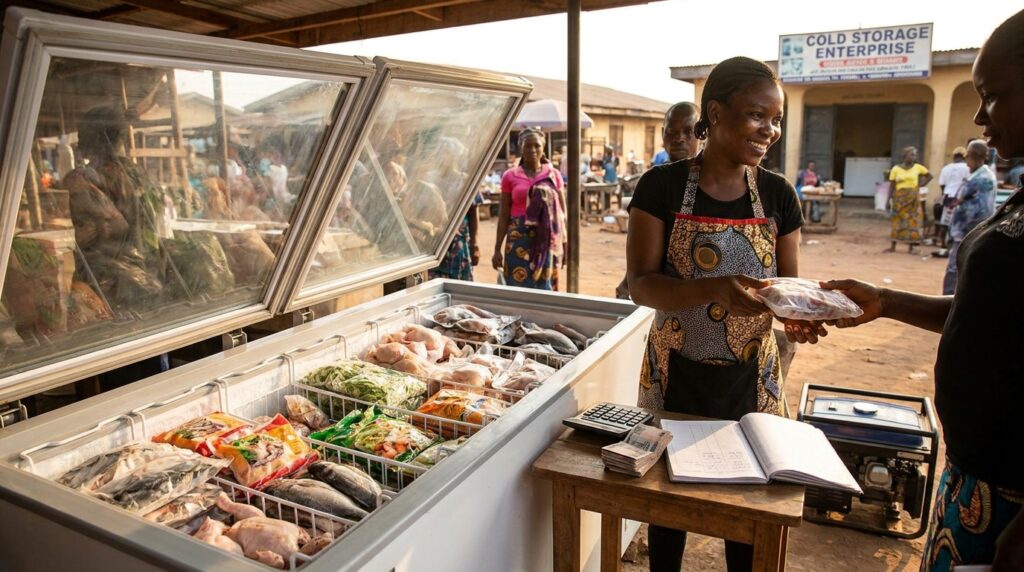

Walk into any busy market in Lagos, Abuja, Port Harcourt, or Enugu, and you will almost certainly find at least one frozen food seller doing brisk business. Frozen chicken, turkey, fish, beef, and assorted meat products are staples of the Nigerian diet, and the demand for them has grown steadily over the years as more Nigerian households, especially in urban areas, shift toward the convenience of buying frozen protein rather than visiting the live market every day.
But here is the question that most people thinking about entering this business actually want answered: Is frozen food business profitable in Nigeria, or does it just look that way from the outside?
The short answer is yes, the frozen food business can be genuinely profitable in Nigeria. But like every business, profitability does not happen automatically. It depends on where you set up, how much you invest in the right infrastructure, how you source your products, who your customers are, and how consistently you market and manage the business.
This article is going to give you the full picture. We will cover what the frozen food business in Nigeria actually involves, how much it costs to start at different scales, what your realistic profit margins look like, the challenges you need to prepare for, and the strategies that separate frozen food businesses that thrive from the ones that merely survive.
By the time you finish reading, you will have a clear, honest picture of what this business involves and whether it is the right opportunity for you.
What Does the Frozen Food Business in Nigeria Actually Look Like?
The frozen food business in Nigeria is broader than most people initially think. When most people hear the term, they picture a small shop with a chest freezer selling frozen chicken and fish. And while that is certainly part of it, the frozen food business in Nigeria actually covers several different business models.
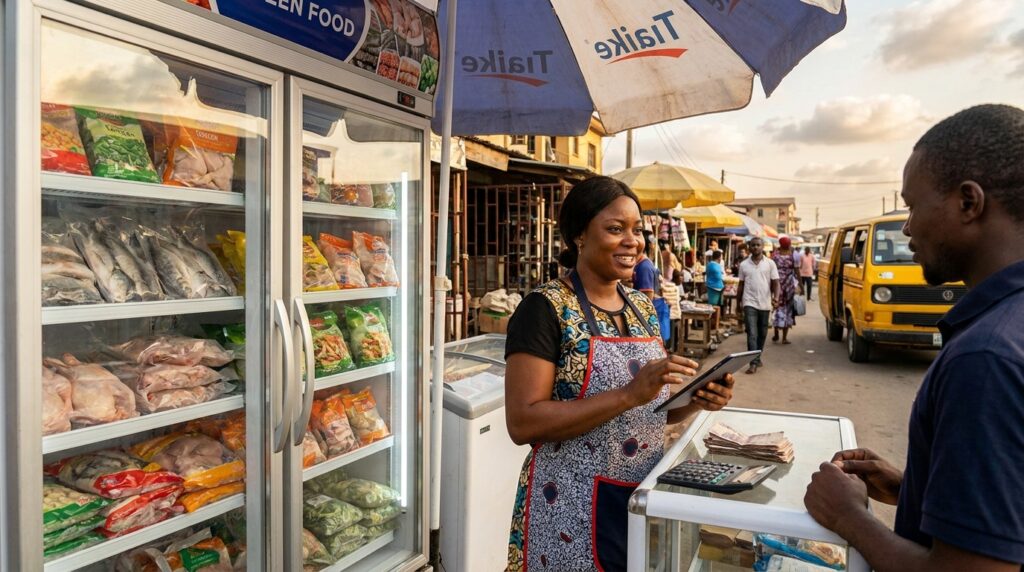
Retail frozen food shop: This is the most common model. You rent a shop, invest in chest freezers, stock frozen proteins (chicken, turkey, fish, beef, pork, croaker, and so on), and sell directly to individual households and small food businesses like restaurants and bukas. Most neighbourhood frozen food businesses in Nigerian cities operate this way.
Wholesale frozen food distribution: Rather than selling to individual consumers, you buy in very large quantities from cold room operators or importers and supply to retail frozen food shops, supermarkets, hotels, and restaurants. The margins per kilogram are lower than retail, but the volume is significantly higher.
Cold room business: You invest in industrial cold storage and rent out space to other frozen food sellers, or you use the facility as the backbone of your own wholesale distribution operation. This is a higher capital model, but one with multiple income streams.
Online frozen food delivery: A growing model in Nigerian cities where customers order frozen proteins online or via WhatsApp and receive delivery to their homes. This model works particularly well in Lagos and Abuja, where time-poor, middle-class consumers are willing to pay a premium for convenience.
Frozen food production and packaging: Rather than importing, you source fresh protein locally, process it, package it under your own brand, and sell it frozen. This is the most capital-intensive model but also potentially the most profitable at scale.
For the purpose of this article, we will focus primarily on the retail model since it is the most accessible entry point for most Nigerian entrepreneurs, while also touching on the wholesale and delivery models where relevant.
How Much Does It Cost to Start a Frozen Food Business in Nigeria?
Startup costs for a frozen food business in Nigeria vary significantly depending on your scale, your location, and how you choose to set up. Here is a realistic breakdown at three different levels.
Small Scale (Home-Based or Kiosk)
This is the entry-level model. You are operating from home or a very small kiosk, targeting neighbours, nearby households, and small food businesses in your immediate area.
- 1 to 2 chest freezers: ₦150,000 to ₦300,000
- Initial stock (frozen chicken, fish, turkey): ₦100,000 to ₦200,000
- Generator or inverter for power backup: ₦80,000 to ₦200,000
- Packaging materials and scale: ₦10,000 to ₦20,000
- Basic marketing (flyers, social media setup): ₦5,000 to ₦15,000
Total estimated startup cost: ₦345,000 to ₦735,000
Medium Scale (Dedicated Shop)
This is the most common model for serious frozen food businesses in Nigerian cities. You rent a shop in a good location, invest in multiple freezers, and build a proper retail operation.
- Shop rent (annual, location-dependent): ₦150,000 to ₦600,000
- 3 to 6 chest freezers: ₦300,000 to ₦700,000
- Generator and fuel costs (setup): ₦150,000 to ₦400,000
- Initial stock: ₦300,000 to ₦600,000
- Shop fitting and shelving: ₦50,000 to ₦150,000
- Business registration and signage: ₦30,000 to ₦80,000
- Marketing and launch costs: ₦20,000 to ₦50,000
Total estimated startup cost: ₦1,000,000 to ₦2,580,000
Large Scale (Wholesale or Cold Room)
- Cold room installation: ₦2,000,000 to ₦10,000,000+
- Large generator and power infrastructure: ₦500,000 to ₦2,000,000
- Initial stock for wholesale: ₦1,000,000 to ₦5,000,000
- Delivery vehicle: ₦1,500,000 to ₦4,000,000
- Staffing, operations, and working capital: ₦500,000 to ₦2,000,000
Total estimated startup cost: ₦5,500,000 to ₦23,000,000+
For most people reading this article who are evaluating whether the frozen food business is profitable in Nigeria, the small to medium scale model is the realistic starting point. So the rest of our analysis will focus primarily on that range.
What Are the Profit Margins in the Nigerian Frozen Food Business?
This is the part everyone really wants to know. Is frozen food business profitable in Nigeria in terms of actual numbers?
The honest answer is that margins in the frozen food business are not as high as in some other product categories, but the volume of sales and the consistency of demand more than compensate for that.
Here is a realistic picture of the margins you can expect at the retail level.
Frozen chicken (whole bird or cut):
- Average buying price from supplier: ₦2,500 to ₦3,500 per kg
- Average selling price to consumers: ₦3,200 to ₦4,500 per kg
- Gross margin per kg: ₦700 to ₦1,000
- Margin percentage: approximately 20 to 35 percent
Frozen turkey:
- Average buying price: ₦3,000 to ₦4,500 per kg
- Average selling price: ₦4,000 to ₦6,000 per kg
- Gross margin per kg: ₦800 to ₦1,500
- Margin percentage: approximately 25 to 35 percent
Frozen fish (croaker, catfish, tilapia):
- Average buying price: ₦2,000 to ₦4,000 per kg, depending on species
- Average selling price: ₦2,800 to ₦5,500 per kg
- Gross margin per kg: ₦700 to ₦1,500
- Margin percentage: approximately 25 to 40 percent
Frozen beef and assorted:
- Average buying price: ₦3,500 to ₦5,000 per kg
- Average selling price: ₦4,500 to ₦7,000 per kg
- Gross margin per kg: ₦700 to ₦2,000
- Margin percentage: approximately 25 to 40 percent
These are gross margins before operational costs. Once you subtract the cost of running your generator, paying your shop rent, paying staff if you have any, and covering your transportation costs for restocking, your net margin is typically lower.
A well-run small to medium-scale frozen food shop in a good Nigerian location can realistically net between ₦150,000 and ₦600,000 per month after operating costs, depending on sales volume, location, and how efficiently the business is managed.
That is a meaningful income for a business at this scale, and it grows as your customer base expands and your purchasing power with suppliers increases.
What Factors Determine Whether Your Frozen Food Business Is Profitable in Nigeria?
Asking whether the frozen food business is profitable in Nigeria is really asking the wrong question. The more precise question is: what determines whether a specific frozen food business in a specific location, run by a specific person, becomes profitable?
Here are the factors that matter most.
Location
Location is arguably the single most important factor in whether a retail frozen food business in Nigeria succeeds or struggles. A frozen food shop in a densely populated residential area of Lagos, Abuja, Port Harcourt, or any other major Nigerian city, particularly one near a market, a school, a church, or a cluster of restaurants and bukas, will see dramatically higher sales volume than an identical shop in a low-traffic area.
Before you commit to a shop location, spend time observing foot traffic at different times of day. Talk to other traders in the area. Find out how many competing frozen food shops are already operating nearby. A location with strong traffic and moderate competition is ideal. A location with weak traffic and multiple competitors is a recipe for struggle.
Power Supply Infrastructure
This is the biggest operational challenge facing frozen food businesses in Nigeria, and it cannot be overstated. Your entire business depends on keeping your products frozen. The moment power fails, and you do not have adequate backup, your stock begins to thaw, and thawed stock that is refrozen loses quality rapidly and can become a health hazard.
A reliable, cost-effective power backup system, whether a petrol or diesel generator, an inverter system, or a solar solution, is not optional in the Nigerian frozen food business. It is as fundamental to your operation as the freezers themselves.
The cost of running your generator is also one of your largest ongoing operational expenses. Factor it into your pricing from the beginning.
Supplier Relationships
The frozen food business in Nigeria is one where your supplier relationships directly affect your profitability. Frozen food sellers who buy in large volumes from established cold room operators or importers get significantly better prices than those buying in small quantities. Better purchase prices translate directly into better margins or more competitive retail prices, both of which improve profitability.
Build your supplier network early and cultivate those relationships carefully. Pay on time, communicate clearly, and increase your order volumes as your capital allows. Over time, you may be able to negotiate credit terms that allow you to stock more without tying up as much of your own capital.
Product Mix
The most profitable frozen food businesses in Nigeria do not just sell chicken and fish. They carry a carefully chosen range of products that serve different customer needs and different price points. Adding assorted parts (which carry higher margins than whole birds), organ meats (which have strong demand in Nigerian cooking), sausages, and other frozen convenience products alongside your core stock diversifies your income and increases the average value of each customer transaction.
Marketing and Customer Retention
A frozen food business is a repeat purchase business. Your goal is not just to make a sale. It is to make a customer who comes back every week or every month. The frozen food businesses that are most profitable in Nigeria are the ones with a loyal, returning customer base that provides predictable, consistent revenue.
Building that loyalty requires consistent marketing, excellent customer service, competitive pricing, and the kind of reliability that makes customers trust you with their household protein budget every single week.
The Real Challenges of Running a Frozen Food Business in Nigeria
No honest assessment of whether the frozen food business is profitable in Nigeria would be complete without addressing the challenges that every operator in this space faces.
Electricity costs and reliability: As mentioned, this is the defining operational challenge. Generator fuel costs can significantly eat into your margins, particularly during periods of fuel scarcity or price spikes. Businesses that invest in solar or inverter backup systems tend to have more stable operating costs over time.
Capital tied up in stock: Frozen food requires a significant amount of working capital tied up in inventory at all times. Unlike some businesses where you can run lean, a frozen food shop that runs out of popular products loses customers quickly.
Price volatility: The prices of frozen protein products in Nigeria fluctuate based on exchange rates (since much of the frozen chicken and turkey sold in Nigeria is imported), fuel costs, seasonal demand, and government import policies. These fluctuations can compress your margins if you are not pricing and restocking strategically.
Theft and spoilage: Both represent real losses in the frozen food business. Spoilage from power failures needs to be managed through proper equipment and backup systems. Theft, particularly in high-traffic retail environments, needs to be managed through proper shop design and staff supervision.
Competition: The frozen food business is not a secret in Nigeria. In many neighbourhoods, the market is already well-served. Standing out requires either a genuine price advantage, a location advantage, superior product quality, better customer service, or some combination of all of these.
How to Market Your Frozen Food Business and Attract More Customers in Nigeria
One of the most overlooked aspects of running a profitable frozen food business in Nigeria is marketing. Many frozen food sellers rely entirely on walk-in traffic and word of mouth, which works to a point but limits how fast the business can grow.
The frozen food businesses generating the most revenue in Nigerian cities in 2026 are the ones that take marketing seriously. Here are the strategies that work.
WhatsApp marketing is arguably the most effective tool for a neighbourhood frozen food business. Build a broadcast list of your regular customers and send weekly updates about new stock arrivals, special prices on specific products, and limited-time deals. A customer who sees your WhatsApp status update showing fresh turkey stock at a good price will often place an order on the spot rather than waiting until their next shopping trip.
Instagram and Facebook work well for frozen food businesses that are willing to post regularly. Fresh product photos, price lists, customer testimonials, and behind-the-scenes content showing your storage hygiene and product quality all build trust and attract new customers in your area.
If your frozen food business is located within or near a shopping complex, our guide on How to Attract Customers to a Shopping Mall: Events, Offers, and Foot Traffic Hacks has specific, actionable strategies for driving foot traffic to your location that complement everything we have covered here.
And if you are working with a limited marketing budget, which most frozen food business owners are when they are starting out, our detailed guide on Smart Ways to Advertise Your Small Business on a Tight Budget covers a full range of affordable and free strategies that work specifically for Nigerian small businesses.
Loyalty programmes are surprisingly powerful in the frozen food business. Something as simple as offering a free kilogram of chicken for every ten kilograms purchased, or giving regular customers a small discount during quiet periods, creates the kind of stickiness that turns occasional buyers into loyal weekly customers.
Partnering with restaurants, bukas, and caterers is one of the highest-volume customer acquisition strategies available to a frozen food business in Nigeria. A single busy restaurant buying 20 to 50 kilograms of chicken and fish from you every week is worth more than dozens of individual household customers. Identify the food businesses near you and pitch them directly on the quality of your products and the reliability of your supply.
How Queposts Can Help Your Frozen Food Business Get Found by More Customers
Running a frozen food business means your customers are primarily local. They are households, restaurants, and food businesses within a specific area that need a reliable, consistent supply of quality frozen protein. The challenge is making sure that when someone in your area is looking for a frozen food supplier, they find you before they find your competitor.
This is exactly where Queposts becomes a valuable tool for your business.
Queposts is a next-generation business portal designed to help businesses, professionals, and consumers discover each other with ease. From company listings and classified ads to jobs, events, and industry content, Queposts connects people to opportunities locally and globally.
For a frozen food business in Nigeria, getting listed on Queposts works on two levels.
Your business becomes searchable. When someone in your city or neighbourhood is looking for a frozen food supplier, a Queposts business listing ensures your shop appears in their search results. Your listing can include your business name, location, the products you stock, your contact details, and your operating hours. A potential customer who finds your listing and sees exactly what you carry and where you are located can contact you directly or walk in knowing you have what they need.
Your products get their own visibility. Beyond your business listing, Queposts allows you to list individual products directly on the platform. For a frozen food business, this is particularly powerful. You can list your frozen chicken at the current price, your turkey stock, your fish varieties, and any special offers you are running. Buyers who are specifically searching for frozen chicken or croaker fish in your area find your product listings and reach out to you directly, bypassing your competitors who are not listed.
Think about what that means in practice. A restaurant owner in your area who is looking for a new frozen food supplier searches on Queposts, finds your listing with your product range and contact details, sees that you are nearby, and calls you that same day. That is a new wholesale customer you might never have reached through your regular marketing activity.
In a business like frozen food, where location, availability, and trust are everything, having a professional, complete, and up-to-date presence on Queposts gives you a tangible advantage over competitors who are relying only on word of mouth and walk-in traffic.
Is the Frozen Food Business the Right Business for You?
Before we wrap up, it is worth being direct about who the frozen food business in Nigeria is genuinely well-suited for.
It is a good fit if you are someone who is detail-oriented and disciplined about managing stock and costs. The margins are not enormous, which means sloppy cost management quickly turns profit into loss. You need to know your numbers, track your stock carefully, and manage your operational costs with discipline.
It is a good fit if you have access to or can raise the right startup capital. This is not a business you can start on a shoestring. The freezers, the generator, the initial stock, and the rent add up to a meaningful investment, and cutting corners on any of these foundational elements tends to create expensive problems later.
It is a good fit if you are customer-focused and willing to build relationships. The frozen food business in Nigeria rewards operators who make their customers feel valued and serve them consistently. If you approach it as a purely transactional business, you will struggle to retain the loyal customer base that makes it truly profitable.
And it is a very good fit if you choose your location carefully. Everything in this business flows from location. A great operator in a poor location will underperform a mediocre operator in a great location every single time.
Final Thoughts
So is the frozen food business profitable in Nigeria? The honest, evidence-based answer is yes, it absolutely can be, for the right person, in the right location, with the right setup and the right approach to marketing and operations.
It is not a get-rich-quick business. The margins require volume and consistency to generate meaningful income. The operational challenges, particularly around power, require investment and discipline to manage. And the competition in many Nigerian markets means you cannot afford to be complacent about the quality of your products or your customer service.
But for entrepreneurs who are willing to do the work, choose their location carefully, invest properly in their infrastructure, build genuine relationships with suppliers and customers, and market consistently, the frozen food business in Nigeria offers a stable, scalable, and genuinely rewarding income opportunity.
Start with the right scale for your capital. Get your location right. Build your customer base one loyal buyer at a time. Use every platform available, including Queposts, to make sure the right people can find you. And run your numbers carefully so you always know exactly where your business stands.
The demand for frozen protein in Nigeria is not going anywhere. Nigerians will keep eating chicken, fish, and turkey regardless of what the economy does. The question is simply whether they are buying it from you.