
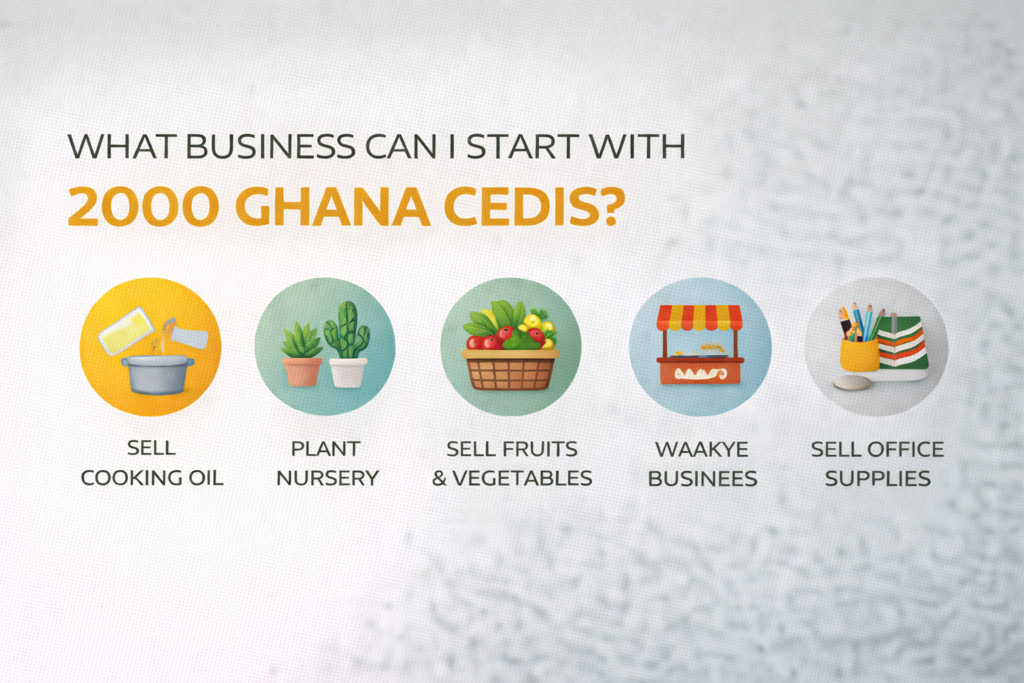

What business can I start with 2000 Ghana Cedis? is a question asked every day by Ghanaians who have saved up, seen enough, and decided that working for themselves is worth attempting.
GHS 2,000 is not a large amount of startup capital, and pretending otherwise helps nobody. What it is, in the right hands with the right decisions, is enough to start a business that generates daily income, builds working capital over weeks, and grows into something considerably larger over months. The businesses that work at this budget share three characteristics: they do not need a rented shop, they convert inventory to cash within 24 to 48 hours, and they can be started by one person without specialist equipment. The ones that fail at this budget are the ones that spend half the money on rent before a single sale is made.
At GHS 2000, turnover speed is your competitive advantage. Every day your capital is sitting in unsold stock is a day it is not growing.
The Ground Rules Before You Start
Before choosing a business, three rules apply at this budget without exception.
No fixed rent
A shop that costs GHS 500 or more per month absorbs 25% of your entire starting capital before you have sold anything. At GHS 2,000, operate from a table, a kiosk, your home, or a space you negotiate informally inside an existing business. The moment revenue is consistent enough to justify a fixed address, that decision becomes available. Not before.
Choose fast-moving products or services
A business where your money is tied up in stock for a week produces one cycle per week. A business where you buy in the morning and sell by evening produces daily cash recycling. At this capital level, the difference between those two models is the difference between growth and stagnation.
Track every transaction
An exercise book or a free spreadsheet that records every purchase and every sale is non-negotiable from day one. Without it, you will not know if the business is profitable, where the money is going, or when you have enough to expand.
10 Businesses You Can Start with GHS 2,000 in Ghana
1. Mobile Money Mini-Point
Use the GHS 2000 entirely as your starting float. Apply for an agent SIM from MTN MoMo, Telecel Cash, or AT Money, set up at a table in a high-traffic location, and earn a commission on every withdrawal and deposit you process. The float does not get spent. It circulates. Withdrawals pay out from your cash and increase your mobile balance. Deposits collect cash from customers and decrease your mobile balance. The commission accumulates with every transaction.
The business scales by adding float and, eventually, registering with a second network. Location is the single most important variable. A busy market entrance, a transport junction, or a spot near a school or clinic will process more transactions per day than a quiet residential lane.
2. Liquid Soap Production
Liquid soap is consumed daily by households, schools, hospitals, kiosks, and restaurants without interruption. The raw materials, including caustic soda, sulphonic acid, texapon, and sodium silicate, are available in bulk from chemical suppliers in Accra’s industrial areas and most regional capitals. GHS 2000 covers a starter stock of chemicals and empty bottles with enough remaining for basic labelling.
The business model is supply-based from the start. Identify kiosks, chop bars, schools, or small offices as your first buyers before you produce your first batch. Producing to confirmed orders solves the problem of unsold inventory and makes your cash recycling predictable.
3. Second-Hand Clothing
Kantamanto in Accra and the equivalent wholesale second-hand clothing markets in Kumasi, Takoradi, and Koforidua sell bales and half-bales of imported used clothing at prices that allow meaningful retail margins. GHS 2000 is sufficient to purchase a half-bale or a curated selection of high-demand items including baby clothes, women’s tops, and school-wear.
The retail channel at this budget is WhatsApp and Instagram. Photograph each item, post consistently, and sell through direct messages with delivery or pickup. Resellers who build a WhatsApp broadcast list of returning buyers, maintain a consistent posting schedule, and offer reliable delivery within 24 hours turn this into a business with daily revenue and no shop rent.

4. Tabletop Provisions Stand
Fast-moving consumer goods sold from a small wooden table or display stand in a residential neighbourhood generate daily cash from the most reliable buyer base in any community: the household that needs sachet water, sugar, biscuits, matches, and tin tomatoes every single day. GHS 2000 covers a starter stock of these fast-movers with enough left for a basic display surface.
The location decision is everything. A spot on a residential street with no nearby competitor, near a school gate, or at the entrance to a compound house with many tenants produces consistent daily traffic without advertising.
5. Fresh Fruit Juice Extraction
A manual citrus juicer, bulk oranges, clean bottles, and a cooler box filled with ice is a complete business setup that fits inside GHS 2000. Fresh-squeezed orange juice sold cold at offices, bus terminals, schools, and market areas in the morning rush and lunch period sells quickly, has no shelf life problem if quantities are managed correctly, and commands a price premium over packaged juice because customers can watch it being made.
The production cycle is daily. Buy fruit in the evening or early morning, juice and bottle in the morning, sell through the day, and repeat. The working capital cycle at this pace produces weekly profit visibility.
6. Charcoal Retailing
The majority of Ghanaian households that cook with charcoal buy it in small quantities at a time, not by the full bag, because the budget runs daily and not weekly. A charcoal retailer who purchases whole bags from a wholesaler and repackages them into GHS 5 and GHS 10 portions for neighborhood sale is serving a purchasing habit that exists independently of income level or economic conditions.
GHS 2000 purchases several bags of charcoal with enough left for basic packaging materials. The business operates from a table or a small outdoor space, sells daily, and restocks as bags are depleted. The margin is thin per unit but the volume from a well-located residential spot is consistent.
7. Phone Accessory Vending
Tempered glass screen protectors, phone chargers, affordable earphones, phone cases, and USB cables are purchased by the million across Ghana every year. These are not luxury items. They are consumables that break, are lost, or wear out and need replacement. GHS 2000 covers a starter stock of the most in-demand accessories for the top-selling phone models in the Ghanaian market.
Sales can happen from a small display board at a transport terminal, from a WhatsApp catalogue, at a school or university, or from a table at a busy junction. The margin on accessories is high relative to their purchase cost, and the items are small, portable, and easy to manage without a shop.
8. Breakfast and Porridge Stand (Koko)
Koko with koose and plain porridge with groundnut cake are consumed by working Ghanaians every morning before 9am. The startup cost is in ingredients and a few large pots or insulated flasks. GHS 2000 covers this comfortably with room left for a folding table and plastic bowls.
The business needs an early start and a good location near a transport hub, market, or school, but the revenue is generated and the cash is in hand before most offices open. Repeat customers who buy every morning become the stable income base within the first two weeks of consistent operation.
9. Home Cleaning Service
A home cleaning service at this budget level starts with a set of quality cleaning chemicals, mops, scrubbing brushes, sponges, and gloves. No shop. No permanent address. GHS 2,000 covers a professional-grade cleaning kit with money remaining for basic marketing, printing flyers, or running a Facebook or WhatsApp promotion.
The target customer in a home cleaning business at this level is the busy professional or dual-income household in urban or peri-urban areas who needs a thorough weekend clean but does not want to employ a live-in housekeeper. Pricing per session, marketing in residential communities and on social media, and delivering a standard that generates referrals from the first few jobs builds a client base that produces recurring weekly income without recurring marketing costs.
10. Pastry and Snack Supply
Meat pies, chin chin, buns are consumed in enormous quantities at schools, offices, bus stations, and kiosks across Ghana every day. GHS 2000 covers baking ingredients, basic baking trays or a hire of a community oven, and simple packaging for the first few production batches.
The supply model, producing snacks and delivering them to kiosks, provision stores, and school canteens on a daily or every-other-day basis, produces faster cash recycling than selling at a fixed location and builds multiple income points across a single morning delivery route. Kiosk owners who buy daily at wholesale and sell at retail are a reliable off-take channel for a home baker who delivers consistently and maintains quality.
Also Read: How to Grow your Business in Ghana
How to Grow Beyond GHS 2000
Every business on this list, when managed with daily tracking and disciplined reinvestment, produces profit that compounds. The rule at this stage is simple: do not spend profit on personal expenses until the working capital has grown to a level that makes the business meaningfully less fragile than it was at launch.
A mobile money agent who grows their float from GHS 2000 to GHS 6000 over three months processes more transactions per day and earns more commission per week than the version of the business that started. A soap producer who reinvests early profits into larger chemical batches reduces cost per litre and improves margin. A provisions seller who adds one new product category per month expands their basket size per customer visit.
The first GHS 2000 is not the ceiling. It is the floor.
Every business on this list is being run profitably by someone in Ghana right now. The ones that work are not the ones with the most capital or the best location. They are the ones where the person running them shows up daily, tracks the numbers, reinvests the profit, and treats a small beginning as the starting point for something bigger.