

If you have spent any time in Nigerian business circles, attended an entrepreneurship seminar, listened to a government speech, or read a business newspaper in this country, you have almost certainly heard the term SMEs thrown around. Politicians talk about empowering them. Banks create special loan products for them. Development organisations build entire programmes around them.
But what exactly are SMEs in Nigeria? Who qualifies? What does the term actually mean in the context of the Nigerian economy? And why does it matter to you as a business owner, an aspiring entrepreneur, or someone who simply wants to understand how the Nigerian economy works?
This article answers all of those questions in plain, straightforward language. We will cover the official definition of SMEs in Nigeria, look at real-world examples across different industries, explore why SMEs are so critical to Nigeria’s economic future, and discuss what Nigerian small business owners can do right now to position their businesses for growth.
What Are SMEs in Nigeria? The Official Definition
SME stands for Small and Medium Enterprise. In Nigeria, the official body responsible for defining, supporting, and developing SMEs is SMEDAN, which stands for the Small and Medium Enterprises Development Agency of Nigeria.
According to SMEDAN, Nigerian businesses are classified into three categories based on the number of employees and annual turnover:
Micro Enterprises:
- Fewer than 10 employees
- Annual turnover of less than ₦25 million
Small Enterprises:
- Between 10 and 49 employees
- Annual turnover between ₦25 million and ₦100 million
Medium Enterprises:
- Between 50 and 199 employees
- Annual turnover between ₦100 million and ₦1 billion
Any business that falls within the micro, small, or medium category is broadly referred to as an SME in Nigeria. When people say SMEs, they are typically referring to all three categories together, though in everyday Nigerian conversation, the term is often used loosely to describe any business that is not a large corporation or multinational.
It is worth noting that these thresholds are periodically reviewed by SMEDAN and the Nigerian government as economic conditions change, so it is always a good idea to verify the current figures with SMEDAN directly if you need the official classification for regulatory or funding purposes.
How Common Are SMEs in Nigeria?
The numbers tell a striking story. According to data from SMEDAN and the National Bureau of Statistics, Nigeria has over 39 million micro, small, and medium enterprises. These businesses account for approximately 96 percent of all businesses in the country, employ around 84 percent of the Nigerian labour force, and contribute roughly 48 percent of the national GDP.
Let those numbers sink in for a moment.
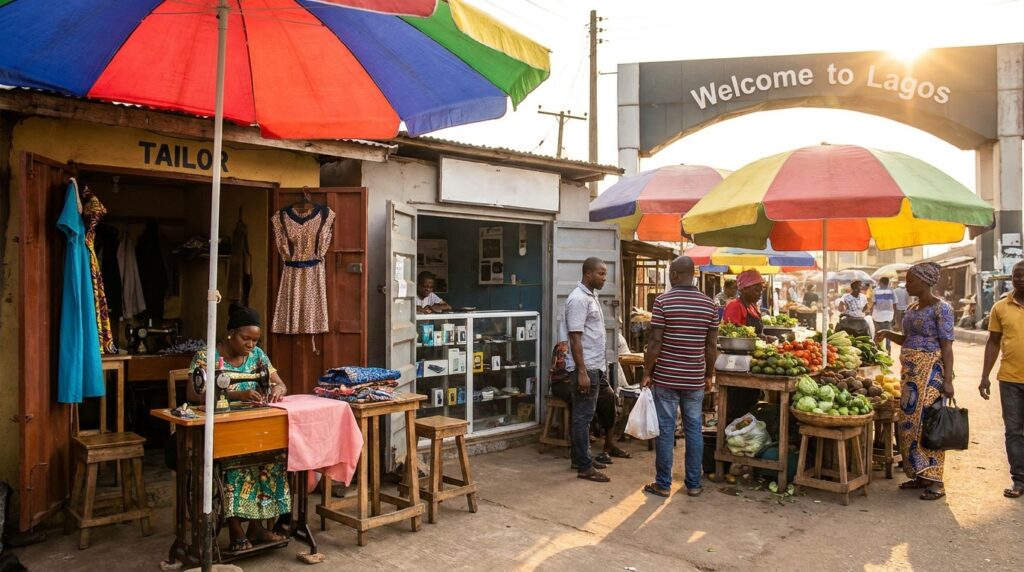
Nearly every business you interact with daily in Nigeria, the tailor in your neighbourhood, the pharmacy around the corner, the logistics startup delivering your packages, the event planning company organising weddings in Lekki, the IT firm in Victoria Island, they are all SMEs. They are the backbone of the Nigerian economy, and they are everywhere.
Real Examples of SMEs in Nigeria Across Different Industries
One of the most helpful ways to understand what SMEs in Nigeria actually look like in practice is to look at examples across different sectors. SMEs in Nigeria are not limited to one type of business or one part of the country. They exist in virtually every industry and every state.
Retail and Trading
The woman selling fabric in Aba market, who has expanded her stall into a small shop with two assistants, is an SME. The supermarket owner in Lekki, with fifteen staff members and a growing home delivery service, is an SME. The spare parts dealer in Ladipo market who supplies mechanics across Lagos is an SME.
Food and Hospitality
The restaurant in Wuse 2 that started as a small food joint and now seats 80 customers and employs a full kitchen team is an SME. The catering company in Enugu that handles corporate events and weddings across the South East is an SME. The small hotel in Calabar with 20 rooms and a full-time staff is an SME.
Fashion and Beauty
The fashion designer in Surulere who started sewing from her bedroom and now runs a studio with five tailors and a full online store is an SME. The hair salon chain in Abuja with three branches and a training academy is an SME. The skincare brand founded in Port Harcourt that now sells across Nigeria through Instagram and Jumia is an SME.
Technology and Digital Services
The software development company in Lagos that builds apps for Nigerian businesses and has a team of 20 developers is an SME. The digital marketing agency in Abuja serving corporate clients across Nigeria is an SME. The logistics tech startup in Ibadan connecting traders with delivery drivers is an SME.
Agriculture and Agribusiness
The cassava processing company in Ogun State, supplying flour to food manufacturers, is an SME. The poultry farm in Kaduna State, supplying eggs and chicken to markets across the North, is an SME. The agricultural export company in Kano connecting Nigerian farmers with international buyers is an SME.
Professional Services
The accounting firm in Port Harcourt serving oil and gas contractors is an SME. The law firm in Lagos with ten lawyers handling corporate and commercial law matters is an SME. The HR consulting company in Abuja, placing candidates with NGOs and government agencies, is an SME.
As you can see, SMEs in Nigeria span every sector of the economy and every region of the country. There is no single face of an SME. They come in all shapes, sizes, and industries.
Why SMEs Matter So Much to the Nigerian Economy
Understanding what SMEs are in Nigeria is one thing. Understanding why they matter is another thing entirely, and it is something every Nigerian should appreciate regardless of whether they own a business or not.
Job Creation
Nigeria has a significant unemployment challenge. With a population of over 220 million people and a large proportion of young people entering the workforce every year, the country needs millions of new jobs created annually just to keep pace with population growth.
Large corporations and the government alone cannot create enough jobs to meet this demand. SMEs are the primary engine of job creation in Nigeria. From the shop owner who hires two assistants to the mid-sized manufacturing company employing 150 workers, SMEs collectively employ more Nigerians than any other category of business.
When Nigerian SMEs thrive, unemployment goes down. When they struggle, unemployment goes up. It really is that direct.
Poverty Reduction
Many Nigerian SMEs are owned and operated by people who come from modest backgrounds and serve communities that large corporations rarely reach. The local pharmacy in a semi-urban town in Benue State, the mobile money agent in a rural community in Kebbi, the small-scale farmer in Plateau State selling produce to local markets, these businesses are not just economic units. They are lifelines for the communities around them.
As SMEs grow and become more profitable, wealth is distributed more widely across Nigerian society. The business owner earns more, their employees earn more, and the communities they serve benefit from the increased economic activity.
Innovation and Adaptability
Some of Nigeria’s most exciting innovations have come from small and medium enterprises, not from large corporations or government institutions. Nigerian SMEs have pioneered new approaches to mobile payments, agricultural logistics, healthcare delivery, education technology, and e-commerce, often solving problems that larger, more bureaucratic organisations were too slow to address.
SMEs are also significantly more adaptable than large corporations. When market conditions change, as they frequently do in Nigeria, a small business can pivot, adjust its pricing, change its product mix, or enter a new market far faster than a company with thousands of employees and layers of management.
Contribution to GDP and Tax Revenue
The contribution of SMEs to Nigeria’s GDP, approximately 48 percent according to SMEDAN figures, makes them critical to the overall health of the economy. A thriving SME sector means more economic activity, more consumer spending, more business-to-business transactions, and ultimately more tax revenue for the government to fund public services.
When SMEs struggle, the ripple effects are felt across the entire economy. Suppliers lose customers. Landlords lose tenants. Banks lose borrowers. Government loses tax revenue. The interconnectedness of SMEs with every other part of the Nigerian economy makes their health a matter of national importance.
Export Potential and Foreign Exchange
Nigeria has historically been heavily dependent on crude oil for its foreign exchange earnings. One of the most important strategies for diversifying the economy is developing the export capacity of Nigerian SMEs in sectors like agriculture, manufacturing, fashion, and creative industries.
Nigerian SMEs are already making inroads in global markets. Aba-made shoes are exported to West African countries. Nigerian fashion designers are winning international recognition. Nigerian food products are finding their way onto shelves in the UK, US, and European markets where the diaspora community is large and growing.
As more Nigerian SMEs develop the capacity to export, the country becomes less dependent on oil revenue and more resilient to the commodity price shocks that have historically caused economic crises.
The Challenges Facing SMEs in Nigeria
No honest discussion of SMEs in Nigeria would be complete without acknowledging the very real challenges these businesses face every day. Understanding these challenges is important both for business owners navigating them and for policymakers working to address them.
Access to finance remains the most commonly cited challenge. Many Nigerian SMEs cannot access affordable loans from commercial banks because they lack the collateral, financial records, or credit history that banks require. This forces many entrepreneurs to rely on personal savings, contributions from family and friends, or expensive informal lending arrangements.
Infrastructure deficits add high costs to doing business in Nigeria. Unreliable power supply means most SMEs must spend heavily on generators and diesel, costs that their counterparts in other countries simply do not face. Poor road infrastructure raises logistics costs. Inconsistent internet connectivity hampers digital operations.
Multiple taxation is a burden that many Nigerian SMEs describe as one of their most frustrating challenges. Taxes and levies from federal, state, and local government levels can sometimes overlap and become difficult to navigate, especially for smaller businesses without dedicated finance staff.
Access to markets is a challenge for SMEs outside major urban centres. A small manufacturer in a rural area of Kogi State may produce a quality product but struggle to reach buyers in Lagos or Abuja because of the cost and complexity of distribution.
Digital literacy and adoption are improving but remain uneven. Many Nigerian SMEs have not yet fully embraced digital tools for marketing, payments, record-keeping, and customer management, which limits their efficiency and their ability to compete.
What Nigerian SMEs Can Do to Grow Faster in 2026
Despite the challenges, this is also one of the most exciting times to be running a small or medium-sized business in Nigeria. Digital technology has dramatically lowered the cost of starting and growing a business. E-commerce platforms, mobile payments, social media marketing, and digital business tools have made it possible for a business in Owerri to reach customers in London, or for a fashion brand in Kano to build a national following without a physical store.
Here are some of the most important things Nigerian SMEs can do right now to accelerate their growth.
Get Online and Stay Visible
If your business is not visible online, you are invisible to a growing segment of Nigerian consumers who research products and services digitally before making a purchase decision. At minimum, every Nigerian SME should have a Google Business Profile, an active social media presence on at least two platforms, and a way for customers to contact and pay you digitally.
Embrace Digital Marketing
Traditional word-of-mouth marketing will always have a place in Nigeria, but digital marketing amplifies your reach in ways that were simply not possible a decade ago. Social media content, search engine visibility, email marketing, and targeted online advertising allow even the smallest Nigerian business to reach thousands of potential customers consistently and affordably.
For a deep dive into what is actually working for Nigerian businesses right now, read our detailed guide on Digital Marketing Strategies for Small Businesses in Nigeria: What Actually Works in 2026, where we break down practical, tested strategies tailored specifically to the Nigerian market.
Build Systems and Keep Proper Records
One of the things that separates growing SMEs from stagnant ones in Nigeria is the presence of basic business systems. This means keeping proper financial records, tracking your inventory, managing your customer relationships systematically, and documenting your processes so that your business does not depend entirely on you being present every minute of every day.
Proper financial records also make it significantly easier to access formal financing when you need it, because lenders and investors want to see evidence that your business is managed responsibly.
Use Queposts to Get Discovered
One of the most practical steps any Nigerian SME can take today to increase its visibility is to get listed on Queposts.
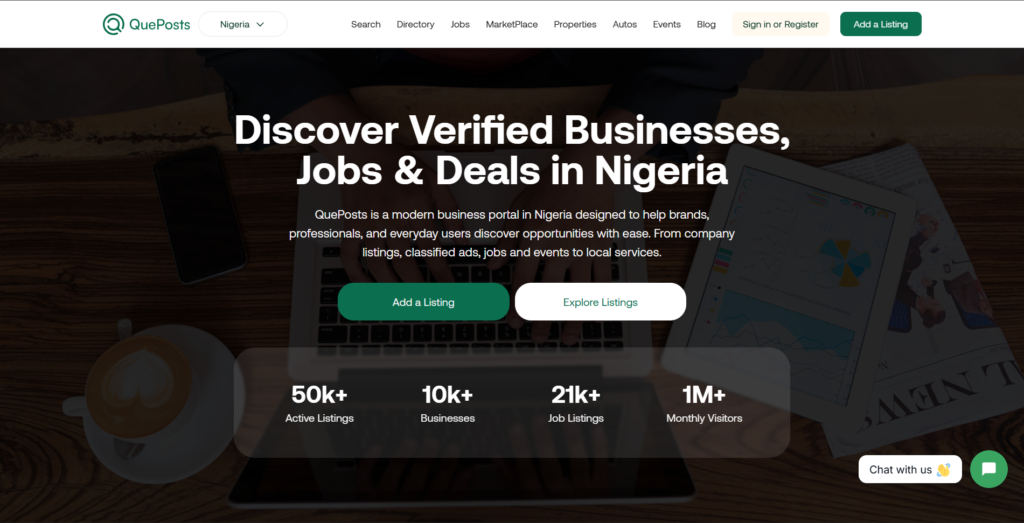
Queposts is a next-generation business portal designed to help businesses, professionals, and consumers discover each other with ease. From company listings and classified ads to jobs, events, and industry content, Queposts connects people to opportunities locally and globally.
For Nigerian SMEs, this matters for several reasons.
Getting listed on Queposts means your business becomes discoverable to customers and partners who are actively looking for what you offer. Whether you run a manufacturing company in Aba, a consultancy in Abuja, a retail store in Kano, or a service business in Lagos, a well-set-up Queposts listing puts your business in front of people who are already in the mindset of finding and engaging a business like yours.
Beyond just a listing, Queposts gives Nigerian SMEs the ability to post classified ads for their products and services, promote job openings as they grow, advertise events and launches, and publish industry content that builds their credibility and keeps their brand visible over time.
In a market as competitive as Nigeria, visibility is everything. The businesses that get found are the businesses that grow. Queposts gives Nigerian SMEs a smart, modern, and accessible platform to make sure they are found by the right people at the right time.
Join Business Networks and Associations
Nigeria has a rich ecosystem of business associations, trade groups, and entrepreneur networks that SME owners can tap into for support, connections, and opportunities. Organisations like the Lagos Chamber of Commerce and Industry, the Manufacturers Association of Nigeria, the Nigerian Association of Small and Medium Enterprises, and various state-level business associations offer their members access to training, advocacy, networking, and sometimes financing opportunities.
Being part of a business network also keeps you informed about regulatory changes, government programmes, and market developments that could affect your business.
Frequently Asked Questions
What are SMEs in Nigeria according to SMEDAN? According to SMEDAN, the Small and Medium Enterprises Development Agency of Nigeria, SMEs are classified based on employee numbers and annual turnover. Micro enterprises have fewer than 10 employees and less than ₦25 million in annual turnover. Small enterprises have 10 to 49 employees and turnover between ₦25 million and ₦100 million. Medium enterprises have 50 to 199 employees and turnover between ₦100 million and ₦1 billion.
How many SMEs are there in Nigeria? Nigeria has over 39 million micro, small, and medium enterprises, according to data from SMEDAN and the National Bureau of Statistics. These businesses account for approximately 96 percent of all businesses in the country and employ around 84 percent of the Nigerian labour force.
Why are SMEs important to the Nigerian economy? SMEs are critical to the Nigerian economy because they create the majority of jobs in the country, contribute approximately 48 percent of GDP, drive innovation, reduce poverty, and have significant potential to generate foreign exchange through exports. Without a thriving SME sector, the Nigerian economy cannot grow at the pace needed to meet the needs of its rapidly expanding population.
What are the biggest challenges facing SMEs in Nigeria? The most significant challenges facing Nigerian SMEs include limited access to affordable finance, poor infrastructure, particularly unreliable power supply, multiple taxation from different levels of government, difficulty accessing wider markets, and gaps in digital literacy and technology adoption.
How can Nigerian SMEs grow faster in 2026? Nigerian SMEs can accelerate their growth by building a strong online presence, embracing digital marketing, keeping proper financial records, getting listed on platforms like Queposts to increase their visibility, and joining business associations that provide support, training, and networking opportunities.
Final Thoughts
So, what are SMEs in Nigeria? They are the heartbeat of the Nigerian economy. They are the millions of hardworking entrepreneurs across every state in this country who wake up every day and build something, create jobs, serve their communities, and drive the economic activity that keeps Nigeria moving.
They face real challenges; there is no point pretending otherwise. But they also have more tools, more platforms, and more opportunities available to them than any previous generation of Nigerian entrepreneurs.
If you are an SME owner in Nigeria, the most important thing you can do is keep building, keep learning, and keep using every available tool to make your business more visible, more efficient, and more competitive. The Nigerian market is enormous, the demand is real, and the opportunity is there for those willing to pursue it with consistency and purpose.
Your business matters more to this economy than you might realise. Keep going.