

Ginger farming in Ghana occupies a peculiar position in the country’s agricultural economy: globally in demand, locally underproduced, and sitting on soil and climate conditions that are well-suited to growing it at commercial scale. Global demand for ginger has grown consistently for over a decade, driven by the food processing industry, the pharmaceutical sector, the beverage industry, and a worldwide shift toward functional foods and natural health products.
Ghana produces ginger that ranks among the most pungent in the world, a quality that processors and exporters actively pay a premium for. And still, Ghana exports only a fraction of what the market could absorb. The farmer who understands ginger’s specific moisture and drainage requirements, manages the rhizome rot threat with soil preparation, and plans for either the fresh export market or the value-addition processing route is entering a sector where the ceiling on commercial returns is considerably higher than what the crop’s relatively low profile in Ghana suggests.
Site Selection and Land Preparation
Ginger’s most unforgiving characteristic is its intolerance of waterlogged soil. One episode of poor drainage during the growing season can destroy rhizomes across an entire planting, and the loss is not apparent until harvest.
Climate Suitability
The Ashanti, Eastern, and Central regions offer the well-distributed rainfall, moderate temperatures, and relative humidity that ginger production performs best in. These zones provide the consistent moisture that ginger needs without the prolonged flooding that its rhizomes cannot survive.
Soil Type
Deep, well-drained sandy loam rich in organic matter is the standard for commercial ginger production. The soil must allow water to move through freely while retaining enough moisture to support consistent growth. Conduct a soil test before committing to a site. Confirm pH is between 5.5 and 7.0 and that drainage is adequate even during peak rainfall months.
Land Preparation
Clear land in February and incorporate well-rotted poultry manure or compost thoroughly into the topsoil during tilling. Ginger is a heavy feeder that draws on soil nutrition consistently throughout its 7 to 9-month growing cycle. Starting with a well-nourished, biologically active soil base reduces your fertilizer dependency during the season and builds the rhizome weight that determines your yield per acre.
Raised Beds
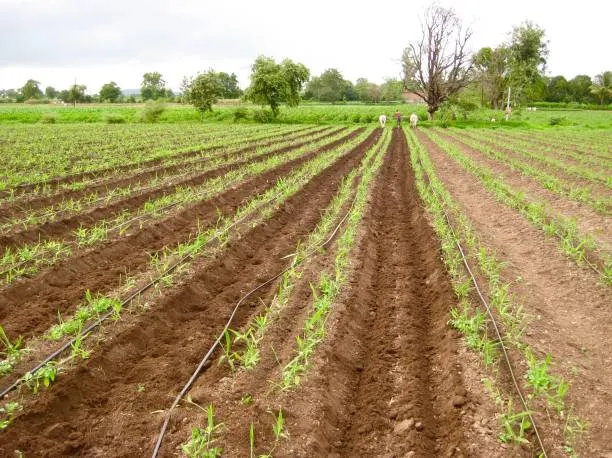
On sites with any drainage uncertainty, raised beds of 15 to 20 centimetres reduce rhizome rot risk by keeping the root zone above the water table during heavy rainfall. This is a modest extra preparation cost relative to the loss a single drainage failure causes.
Variety Selection
The ginger variety you plant determines your buyer, your processing pathway, and your price per kilogram at harvest.
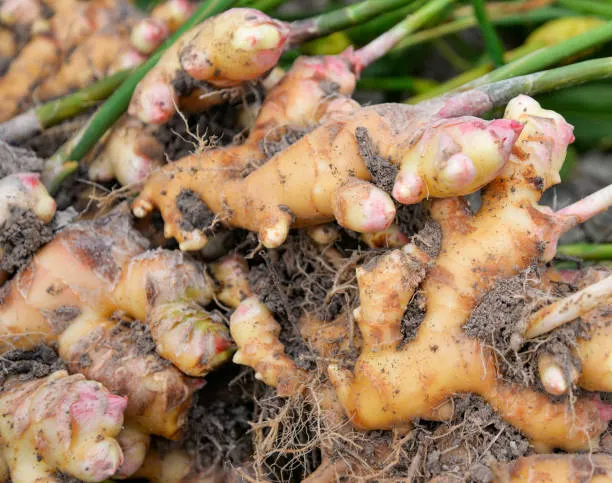
- Local Yellow Ginger: The most widely grown variety in Ghana, known for high pungency and fiber content. It is popular in local markets, with shito producers, and with herbal medicine manufacturers who value the high oleoresin content. Yields are reliable and the market is familiar, but prices for undifferentiated fresh yellow ginger fluctuate with supply.
- Blue Ginger (Narrow-Leaf): Produces larger rhizomes than the local yellow variety, preferred by some industrial processors for juice extraction and dried ginger production. The larger rhizome size also reduces the labor per kilogram during harvest and post-harvest handling.
- Chinese and Exotic Varieties: Occasionally imported and grown in Ghana for the fresh export market. These varieties produce the smooth skin, uniform shape, and large rhizome size that European and North American fresh ginger buyers specify. They command export prices above local market rates but need more intensive management and access to certified planting material from reputable sources.
Which Month Is Good for Ginger Farming in Ghana?
Timing in ginger farming is not simply about when to plant. It is about aligning your planting window with the rainfall calendar so that your rhizomes establish well, your growing season coincides with adequate moisture availability, and your harvest falls at a time when market prices are most favorable.
March and April are the primary planting months for commercial ginger farming in Ghana. Planting at the onset of the major rains gives rhizomes access to consistent soil moisture during the establishment phase, when buds are breaking and the first shoots are pushing through the mulch layer. Planting too early into dry soil delays establishment and increases seed rot before sprouting begins. Planting too late compresses the growing season and reduces final rhizome size at harvest.
December and January are the primary harvest months. After 7 to 9 months in the ground, ginger planted in March or April is ready for harvest as leaves yellow and dry down at the end of the year. This harvest timing is commercially advantageous because December and January fall outside the peak supply period in the global fresh ginger market, and domestic processor demand for dried and powdered ginger tends to be highest in the first quarter of the year.
Minor season planting between September and October is practiced by some farmers in the forest-transition zones with reliable minor season rainfall. This extends production into a second cycle and allows harvest in June or July of the following year. Minor season ginger faces more pest pressure and less predictable rainfall but can fill a supply gap in the fresh market between December and the following major season harvest.
Planting and Crop Management
Establishment decisions at planting set the architecture of your rhizome development for the entire season.
Seed Rhizome Preparation
Select healthy seed bits with at least two to three visible, firm buds. Cut larger rhizomes into sections of 40 to 60 grams each. Allow cut surfaces to cure for one to two days in a shaded, ventilated area before planting to reduce infection risk at the cut face. Treat seed bits with a fungicide dip if rhizome rot is a documented issue on your site or in your source material.
Spacing
Plant 25 to 30 centimetres apart within rows, with rows 30 to 40 centimetres apart. Bury seed bits 5 to 10 centimetres deep with the bud facing upward. Correct depth is important. Too shallow exposes developing rhizomes to sun scorch. Too deep delays emergence and increases rotting risk in heavy soils.
Mulching
Apply a thick layer of rice straw or dry grass over the entire bed immediately after planting. Mulching is not optional. It conserves soil moisture during dry spells, moderates soil temperature fluctuations, suppresses weed growth through the early weeks before shoots emerge, and reduces soil compaction from rainfall impact. Maintain mulch cover throughout the growing season, replenishing as it decomposes.
Shade Management
Ginger performs well in partial shade, which reduces leaf temperature and soil evaporation. In full sun conditions, consistent irrigation and mulching become more demanding to maintain the moisture levels that full-sun ginger needs. Intercropping ginger under a light canopy of plantain or yam is a common and effective practice on Ghanaian farms.
Earthing Up
Every two months, heap additional soil around the base of each plant to give expanding rhizomes room to develop and prevent any exposed sections from sun scorch. This is one of the most impactful routine management practices in ginger production and is frequently skipped on low-yield farms.
Also Read: How to Start Pepper Farming in Ghana
Inputs and Fertilization
Ginger’s heavy feeding habit means that soil nutrition must be actively managed throughout the growing season, not just at planting.
Apply NPK 15-15-15 at six weeks after emergence to support vegetative growth and canopy development. Follow with a potassium-rich fertilizer at 12 weeks after emergence. Potassium is the nutrient most directly linked to rhizome weight and density in ginger, and an adequate potassium supply during the bulking phase is the input decision with the highest yield-return ratio in commercial ginger production.
Supplement inorganic fertilizers with additional compost top-dressing at the earthing-up stages to maintain soil biological activity and organic matter levels throughout the growing season. Farms that rely exclusively on inorganic fertilizers without organic matter maintenance see soil structure decline over successive seasons.
Pest and Disease Management
Two threats cause the majority of commercial losses in Ghanaian ginger farms.
Rhizome Rot caused by Pythium and Fusarium fungi is the most destructive disease in ginger production globally and in Ghana specifically. Infected plants show yellowing of the youngest leaves followed by wilting and collapse of the shoot. Underground, the rhizome is discolored and soft. There is no effective curative treatment once infection is established. Prevention is the only management strategy: use disease-free seed material, prepare soil drainage before planting, avoid waterlogging at any point in the season, and rotate ginger out of any site that has had a rot outbreak for a minimum of three years.
Shoot Borers are the primary insect pest on Ghanaian ginger farms. The larvae tunnel into the stem base and growing shoot, causing dead heart symptoms where the central shoot wilts and dies. Scout weekly from four weeks after emergence. Apply EPA-approved systemic insecticides at the first sign of wilting shoots that are not explained by moisture stress. Early intervention prevents the population buildup that causes stand-level damage.
Commercial Ginger Farming in Ghana
Commercial ginger production in Ghana serves three distinct markets, each with different quality standards, price dynamics, and buyer relationships.
The domestic fresh market absorbs the bulk of Ghanaian ginger through urban markets including Makola, Agbogbloshie, and regional wholesale markets. Fresh ginger prices in this market fluctuate between harvest season and the off-season months. Farmers who can store cured ginger in a cool, ventilated space and release it gradually between February and August earn considerably more per kilogram than those who sell everything at harvest.
The industrial processing market covers beverage companies, herbal medicine manufacturers, and food processing companies that produce ginger-flavored products for the domestic and export markets. Industrial buyers purchase in bulk and specify moisture content, pungency levels, and contamination limits. Supply contracts with industrial buyers provide price certainty and volume commitment that open-market sales do not.
The export market is the highest-price channel available to Ghanaian ginger farmers. EU and UK buyers pay export premiums for high-pungency dried ginger and ginger powder that meets food safety and pesticide residue standards. Accessing this market involves PPRSD phytosanitary certification, EPA pesticide compliance records, and in some cases third-party food safety certification depending on the specific buyer’s requirements. Ginger export is most practically accessed through an established exporter relationship instead of direct shipment by individual farms.
Harvesting and Post-Harvest Management
Ginger harvest needs more care per kilogram than most other Ghanaian field crops because bruising at harvest directly causes mold development that reduces market value.
Harvest when leaves have yellowed and begun to dry down, signaling that the plant has completed its vegetative cycle and rhizome development is at its maximum. Dig carefully with garden forks, working around the rhizome mass and not through it. Bruised or cut rhizomes mold within days and are downgraded or rejected by buyers.
After digging, shake off soil and move rhizomes immediately to a shaded, well-ventilated area. Air-cure for two to three days before bagging or further processing. Do not wash rhizomes intended for fresh sale or drying. Washing introduces surface moisture that accelerates mold development during storage.
Value addition options:
- Cured whole fresh rhizome for domestic fresh market.
- Washed and graded fresh rhizome for export markets.
- Sun-dried ginger slices for ingredient and spice buyers.
- Ginger powder for packaged consumer goods and industrial buyers.
- Ginger juice or extract for beverage manufacturers.
The spread between fresh farm-gate prices during harvest season and dried or powdered ginger prices in the off-season is one of the most significant value-addition opportunities in Ghana’s spice sector.
List Your Ginger Farm on QuePosts
Beverage companies, herbal product manufacturers, spice exporters, and food processors looking for reliable ginger supply in Ghana do not always find their suppliers through traditional market channels. QuePosts is a digital business directory and discovery portal built specifically for Ghanaian brands and entrepreneurs. It gives your ginger farm a professional online listing where industrial buyers, export agents, and processing companies can find your production capacity, your variety range, and your contact details directly.
QuePosts also integrates job posting features, so when your farm scales and you need to hire harvest workers, a post-harvest processing team, a sales contact for industrial outreach, or a field supervisor for multi-acre operations, you can post those vacancies on the same platform where your business is already listed.
Ginger farming in Ghana gives back what you put into it with unusual consistency, provided the drainage is right, the seed material is clean, and the post-harvest plan exists before the first rhizome comes out of the ground. The crop’s reputation for being difficult is almost entirely built on farms that skipped the drainage assessment, used infected seed bits, or sold everything fresh at harvest-season prices when the real money in Ghanaian ginger is in the processing and the timing.