


Starting a Pig farm in Ghana sits in the middle of a market dynamic that most people outside the industry do not fully appreciate: pork consumption is concentrated, culturally specific, and deeply loyal. In communities across the Brong-Ahafo, Volta, Ashanti, and Greater Accra regions where pork is part of the food culture, the demand at the local chop bar, and the open-air barbecue joint is consistent throughout the year and intensifies dramatically at Christmas and Easter.
At the same time, commercial pig production in Ghana is underdeveloped relative to that demand, disease outbreaks periodically reduce herd sizes, and many farmers exit the business before building the systems that make it sustainable. The farmers who remain are the ones who understood from the beginning that pig farming is a biosecurity business first and a livestock business second. Get the biosecurity right, and everything else becomes manageable.
Legal and Registration Setup
- Office of the Registrar of Companies: Incorporate your farm as a sole proprietorship or limited liability company to receive your Certificate of Incorporation. A registered business opens access to Ministry of Food and Agriculture (MoFA) technical support programs, agricultural financing, and formal supply contracts with processors and institutional buyers.
- Tax Identification Number: Register with the Ghana Revenue Authority for your TIN before approaching any formal buyer, processor, or abattoir for a supply arrangement.
- Veterinary Services Directorate: Register your farm with the VSD to access government vaccination programs for swine diseases, veterinary health certifications for live animal movement, and technical guidance from district animal health officers.
- Environmental Protection Agency: Large-scale pig farms produce significant volumes of liquid and solid waste that must be managed under EPA guidelines. Secure an environmental permit before commencing operations, particularly if your farm is within proximity of water bodies or residential areas.
- District Assembly Permit: Confirm that your chosen site is zoned for livestock use and collect the annual operating permit from your Metropolitan, Municipal and District Assembly (MMDA).
Site Selection and Biosecurity
Site selection for a pig farm is inseparable from biosecurity planning. The two decisions must be made together.
Location
Choose a site with good drainage, adequate road access for feed delivery and live animal transport, and sufficient distance from residential areas to manage odor and noise without generating community complaints. Pigs produce pungent waste, and proximity to neighbors is among the most common causes of operational disruption for Ghanaian pig farms.
Prevailing Wind
Position pig housing so that prevailing winds carry odor away from residential areas and away from your feed storage and water supply areas.
Perimeter Security
A complete perimeter fence with a single controlled entry point is the foundation of farm biosecurity. All visitors, vehicles, and equipment that enter the farm are potential disease vectors. A single perimeter breach that allows wild animals, stray livestock, or unauthorized visitors contact with your pigs is a disease risk.
Footbaths and Disinfection Points
Install disinfectant footbaths at every entry point and at the entrance to each pig house. African Swine Fever (ASF), the most devastating disease affecting Ghanaian pig farmers, spreads through contact with infected animals, their secretions, and contaminated objects including boots, vehicles, and clothing.
Water Supply
Sink a dedicated borehole for your pig farm. Shared water sources that also serve other livestock or humans introduce disease risk that a dedicated supply protects against. Pigs consume large volumes of water daily, and water quality directly affects feed intake, growth, and reproduction.
Housing and Infrastructure
Pig housing in Ghana must balance the need for shade and ventilation against the biosecurity requirement for contained, controlled environments.
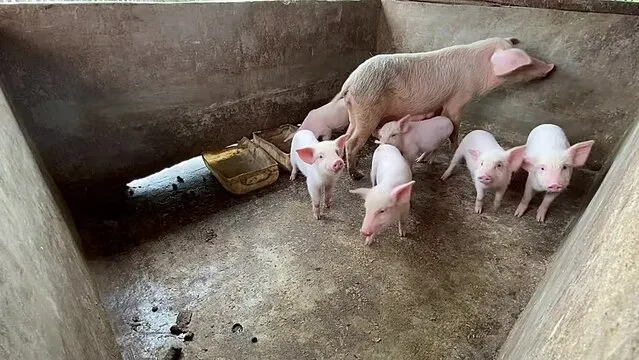
Open-sided concrete or brick structures with a solid roof are the standard commercial housing design in Ghana. The roof shade reduces heat stress, which is among the most productivity-limiting factors for pigs in Ghana’s climate. Heat stress suppresses feed intake, reduces growth rates in finishing pigs, and decreases conception rates in breeding sows.
Pens must be constructed with concrete floors that slope toward drainage channels for efficient waste removal. Flat floors that retain urine and manure create ammonia buildup that damages the respiratory health of the animals and the workers managing them.
Separate housing units for different production categories are essential for disease control and efficient management. At minimum, a commercial pig farm needs dedicated pens for breeding sows, boars, farrowing sows and piglets, weaners, growers, and finishing pigs. A quarantine unit for new arrivals must be physically separated from all production pens.
Breed Selection and Stock
The breed choice in pig farming has a more direct impact on your feed conversion and growth rate than in most other Ghanaian livestock enterprises.
Large White and Landrace breeds and their crosses are the most productive commercial meat breeds in Ghana. They grow rapidly, convert feed efficiently, and produce lean carcasses that meet market and processor specifications. They need consistent, balanced nutrition and good housing to perform at their genetic potential. Under poor management, exotic breeds underperform because their productivity is conditional on the management inputs they receive.
Local Ghana pigs are more resilient under extensive management conditions but grow more slowly and produce less lean meat per kilogram of feed consumed than exotic breeds. They are better suited to smallholder systems where feed consistency and veterinary access are limited.
Duroc crosses combine the lean growth of the Duroc breed with the robustness of other commercial lines and are increasingly used by medium-scale Ghanaian producers who want better performance than local breeds without the full management intensity that pure exotic lines need.
Source breeding stock from farms with documented health status and production records. Introducing pigs from unknown health backgrounds into an established herd is one of the most common routes of disease introduction in Ghana’s pig sector.
Commercial Pig Farming in Ghana
Commercial pig farming in Ghana is organized around two primary production systems that serve different market segments.
Farrow-to-finish operations
Farrow-to-finish operations manage the entire production cycle from breeding through to slaughter weight on a single farm. This model gives the farmer maximum control over biosecurity, health status, and production scheduling. It also concentrates all production risk within a single location, which means a disease outbreak on a farrow-to-finish farm can affect animals across all production stages.
Finishing operations
Finishing operations purchase weaner piglets from specialist breeding farms and grow them to slaughter weight. The capital outlay is lower than a farrow-to-finish system, and the production cycle is shorter, generating faster cash flow. However, the farm is dependent on an external weaner supply of consistent health status, and sourcing clean, healthy weaners at a reliable price and schedule is a recurring operational challenge in Ghana.
Abattoir and processor supply
Abattoir and processor supply channels connect commercial farms to pork processors, sausage manufacturers, and slaughterhouses that supply formal retail and institutional buyers. These relationships pay lower per-kilogram prices than direct consumer sales but provide volume commitment and payment terms that make cash flow more predictable.
Pig Farming Competition in Ghana
Competition in Ghana’s pig farming sector comes from several directions that commercial farmers must plan around and plan for them directly.
Informal sector producers including backyard farmers, smallholders, and urban pig keepers who keep a few animals on household waste contribute significant volume to local fresh pork markets, particularly in areas where pig consumption is highest. These producers have lower fixed costs and often sell below prices that reflect the true cost of formal commercial production. Competing on price alone with informal producers is not a sustainable strategy for a commercial farm.
Imported frozen pork from Brazil, Europe, and other major producing countries enters the Ghanaian market at prices that are sometimes below the cost of local production. The import pressure is most felt in the processed pork segment including sausages, ham, and packaged pork products sold through supermarkets. Local fresh pork sold directly to consumers, chop bars, and event caterers is less affected because freshness and cultural preference for locally known supply give domestic producers a meaningful advantage.
Differentiation strategies that successful commercial pig farmers use to reduce direct competition include building direct relationships with specific high-volume buyers who prefer local supply, developing a reputation for consistent animal health status that buyers in the hospitality sector prioritize, and timing production for price-peak periods at Christmas and Easter when demand consistently outpaces supply and prices strengthen.
Profitability of Pig Farming in Ghana
Pig farming in Ghana can be profitable, but the margin structure is more sensitive to disease events and feed cost fluctuations than most other livestock enterprises.
Feed is the dominant cost center in a commercial pig operation, accounting for the majority of production cost per kilogram of pig produced. Pigs cannot graze or browse to supplement their diet the way ruminants do. Every kilogram of growth needs a kilogram of purchased feed, which means feed cost management is the single most impactful lever on your profit margin.
The most profitable pig farms in Ghana manage three variables. First, they control their feed cost through bulk purchasing agreements, on-farm mixing where scale justifies it, or supplier relationships that lock in supply continuity during periods of maize and soya price volatility. Second, they minimize production losses by maintaining the biosecurity protocols that prevent African Swine Fever and other high-mortality diseases from entering their farms. Third, they align finishing and slaughter timing with the Christmas and Easter price-peak periods when live pig and pork prices are strongest.
A single African Swine Fever outbreak on a farm without solid biosecurity can wipe out an entire herd in weeks. The financial recovery from a total herd loss, accounting for the cost of restocking, disinfection, and the income gap during the recovery period, can take multiple production cycles to complete. Disease prevention is not a management overhead. It is the profit protection strategy.
Prospects of Pig Farming in Ghana
The long-term prospects for commercial pig farming in Ghana are positive for producers who build their operations on solid biosecurity and confirmed market relationships.
Ghana’s growing urban population is increasing demand for diverse protein sources, and pork consumption is expanding beyond its traditional stronghold communities as urbanization brings Ghanaian consumers from different regions into shared food environments. The restaurant, hospitality, and processed food sectors in Accra and Kumasi are growing markets for consistently sourced, verified-quality pork that formal commercial farms are positioned to supply.
The formalization of the Ghanaian food system, driven by supermarket expansion and institutional food procurement, favors registered, certified commercial producers over informal suppliers who cannot meet documentation and food safety requirements. Pig farmers who build their regulatory compliance from the start are positioning themselves for the buyer segment that will grow most significantly over the next decade.
Government agricultural policy has periodically included smallholder livestock support programs that benefit registered pig farmers. Accessing these programs, as they become available, adds a non-market income layer that supplements production revenue during periods of price pressure.
Pig Farming Opportunities in Ghana
Beyond direct pig production, several adjacent opportunities exist for farmers and entrepreneurs within Ghana’s pig sector.
Pig manure and biogas are a secondary revenue stream for medium to large pig farms. Pig waste produces biogas at rates that can power farm operations and reduce fuel costs, while the post-digestion slurry is a high-quality fertilizer with commercial value to vegetable and crop farmers.
Weaner production for finishing operations is a niche with consistent demand. Farms that specialize in breeding and weaner production supply finishing operations that lack breeding infrastructure. This model reduces the complexity of the production system to a single stage and generates revenue on a shorter cycle than farrow-to-finish.
Pork processing and value addition including sausage making, smoked pork, pork seasoning, and dried pork products extend the revenue potential of a pig farm beyond live animal and carcass sales.
Technical training and consultancy is an opportunity for experienced pig farmers who have built successful, disease-resistant operations. As interest in commercial pig farming grows among Ghanaian entrepreneurs, demand for practical, locally relevant training from proven practitioners is increasing.
List Your Pig Farm on QuePosts
Processors, abattoir operators, hotel purchasing managers, and event caterers looking for reliable pork supply in Ghana face a consistent challenge: finding commercial farms with verified health status and consistent production capacity. QuePosts is a digital business directory and discovery portal built specifically for Ghanaian brands and entrepreneurs. A listing there makes your farm findable to these buyers without the referral chain that most farm-to-buyer relationships in Ghana currently depend on.
For recruitment, the platform’s job posting feature connects your farm to local candidates for roles including herdsmen, feed managers, biosecurity officers, and sales staff, without the overhead of traditional advertising.
Pig farming in Ghana is a business that punishes shortcuts and rewards systems. The farms that survive disease outbreaks, sustain profitability through feed price cycles, and build the buyer relationships that make their production commercially viable are almost always the ones that treated biosecurity as a daily discipline from the first animal that arrived on the farm. That discipline, more than breed selection, feed quality, or market timing, is what separates the farms still operating five years in from the ones that are not.