

A cleaning business in Ghana sits in a rare category of enterprise where the startup costs are relatively low, the demand is consistent across every income bracket, and the barrier between a part-time side hustle and a fully structured company is almost entirely about systems and reputation not just capital.
Office buildings fill up every morning and need to be cleaned every evening. Construction projects finish every week and leave behind concrete dust, paint residue, and debris that someone must clear. Families move into new apartments and want them spotless before the furniture arrives. None of this demand goes away during economic downturns, and none of it is being fully served by the current supply of professional cleaning companies in Ghana. The entrepreneur who builds a reliable, well-branded operation with trained staff, proper equipment, and signed contracts will find clients faster than most businesses in any other sector.
Legal and Registration
Getting registered is the first step that separates a legitimate cleaning company from an informal arrangement that clients are reluctant to trust with access to their offices, homes, and assets.
- Registrar General’s Department: Incorporate your business as a sole proprietorship or limited liability company to receive your Certificate of Incorporation. A limited liability structure is worth considering from the start because cleaning contracts often involve access to high-value property, and the liability protection it offers is genuinely useful.
- Tax Identification Number: Register with the Ghana Revenue Authority for your TIN immediately after incorporation. Corporate clients will ask for this before signing any service agreement.
- Business Operating Permit: Your Metropolitan, Municipal, or District Assembly issues an annual business operating permit for your specific location. This permit is a standard requirement for any business with a fixed office or registered service area.
- SSNIT Registration: Register as an employer with the Social Security and National Insurance Trust to cover your cleaning staff. This is a legal obligation once you begin paying wages and also signals to potential clients that you run a properly structured operation.
- Public Liability Insurance: A public liability policy protects your business against claims arising from accidental damage to a client’s property during service. No serious corporate client will sign a cleaning contract without first confirming that you carry this cover.
Equipment and Supplies
The quality and condition of your equipment reflects directly on the quality of service you deliver. Underpowered or poorly maintained machines produce inconsistent results, which in a business built on trust and repeat contracts is a serious commercial liability.
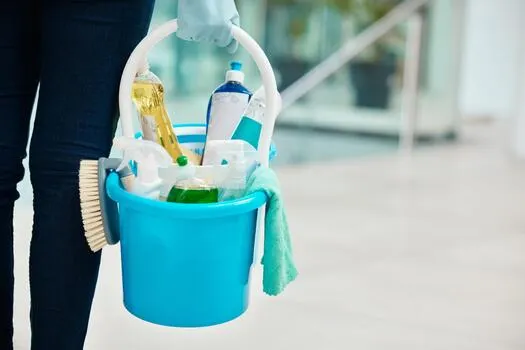
Equipment for a professional cleaning operation:
- Industrial Vacuum Cleaners: Heavy-duty machines that handle both dry dust and wet spills are essential for office and post-construction cleaning. Domestic vacuums burn out quickly under commercial workloads.
- Rotary Floor Scrubbers and Polishers: Deep cleaning of tiles, terrazzo, and concrete floors in office buildings and large residential properties is not possible with mops alone. A rotary floor machine is one of your most productive investments.
- Pressure Washers: External facade cleaning, car park washing, and deep cleaning of factory floors all benefit from high-pressure water systems.
- Microfibre Cloths and Mop Sets: Color-coded systems for different surface types reduce cross-contamination between bathroom areas, kitchens, and general surfaces.
- Cleaning Solutions: Stock bulk detergents, multipurpose disinfectants, glass cleaners, descaling agents, and specialized chemicals for stubborn stains. Always verify that your chemicals are appropriate for the specific surfaces at each client site before application.
- PPE and Branded Uniforms: Overalls, gloves, nose masks, and non-slip safety boots are non-negotiable for staff safety and professional presentation. Branded uniforms also function as a visible marketing tool on every job site.
- Transport: A van or pickup truck for moving equipment and staff between sites is essential once you are managing more than two contracts simultaneously.
Staffing and Training
A cleaning business is fundamentally a people business. Your staff are your product, and the impression they leave on a client’s premises and with a client’s team determines if the contract gets renewed.
- Recruitment: Hire staff who are punctual, honest, and have passed a basic background check. Clients who give your team access to their offices and homes after hours are placing significant trust in your hiring decisions. Take those decisions seriously.
- Technical Training: Train your team on the correct techniques for cleaning different surfaces including wood floors, marble countertops, glass partitions, stainless steel fixtures, and ceramic tiles. Using the wrong product or method on a sensitive surface is a fast way to end a contract and face a compensation claim.
- Customer Interaction Standards: Cleaners who work in occupied offices or occupied homes represent your brand in every interaction with the client’s staff or family members. Training on privacy, discretion, and professional communication is not optional for a business targeting corporate or premium residential clients.
- Supervisor Structure: Appoint a lead cleaner for every active site. The supervisor is accountable for quality control, time management, chemical usage, and reporting any issues back to management before the client notices them.

Commercial Cleaning Business in Ghana
Commercial cleaning in Ghana covers a wider range of service categories than most people entering the industry initially realize.
Office and corporate cleaning is the most consistent revenue segment. Companies need daily, weekly, or monthly maintenance cleaning of their workspaces, restrooms, and reception areas. Corporate contracts are annual and paid on a monthly retainer, making them the most predictable income stream in the industry.
Post-construction cleaning is one of the highest-paying service categories. Finishing a building site generates concrete dust, paint overspray, tile adhesive residue, and debris that requires specialized equipment and chemicals to clear properly. Developers, real estate companies, and construction firms are your primary clients in this segment.
Move-in and move-out cleaning serves tenants and landlords at the point of a property handover. The demand is consistent across Accra, Kumasi, and other major cities where the rental market is active.
Deep cleaning and fumigation services target hotels, restaurants, hospitals, schools, and food processing facilities that need periodic intensive cleaning beyond routine maintenance. This segment commands premium pricing and tends to involve long-term institutional relationships.
Domestic and residential cleaning serves households on a scheduled weekly or fortnightly basis. This segment is growing rapidly among middle-class and upper-income Ghanaian households where dual-income families and busy professionals are willing to pay for reliable home cleaning help.
Building expertise in more than one segment from the beginning gives your business resilience when one market slows down.
How Profitable Is a Cleaning Business in Ghana
Cleaning businesses in Ghana can generate good margins when the pricing is set correctly and the operational costs are managed with discipline.
Revenue benchmarks:
| Service Type | Typical Price Range (GHS) |
|---|---|
| Office maintenance cleaning (monthly retainer) | 800 to 5,000+ depending on size |
| Post-construction cleaning (per job) | 1,500 to 15,000+ |
| Move-in / move-out cleaning | 400 to 1,200 |
| Domestic residential cleaning (per visit) | 150 to 400 |
| Deep cleaning (hotel or restaurant) | 2,000 to 8,000+ |
The major cost components are labor (around 40 to 55% of revenue), chemicals and consumables (10 to 15%), transport (8 to 12%), and equipment depreciation. A well-managed cleaning business with five active corporate contracts and a small residential portfolio can generate a net profit margin of 20 to 35%, which is significantly better than most physical retail or food businesses.
Profitability is most at risk when pricing is set too low to win contracts, when chemical costs are not tracked per job, and when high staff turnover forces repeated recruitment and training spending. Contracts with clear pricing formulas tied to square footage instead of “per job” estimates protect your margins when scope creep occurs
Business Operations
The operational backbone of a cleaning company is what determines if clients stay or leave after the first month.
- Service Packages: Define clear offerings such as post-construction cleaning, weekly office maintenance, move-in cleaning, carpet steam cleaning, and deep sanitization. Packages make it easier for clients to understand what they are buying and make it easier for you to cost and schedule jobs consistently.
- Pricing Strategy: Set rates based on square footage, number of rooms, surface types, and frequency. Always factor in transport, chemical consumption, labor hours, and equipment wear. Rates priced below your true cost of delivery are a structural problem that no volume of contracts can solve.
- Client Contracts: A simple service agreement that clearly states your scope of work, pricing, payment terms, liability limits, and notice period for cancellation protects both parties and prevents the disputes that derail long-term relationships.
- Quality Control Checks: Use a site inspection checklist after every cleaning session to confirm standards before leaving the premises. A consistent quality control process is what justifies contract renewals and referrals.
- Digital Presence: Social media pages on Instagram and Facebook featuring before-and-after photos of your work are among the most effective marketing tools for a cleaning business. Visual evidence of results converts a browsing prospect into a paying client faster than any other content format.
Grow Your Cleaning Business with QuePosts
Getting your first few clients through personal referrals is a good start. Building a business that grows predictably beyond your immediate network is a different challenge, and that is where QuePosts becomes useful. QuePosts is a digital business directory and discovery portal built specifically for Ghanaian brands and entrepreneurs. It gives your cleaning company a professional online listing where property managers, real estate developers, corporate procurement teams, hotel operators, and individual homeowners can find your business, review your services, and contact you directly.
The platform also integrates job posting features, which solves one of the most persistent operational headaches in the cleaning industry. Staff turnover is high, and consistently finding reliable, trainable workers takes time and effort. With QuePosts, you can post vacancies for cleaners, supervisors, chemical handlers, and drivers on the same platform where your business is listed, reaching local job seekers who are already browsing Ghanaian businesses.
For a cleaning company at any stage of growth in Ghana, a QuePosts listing is a low-cost, high-visibility investment that puts your business in front of the clients who are already looking for exactly what you offer.