

The cost of starting a tomato farm in Ghana is the wrong first question, and almost everyone asks it first. The right question is when you plan to harvest, because the answer to that determines what your investment is actually worth. Tomatoes harvested during the rainy season glut sell at prices that can barely cover input costs. The same tomatoes harvested between January and May, when supply collapses and demand does not, sell at multiples of that price from the same crate.
The cost structure of a tomato farm is largely fixed across both scenarios. The revenue is not. Understanding that asymmetry before the first seed goes into a nursery tray is the commercial insight that separates profitable tomato farmers in Ghana from the majority who work hard for a season and wonder why the numbers did not add up.
Cost of Tomato farming in Ghana
Tomato farming in Ghana is a capital-intensive enterprise relative to most other vegetable crops because the production system that generates the highest returns, irrigated off-season hybrid production, demands investment across multiple input categories simultaneously.
Land Preparation covers clearing, primary ploughing, and harrowing to create the fine seedbed that transplanted tomato seedlings need for good root contact and establishment. Deep ploughing breaks up hardpan layers that restrict root penetration and drainage, both of which are important for tomato production.
Hybrid Seeds are non-negotiable for commercial production. Varieties including Cobra F1 and Mona F1 produce the fruit set, disease resistance, and shelf life that make commercial returns possible. Open-pollinated or saved seeds produce inconsistent fruit, lower yields, and inferior post-harvest quality.
Irrigation Infrastructure is the input that determines access to the off-season market. Without irrigation, your production is tied to rainfall timing and you are farming in the same window as every other rain-dependent tomato farmer in Ghana. A water pump, delivery pipes, and either a drip kit or sprinkler system is a significant upfront cost but is the infrastructure that converts a seasonal gamble into a managed production calendar. Drip irrigation reduces water consumption, delivers moisture directly to the root zone, and minimizes the foliar wetness that fungal diseases exploit.
Nursery Management covers seedling trays, shade netting, and the dedicated nursery space where seeds germinate and seedlings develop for 21 to 28 days before transplanting. Nursery management quality determines transplant success rates. Weak, overcrowded, or disease-affected seedlings do not recover full productive potential after transplanting regardless of subsequent management.
Fertilizers and Soil Amendments cover NPK 15-15-15 at basal application, Urea for nitrogen top-dressing at intervals through the growing season, calcium and magnesium supplements to prevent blossom-end rot, and organic manure incorporated during land preparation to improve soil structure and biological activity.
Crop Protection is a recurring, non-negotiable cost across the entire growing cycle. Tomatoes in Ghana face disease pressure from early and late blight (Phytophthora and Alternaria), insect pressure from whiteflies that transmit Tomato Yellow Leaf Curl Virus, and Tuta absoluta (South American tomato moth), whose larvae tunnel into fruits and destroy them from the inside. A strict, scheduled crop protection program using EPA-approved fungicides and insecticides on a rotating mode-of-action basis is the only management approach that protects yield across a full production cycle.
Staking Materials including bamboo poles, wooden stakes, and sisal twine are used to keep growing tomato plants and their fruit off the soil surface. Unstaked tomatoes produce fruit with higher rates of soil contact rot, fungal infection, and insect damage at ground level. The labor and material cost of staking is recovered many times over in reduced post-harvest losses.
Labor is the largest variable cost category and covers transplanting, regular weeding, pruning, crop protection applications, irrigation management, and the intensive daily harvesting and sorting that commercial tomato production demands at peak fruiting. Tomato harvesting is not a single event. It is a daily or near-daily activity across a four to eight week harvest window, and labor availability and reliability at this stage directly affects how much of your yield actually reaches the market in saleable condition.
Also Read: How to Start Ginger Farming in Ghana
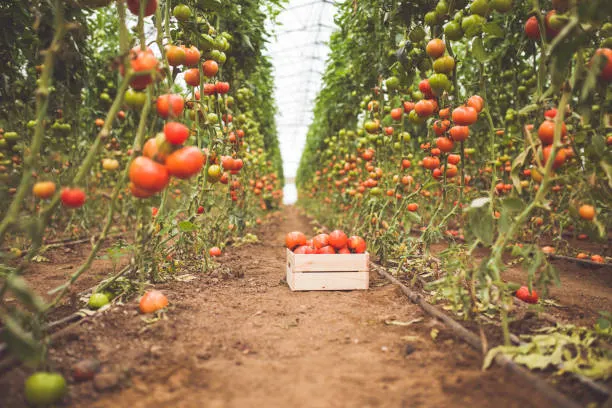
Greenhouse Tomato Farming in Ghana
Greenhouse tomato farming is the highest-investment, highest-control model of tomato production in Ghana and is gaining traction among commercial operators who want to produce year-round without the weather-related yield variability that open-field farming produces.
A greenhouse structure, either a simple screenhouse using shade netting and bamboo or a more sophisticated polycarbonate or polyethylene tunnel, creates a managed environment that gives the farmer control over temperature, humidity, and pest entry that open-field farming cannot provide.
The benefits of greenhouse production in Ghana are:
Pest exclusion is the most commercially significant benefit. The physical barrier that a well-sealed greenhouse provides dramatically reduces the pressure from whiteflies and Tuta absoluta, which are the two pest categories that cause the most consistent yield and quality losses in Ghanaian open-field tomato production. Reduced pest pressure means lower crop protection chemical costs and higher marketable fruit proportions per harvest.
Year-round production is possible in a greenhouse because the structure modifies the internal climate to extend the productive season beyond what open-field planting allows. Producers can plan harvest timing around market price peaks without being constrained by the rainy season planting window.
Fruit quality consistency improves under greenhouse conditions because the protected environment reduces the weather variability that causes blossom drop, fruit cracking, and disease-driven quality deterioration in open-field crops.
The trade-offs are real. Greenhouse infrastructure is expensive to construct and must be amortized over multiple production seasons. Internal temperature management in Ghana’s heat needs ventilation design that prevents heat buildup. Soil-borne diseases including Fusarium and Verticillium wilt can accumulate in greenhouse soil over successive cropping seasons without proper soil management or the crop rotation that open-field systems allow more naturally.
The most commercially successful greenhouse tomato operations in Ghana around Accra, Kumasi, and the peri-urban belt of Tema supply supermarkets, hotels, and food service chains that prioritize consistent size, color, and packaging quality over open-market spot purchases. T
Returns on Tomato Farming in Ghana
The return on a tomato farm in Ghana is one of the most variable income outcomes in any Ghanaian agricultural venture. The same input cost base can produce a profitable season or a loss, making one depending almost entirely on what the market price is doing when your harvest arrives.
Yield potential
A well-managed acre of hybrid tomatoes under irrigation in Ghana can produce between 12 and 20 tonnes of marketable fruit per crop cycle. This range reflects the variation between farms with good soil fertility, consistent irrigation, and disciplined crop protection at the upper end, and farms where one or more of those variables is poorly managed at the lower end.
The price timing problem
Ghana’s tomato market oscillates between glut and scarcity in a pattern that is well-documented and largely predictable. During the major rainy season, when rain-fed tomato production from the Upper East Region (Bawku, Zebilla, Gushiegu), the Brong-Ahafo belt, and the Volta Region all arrive at Accra and Kumasi markets simultaneously, prices collapse. During the dry season from January to May, supply from rain-fed farms drops sharply and prices at major urban markets rise by multiples of the rainy season low.
The farmer who harvests during the glut and the farmer who harvests during the dry season scarcity both spent roughly the same amount producing their crop. The difference in what they receive per crate at the market is the most important financial variable in tomato farming in Ghana.
Irrigation as a return multiplier
The cost of irrigation infrastructure is the input that most directly determines access to the high-price dry-season window. Farmers who invest in irrigation and plan their transplanting calendar backward from a January to March target harvest date consistently outperform rain-dependent farmers on a revenue-per-acre basis, even accounting for the additional infrastructure cost.
Post-harvest losses
Without cold storage, fresh tomatoes in Ghana deteriorate rapidly after harvest. Post-harvest losses of 30 to 40% are common on farms that lack pre-arranged buyers, must transport to distant markets in non-refrigerated vehicles, or harvest faster than they can sell. The most effective loss-reduction strategies are pre-harvest contracts with market traders or wholesale distributors, direct supply relationships with processors or hotels, and staging harvest to match sales capacity instead of picking everything at once.
Pre-harvest contracting
Pre-harvest contracting with market women or wholesale distributors, arranged two to four weeks before first harvest, locks in a buyer and a price before the fruit is fully ripe. This removes the post-harvest scramble that forces farmers to accept distressed prices when they arrive with a truckload of tomatoes and no confirmed buyer. The contract price may be below the peak spot market price, but the certainty of sale and the elimination of post-harvest loss usually produces a better net outcome.
Value addition
Value addition through tomato paste, canning, or sun-drying converts a highly perishable fresh product into a shelf-stable one. The investment in processing equipment is significant, but the revenue from processed tomato products extends the income window far beyond the fresh harvest period and opens institutional and export buyers that fresh supply cannot serve.
Production Decisions That Affect Returns
Variety selection counts for more in tomato farming than in most other vegetable crops. High-yielding, disease-resistant hybrid varieties including Cobra F1 and Mona F1 produce fruit with the shelf life, firmness, and disease tolerance that commercial production needs. Varieties with soft fruit that bruises easily in transit lose value between the farm and the urban market. Varieties with thin skin crack under inconsistent irrigation, which reduces marketable grade at the point of sale.
Harvest management is where a large portion of potential revenue is won or lost. Tomatoes harvested at the correct maturity stage, handled gently into plastic crates instead of packed into bags or baskets where compression causes bruising, and moved to market quickly after harvest arrive in better condition and sell at better prices than those harvested too early, packed poorly, or left in the field past peak.
Buyer relationships built before the farming season begins are more commercially valuable than any single agronomic decision made during the season. A pre-arranged buyer who commits to purchasing a weekly volume at a negotiated price removes the market risk that makes tomato farming in Ghana so volatile for farmers without established commercial networks.
List Your Tomato Farm on QuePosts
Hotel purchasing departments, tomato paste processors, supermarket produce buyers, and wholesale market distributors who want consistent, quality tomato supply often have no reliable way to find farms outside their existing networks. QuePosts is a digital business directory and discovery portal built specifically for Ghanaian brands and entrepreneurs. A listing on QuePosts puts your farm’s details, production capacity, and contact information in front of these buyers through a channel they can search directly.
The platform’s job posting feature makes finding harvest labor, irrigation technicians, packaging staff, and seasonal farm hands easier when peak production periods arrive and staffing needs are immediate.
Tomato farming in Ghana can be one of the most financially rewarding agricultural businesses per acre or one of the most demoralizing. The agronomy is demanding and the post-harvest window is brutally short. But none of that changes the underlying commercial reality: Ghana consumes enormous volumes of tomatoes every day, supply collapses every dry season, and the farmers who arrive at that market with quality fruit and a buyer already waiting earn returns that justify every input cost that came before.