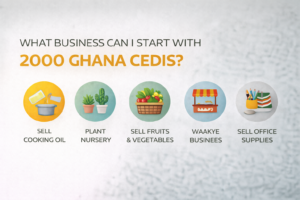



Capital is the excuse most people give for not starting. In Ghana, it is often not the real obstacle. The real obstacle is not knowing which businesses actually work at a small scale, which ones have consistent demand, and which ones can grow without requiring you to reinvest everything you earn just to stay afloat.
The five business ideas in Ghana with little capital below solve that problem. Each one is built around real, recurring demand in the Ghanaian market. None of them need a shop, a loan, or years of industry experience to get off the ground. What they need is someone willing to start small, stay consistent, and pay attention to what the market is telling them.
1. Agribusiness Reselling (Foodstuff Sourcing)
Food is the one product that never goes out of demand. Every household in Ghana buys it. Every chop bar, canteen, and restaurant depends on a steady supply of it. And yet the gap between where food is cheapest, at rural farming markets, and where it is most needed, in urban areas, remains one of the most accessible arbitrage opportunities available to a small trader.
The model is straightforward. You buy fast-moving food items like bags of rice, onions, gari, or tubers of yam directly from sourcing markets such as Techiman or Kumasi Central Market, where prices are significantly lower. You then resell them in bulk or retail quantities to households, food vendors, and small restaurants in urban areas like Accra or Tema, where the same items carry a meaningful price premium.
Your edge in this business is relationships. Farmers and bulk sellers in sourcing markets reward buyers who come consistently and pay promptly with better prices and priority access to fresh stock. On the selling side, food vendors who can count on you to deliver reliably and on time will become repeat customers who refer others.
A small startup fund is enough to buy your first batch. A handcart, a shared transport arrangement, or even a reliable trotro route can handle logistics in the early stages. As your volume grows, so does your negotiating power on both ends of the chain.
2. Commercial Liquid Soap and Detergent Production
This business lives in a category that almost every Ghanaian household, school, restaurant, and office building buys from every single month without exception. Liquid soap, bleach, and hand sanitizers are not luxury purchases. They are essentials that run out and get replaced on a regular cycle, which makes the demand for them unusually predictable.
The production process is learnable. Chemical raw materials are affordable and accessible at markets like Makola in Accra. A basic production setup at home requires no specialized equipment, just the right formulations, the right containers, and a commitment to consistent quality. Producing in bulk brings your cost per unit down quickly, and selling to institutions like schools, clinics, and restaurants means you are moving large quantities in single transactions.
Branding your product properly from the start makes a significant difference. A clean label, a hygienic-looking bottle, and a consistent scent profile will set your product apart from generic alternatives. Customers who buy cleaning products are sensitive to quality. Give them a product they trust and they will not go looking for a cheaper option.
Word of mouth and WhatsApp are your primary marketing channels early on. Bulk orders from a single school or office block can sustain a month of production costs on their own.
3. Pastries and Local Snack Catering
Ghana has a deeply rooted culture of buying and sharing food, and the snack market sits right at the heart of that culture. Meat pies disappear from trays before the vendor has finished setting up. Bofrot sells out at morning school gates. Chin chin and plantain chips move steadily through offices, tuck shops, and market stalls throughout the day.
If you can cook, this business requires almost no additional infrastructure. Your home kitchen is your production facility. Your phone is your marketing department. WhatsApp broadcast lists, food photos on Instagram, and short TikTok videos of your baking process can generate your first orders before you have spent a single pesewa on advertising.
The opportunity to scale lies in corporate catering. Many offices and schools place standing weekly orders for snacks and pastries for staff or students. Securing two or three institutional clients early on transforms this from a hustle into a predictable revenue stream.
Packaging is the investment most new food entrepreneurs underestimate. Clean, branded packaging communicates hygiene and professionalism. A sticker with your name, logo, and contact number on every bag or box is a marketing tool that travels with your product to every customer it reaches.

4. Mobile Phone Accessories Vendor
Ghana’s mobile phone market is enormous and still growing. Phones break, charge cables fray, screen protectors crack, and earpieces stop working on a timeline that is entirely independent of the economy. The accessories that keep phones functioning are bought constantly, by students, traders, office workers, and everyone in between.
The startup model is accessible. A small roadside display, a glass box, or even a clean tabletop in a high-foot-traffic location is enough to begin. Items like charging cables, screen protectors, earpieces, and power banks can be sourced at cheap wholesale prices from trading hubs, where the same accessories that retail for multiples of their cost elsewhere are available in bulk.
Location is the single biggest variable in this business. A spot near a transport terminal, a market entrance, a university gate, or a busy junction will consistently outperform a quieter location regardless of how good your prices are. Spend time scouting before you commit to a spot.
Build a small float of the fastest-moving items first, learn what your specific customer base buys most frequently, and expand your inventory based on what the data tells you.
5. Home and Office Cleaning Services
The professional cleaning market in Ghana is growing as more households, rental apartments, and small offices recognize the value of outsourcing a task that takes significant time and energy. Moving-in cleans, post-event cleans, and regular office maintenance contracts are all categories with recurring demand.
Your entire startup investment goes into basic cleaning agents, brushes, mops, and protective gear. There is no shop to rent, no heavy equipment to finance, and no large inventory to maintain. Your service is the product, and the quality of that service is what determines how fast your client list grows.
Social media does the heavy lifting on marketing. Before-and-after photos of a cleaned apartment are some of the most shareable content on Instagram and WhatsApp. A single impressive transformation posted in a community group or on your business page can generate multiple inquiries in a single day.
Reliability and trustworthiness are the competitive advantages in this business. Clients are inviting you into their homes and offices. When they find someone who shows up on time, works thoroughly, and handles their space with care, they do not go looking for alternatives. They refer you to everyone they know.
How Queposts Helps New Businesses Get Found Faster
Starting a business is one challenge. Getting customers to find it is another one entirely, and it is the one that trips up most people who have done everything else right.
Queposts is a Ghana-focused business directory built to connect local businesses and service providers directly with customers who are actively searching for what they offer. For any of the five businesses above, a Queposts listing creates an immediate, searchable online presence before a website exists, before a social media page has built any following, and before word of mouth has had time to spread.
Think about what your customer does when they need a cleaning service, a soap supplier, or a snack caterer they can trust. Many of them search online first. A listing on Queposts ensures your business appears in that search with your name, your category, your location, and your contact details presented clearly and credibly.
For a new business with a small marketing budget, this kind of passive discoverability is one of the highest-return moves available. Set up your listing on Queposts as one of your first steps after launching, and let it work in the background while you focus on delivering for the customers it brings to your door.
Conclusion
Across every business on this list, the owners who build something lasting share one trait. They treat their customers like people they intend to keep, not transactions they are trying to close. In a market where inconsistency is common and follow-through is rare, the business owner who shows up reliably, communicates clearly, and delivers on their promises stands out almost immediately.
Low capital gets you started. Character keeps you in business. Pick the idea that fits your skills, your location, and your current resources most naturally. Start with what you have. Improve as you go. The market in Ghana rewards people who are present and genuinely useful, and none of that costs anything to begin.