



Let us be honest about something. When most Nigerians say they want to start a business, the first thing that stops them is not lack of ideas. It is money. Or more precisely, the belief that you need a lot of money before you can start anything meaningful.
That belief, while understandable, is simply not true in 2026.
Some of the most successful small businesses running in Nigeria today were started with nothing more than a phone, a skill, a small corner of a room, or a few thousand naira. The people running them did not wait until conditions were perfect. They started with what they had, where they were, and built from there.
This article is for anyone in Nigeria who is ready to start a business but is working with a tight budget. We are going to walk through the cheapest businesses to start in Nigeria in 2026, what each one involves, how much you realistically need to get going, and how you can start attracting customers quickly, even before you have money to spend on advertising.
Whether you are in Lagos, Abuja, Port Harcourt, Enugu, Kano, Owerri, Ibadan, or any other part of Nigeria, at least a few of these business ideas will be a realistic fit for your situation.
What Makes a Business the Cheapest to Start in Nigeria?
Before we get into the list, it helps to understand what we mean when we talk about the cheapest business to start in Nigeria. We are not just talking about businesses with zero startup cost, because almost every business requires some form of investment, even if it is just your time and your data subscription.
What we mean is businesses where:
- The startup capital required is low enough that most Nigerians can realistically access it through personal savings, a small contribution from family, or a minor loan
- The overhead costs of running the business day to day are minimal
- The business can start generating income relatively quickly, meaning you are not waiting six months or a year before you see your first naira
- The business does not require expensive equipment, a large physical space, or specialist licences to get started
With those criteria in mind, here are the cheapest businesses to start in Nigeria in 2026.
1. Freelance Writing and Content Creation
Startup cost: ₦0 to ₦20,000
If you can write clearly and communicate ideas well, freelance writing is one of the cheapest businesses to start in Nigeria because your main tool is a skill you already have. Businesses, websites, blogs, and online publications across Nigeria and internationally pay writers to produce articles, product descriptions, social media captions, email newsletters, and more.
You do not need an office. You do not need expensive equipment. A decent smartphone or a basic laptop and a reliable internet connection are enough to get started.
Where to find writing clients in Nigeria:
- LinkedIn, where businesses and marketing agencies regularly post for content writers
- Upwork and Fiverr, where international clients hire Nigerian freelancers every day
- Direct outreach to Nigerian businesses, blogs, and digital marketing agencies
- Facebook groups for Nigerian freelancers and entrepreneurs
Experienced freelance writers in Nigeria earn anywhere from ₦50,000 to ₦500,000 per month, depending on their niche, their client base, and how consistently they work. Starting out, you might earn less than that, but your income grows as your portfolio and reputation build.
2. Social Media Management
Startup cost: ₦0 to ₦30,000
Nigerian businesses of every size need help managing their social media pages. Many business owners know they should be posting on Instagram, Facebook, and TikTok regularly, but they simply do not have the time or the knowledge to do it well. This creates a very real opportunity for anyone who understands how social media works.
As a social media manager, you create and schedule content for your clients, engage with their audiences, grow their follower count, and report on their performance. You can manage multiple clients simultaneously, which means your income scales without requiring additional startup costs.
What you need to start:
- A smartphone with good camera capability
- Basic knowledge of Instagram, Facebook, TikTok, and WhatsApp Business
- A Canva account (free) for creating graphics
- A portfolio, even if it is just content you create for your own pages to demonstrate your skills
Rates for social media management in Nigeria typically range from ₦30,000 to ₦200,000 per client per month, depending on the scope of work. Landing two or three clients puts you on a meaningful income very quickly.
3. Mini Importation Business
Startup cost: ₦50,000 to ₦200,000
Mini importation is one of the most popular and accessible cheapest businesses to start in Nigeria, and for good reason. The model is straightforward: source products from China at low prices through platforms like AliExpress or Alibaba, bring them into Nigeria, and sell them locally at a profit.
Products that sell well for Nigerian mini importers include phone accessories, fashion jewellery, beauty tools, baby products, fitness equipment, and kitchen gadgets. These are all lightweight, high-demand items with strong price gaps between what you pay in China and what you can sell for in Nigeria.
You do not need a shop. Many successful mini importers in Nigeria run their entire business from their bedroom, selling through Instagram, WhatsApp, Jiji, and Jumia.
The key to succeeding with mini importation is starting small, testing your products before ordering large quantities, building your customer base consistently, and reinvesting your profit back into growing your stock. Read more on mini importation – How to Do Mini Importation from China: A Beginner’s Guide for Nigerians
4. Catering and Home Cooking Business
Startup cost: ₦20,000 to ₦100,000
Food is one of the most reliable businesses you can start in Nigeria, regardless of the economic climate. Nigerians eat every day, and the demand for good home-cooked food, small chops, jollof rice, puff puff, chin chin, cakes, and other food items is constant and growing.
The cheapest way to start a catering or home cooking business in Nigeria is to begin from your kitchen using equipment you already have. You do not need a restaurant or a commercial kitchen to get started. Many successful food business owners in Nigeria started by cooking from home and delivering orders through logistics platforms like Gokada, Sendbox, or Kwik.
Start by cooking for people you know, friends, colleagues, neighbours, and church members. Ask them to refer you to others. Post your food on WhatsApp Status and Instagram every day. Build a reputation for quality and reliability, and the orders will follow.
As the business grows, you can invest in better equipment, hire an assistant, and eventually move into a commercial space if demand justifies it.
5. Barbing and Hair Styling
Startup cost: ₦30,000 to ₦150,000
Personal grooming is a business that never goes out of demand in Nigeria. People need haircuts and hairstyles regardless of what the economy is doing. If you have the skill, starting a barbing or hair styling business is one of the cheapest businesses to start in Nigeria, with a clear, direct path to daily income.
You can start from home, accepting clients in your living room or backyard, while you save toward renting a proper shop. A basic set of barbing clippers, scissors, a mirror, and a chair is enough to serve your first customers.
As your clientele grows and your reputation builds, you invest in better equipment, a more professional space, and eventually hire other barbers or stylists to increase your capacity and income.
The key to growing a barbing or hair styling business in Nigeria is consistency, quality, and making every customer feel valued. Word of mouth is extremely powerful in this industry, and one satisfied customer who refers their friends is worth more than any advertisement. Learn more about how to attract clients – How to Attract Customers to a Barber Shop.
6. Laundry and Dry Cleaning Business
Startup cost: ₦20,000 to ₦100,000
The laundry business is one of the most underrated cheapest businesses to start in Nigeria. Urban Nigerians, particularly those in Lagos, Abuja, and other major cities, are increasingly time-poor. Working professionals, students, and young families often simply do not have the time to do their own laundry, creating steady demand for affordable laundry services.
You can start a laundry business from home using a washing machine you already own or even by hand washing, offering pickup and delivery to your immediate neighbourhood. As the business grows, you invest in a proper washing machine, drying equipment, and a steam iron. Later, you can move into a dedicated space and offer dry cleaning as an additional service.
Marketing a laundry business in Nigeria is straightforward. Distribute flyers in your neighbourhood, post on local WhatsApp community groups, create an Instagram page, and ask your first customers to refer their neighbours. A reputation for getting clothes back clean, on time, and without damage is all you need to build a loyal customer base.
7. Graphic Design and Digital Art
Startup cost: ₦0 to ₦50,000
If you have a creative eye and the willingness to learn design software, graphic design is one of the cheapest businesses to start in Nigeria, with the potential to earn very well. Nigerian businesses of every size need logos, social media graphics, flyers, banners, business cards, and marketing materials. The demand is enormous and growing every year.
Tools you can start with:
- Canva (free, web-based, no design experience required for basic work)
- Adobe Photoshop or Illustrator (industry standard, requires a learning curve, but paid work commands higher rates)
- A smartphone or a laptop
Many Nigerian graphic designers started on Canva, built a portfolio, and gradually learned more advanced software as their income from the business grew. You do not need to be an expert to start charging for your work. Basic logo design, social media graphics, and flyer design can earn you ₦5,000 to ₦30,000 per job even as a beginner.
8. Vegetable and Foodstuff Retail
Startup cost: ₦10,000 to ₦50,000
Selling vegetables, tomatoes, peppers, onions, and other everyday food items is one of the oldest and most reliable, cheapest businesses to start in Nigeria, and it remains very much viable in 2026. Every Nigerian household buys foodstuffs regularly. The market is guaranteed.
What makes this business attractive as a starter is that the capital requirement is very low. You can start with ₦10,000 worth of stock, sell from home, and restock daily or weekly as your sales grow. Many successful foodstuff sellers in Nigeria have expanded from selling from a tray or small table to running substantial supply operations serving restaurants, schools, and corporate caterers.
To differentiate your foodstuff business in a competitive market, focus on freshness, consistent availability of items your customers want, and reliable delivery if you can offer it. Selling through WhatsApp to a curated list of regular customers is one of the most effective models for foodstuff businesses in Nigerian residential areas.
9. Photography and Videography
Startup cost: ₦50,000 to ₦300,000
Nigeria has a vibrant events culture. Weddings, birthdays, corporate events, graduations, naming ceremonies, and owambes happen every single weekend across every state in the country. All of these events need photographers and videographers, creating consistent, year-round demand for anyone with the skill and the equipment.
If you already own a decent smartphone with a good camera, you can start offering photography services immediately while you save toward a proper DSLR or mirrorless camera. Several successful Nigerian photographers started with smartphone cameras, built their portfolio, established a reputation, and then invested in professional equipment once the income was coming in.
Focus on a specific niche to stand out. Portrait photography, product photography for small businesses, event photography, or real estate photography all have clear, targetable customer bases in Nigeria. Specialising makes it easier to market yourself and to charge premium rates as your skills improve.
10. Tutorial and Teaching Services
Startup cost: ₦0 to ₦20,000
Education is a priority for Nigerian families at every income level, and the demand for private tutoring, after-school lessons, and skills training is enormous across the country. If you are strong in any academic subject, a vocational skill, a language, a musical instrument, or any area of professional knowledge, you can turn that knowledge into a business with almost zero startup cost.
You can teach:
- Primary and secondary school subjects (Mathematics, English, Sciences, and so on)
- University-level subjects for students struggling in specific courses
- Vocational skills like tailoring, bead making, soap making, or baking
- Digital skills like Microsoft Office, graphic design, or social media management
- Music, spoken English, or foreign languages
Start by offering lessons to students in your neighbourhood. As your reputation grows, add more students, increase your rates, and consider moving to group classes, which allow you to earn more per hour without proportionally increasing your time.
Online tutoring through platforms like Zoom or Google Meet also allows you to serve students anywhere in Nigeria, removing the limitation of your physical location entirely.
11. Cleaning Services
Startup cost: ₦15,000 to ₦60,000
Home and office cleaning services are in growing demand in Nigerian cities, particularly Lagos and Abuja, where a large population of working professionals simply does not have the time to clean their homes thoroughly. Starting a cleaning business requires minimal equipment and no specialist training.
Basic cleaning supplies, a mop, buckets, brushes, cleaning agents, and protective gloves are all you need to take your first job. Offer deep cleaning services for homes, post-construction cleaning for newly built or renovated properties, and regular weekly or monthly cleaning for offices and apartments.
Market your cleaning business through WhatsApp, neighbourhood Facebook groups, and estate management platforms in your area. Residential estates in Lagos and Abuja are particularly good markets because they have large concentrations of your ideal customers, working professionals with disposable income, living close together.
12. Blogging and Content Publishing
Startup cost: ₦5,000 to ₦30,000
Blogging has evolved significantly in Nigeria over the past few years. While it takes longer to generate income than most businesses on this list, it is one of the cheapest businesses to start in Nigeria and one of the few that can generate passive income once it is established.
A Nigerian blog focused on a specific niche, whether that is personal finance, food, fashion, parenting, technology, entertainment, or business, can generate income through display advertising (Google AdSense), sponsored content, affiliate marketing, and digital product sales.
The cost of starting a blog in Nigeria today is minimal. A domain name costs around ₦5,000 to ₦10,000 per year, and basic web hosting starts from around ₦5,000 to ₦15,000 per year. That is a total startup cost of less than ₦25,000 for a professional-looking website.
The investment in blogging is primarily time, not money. Consistently publishing high-quality content on a topic you know well, optimising it for Google search, and promoting it on social media are the activities that build a blog audience over time. Nigerian bloggers who have built substantial audiences in specific niches are now earning very meaningful incomes from their platforms.
How Queposts Can Help Your Business Gain Visibility from Day One
One of the biggest challenges for anyone starting the cheapest business in Nigeria is not getting started. It is getting noticed. You can have the best jollof rice in Abuja, the cleanest graphic designs in Lagos, or the most affordable phone accessories in Port Harcourt, but if the right people cannot find you, none of that matters.
This is one of the most important things Queposts solves for new and growing Nigerian businesses.
Queposts is a next-generation business portal designed to help businesses, professionals, and consumers discover each other with ease. From company listings and classified ads to jobs, events, and industry content, Queposts connects people to opportunities locally and globally.
For someone starting a new business in Nigeria, especially one with little or no capital for advertising, Queposts offers something genuinely valuable: a platform that actively connects buyers and customers to businesses like yours without requiring you to spend money to be seen.
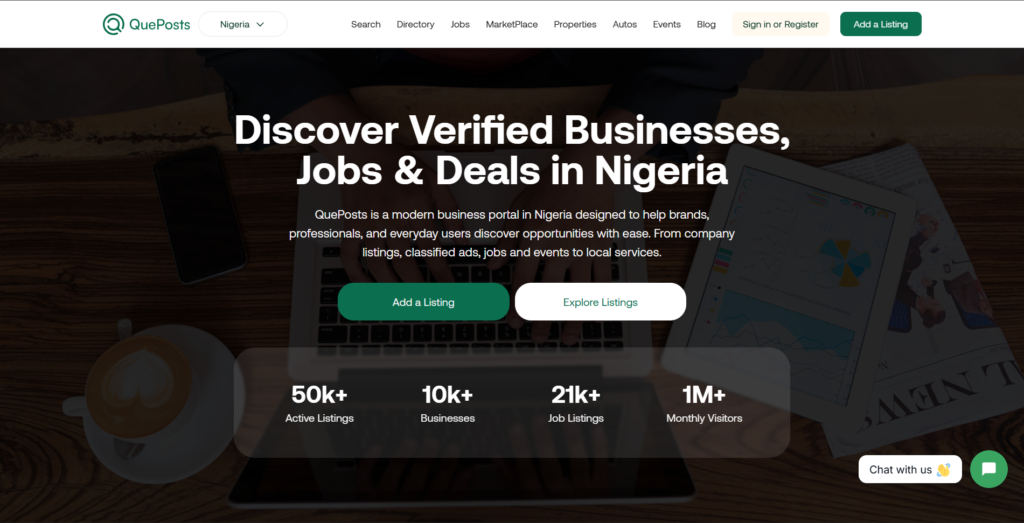
Here is specifically how Queposts helps Nigerian small businesses gain visibility:
Create a Professional Business Listing. Even if you are just starting out and have no website, no office, and no formal setup, a Queposts business listing gives your business a credible, professional online presence from day one. Potential customers searching for your type of product or service can find your listing and contact you directly.
List Your Products and Services. Whether you sell imported goods, homemade food, professional services, or handcrafted items, you can list them individually on Queposts so that buyers searching specifically for those products or services find you quickly. This is particularly powerful for businesses like mini importation, food businesses, and craft-based businesses, where individual product visibility matters enormously.
Reach Customers Beyond Your Immediate Circle. When you are starting a business, your initial customers are typically people you already know. Queposts helps you break out of that circle by making your business discoverable to people who have never heard of you before but are actively looking for what you offer.
Build Credibility as a New Business. In the Nigerian market, trust is everything. A new business with no track record faces an uphill battle convincing strangers to buy from it. A professional, complete Queposts listing that clearly shows what you do, where you are, and how to contact you signals to potential customers that you are a legitimate, serious business worth engaging with.
Promote Events and Offers. If you are launching a new business, running a promotional sale, hosting a pop-up market, or offering an introductory discount, Queposts gives you a platform to promote those events and offers to a relevant audience.
For any Nigerian entrepreneur starting a business with little or no capital, getting listed on Queposts is one of the most cost-effective first steps you can take to build visibility and start attracting customers right from the beginning.
Tips for Making Any of These Businesses Work in Nigeria
Starting the cheapest business in Nigeria is just the beginning. Making it work and grow requires a few fundamental habits that separate the businesses that succeed from the ones that fizzle out after a few months.
Start before you are ready. Waiting for the perfect moment, the perfect product, the perfect location, or the perfect amount of money means you will wait forever. Start with what you have and improve as you go.
Treat it like a business from day one. Even if you start from your bedroom with ₦20,000, open a dedicated bank account, keep track of your income and expenses, and operate with the professionalism of an established business. The habits you build at the start determine the kind of business you build over time.
Be consistent with marketing. Many Nigerian small business owners market intensely when they first start and then go quiet once a few orders come in. Consistent, regular marketing, even when business is good, is what builds sustainable growth.
Deliver on your promises. In a market driven by word of mouth and referrals, your reputation is your most valuable asset. Do what you say you will do, deliver when you say you will deliver, and handle problems quickly and honestly when they arise.
Reinvest your early profits. It is tempting to spend your first profits, but the businesses that grow fastest are the ones whose owners reinvest a significant portion of early income back into stock, equipment, marketing, or training. Discipline in the early months builds momentum that compounds over time.
Frequently Asked Questions
What is the cheapest business to start in Nigeria in 2026? Some of the cheapest businesses to start in Nigeria in 2026 include freelance writing, social media management, home cooking and catering, vegetable retail, laundry services, graphic design, and tutorial services. These businesses can be started with between ₦0 and ₦100,000 and have clear paths to generating income quickly.
Can I start a business in Nigeria with no money at all? Yes, certain businesses in Nigeria require little to no startup capital. Freelance writing, social media management, tutoring, and content creation can all be started with skills you already have and a smartphone and internet connection you likely already own. The investment is your time and expertise rather than money.
Which business is most profitable with small capital in Nigeria? Mini importation, social media management, catering, and photography are among the most profitable businesses you can start with small capital in Nigeria. Each of these has the potential to generate income quickly and scale significantly as you build your client base and reputation.
How can I get customers for my new small business in Nigeria? Start by marketing to people you already know and asking them to refer others. Build your presence on WhatsApp, Instagram, and TikTok. Get your business listed on platforms like Queposts and Jiji to be discoverable to new customers. Consistency in your marketing and excellence in your service delivery are the two most reliable customer acquisition strategies for any Nigerian small business.
Is it possible to grow a small business in Nigeria without a physical shop? Absolutely. Many of the most successful small businesses in Nigeria today operate without a physical shop. Freelancers, social media managers, mini importers, food businesses, and service providers regularly build substantial incomes operating entirely from home or online. A professional online presence and reliable delivery or service fulfilment are more important than a physical location for most of these businesses.