

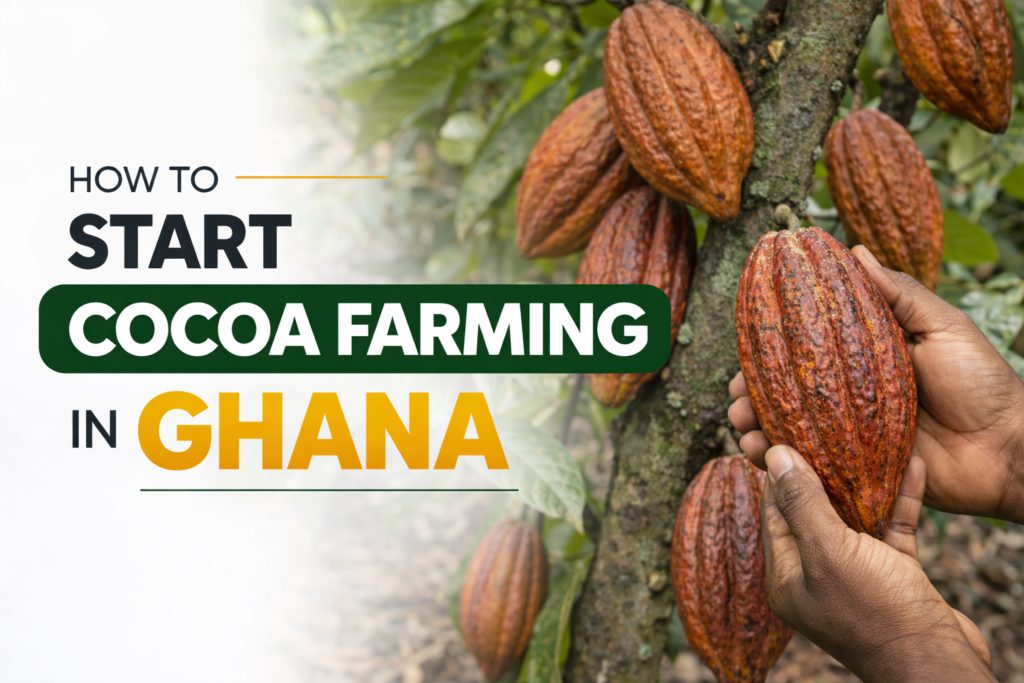

Cocoa farming in Ghana is not a business for the impatient, and anyone who tells you otherwise has never waited three years for a tree to fruit. It is a generational investment with a lifespan measured in decades, a price controlled by a government board, and a post-harvest process that is as scientifically specific as anything in food production. It is also the backbone of Ghana’s export economy, the source of income for millions of farming families, and one of the few agricultural enterprises in the country where the government actively subsidizes inputs, provides technical support, and guarantees purchase of your entire output through a licensed buying network.
The combination of long gestation, guaranteed off-take, and multi-decade productivity makes cocoa farming in Ghana unlike any other agricultural business available. Understanding those trade-offs clearly before the first seedling goes in the ground is the difference between a productive farm and an abandoned plot.
Land and Site Selection
Cocoa grows well within a specific band of conditions. Farms established outside those conditions produce below-potential yields regardless of how well everything else is managed.
Regional Suitability
The Western, Ashanti, Eastern, and Brong-Ahafo regions are Ghana’s established cocoa belt. These areas combine the rainfall distribution, humidity, temperature range, and soil depth that cocoa trees need for productive long-term performance. The Western Region accounts for the largest share of Ghana’s total cocoa output.
Soil Requirements
Deep, well-drained loamy soils with high organic matter content and a pH of 6.0 to 7.0 produce the best cocoa yields. Cocoa roots penetrate deeply and are sensitive to waterlogging. Avoid sites with impermeable subsoil layers or seasonal flooding.
Land Documentation
Cocoa trees remain productive for 30 to 50 years. The land you plant on must be secured with a formal title or a long-term lease documented, signed, and witnessed by the appropriate local authority before any investment in site preparation or planting material is made. Land disputes on mature cocoa farms are among the most costly and damaging legal situations in Ghanaian agriculture.
Shade Trees
Cocoa is a forest understory crop that performs best with partial shade, especially in the first two to three years. When clearing the site, retain tall timber trees or hardwood species that can provide canopy cover without excessive root competition. Complete clearing of all overhead vegetation stresses young cocoa seedlings and increases moisture loss from the soil.
COCOBOD Registration and Legal Setup
The Ghana Cocoa Board (COCOBOD) is the regulatory and support body that governs every aspect of commercial cocoa production, purchasing, and export in Ghana. Registering with COCOBOD is not optional for a farmer who wants access to the subsidized inputs, spraying programs, and farmer pension scheme that make cocoa farming commercially viable.
Business Registration
Register your farm at the Office of the Registrar of Companies to receive your Certificate of Incorporation and TIN. A registered business entity can access agricultural financing from ADB and other banks using your COCOBOD registration and farm records as supporting documentation.
Cocoa Management System (CMS)
Register your farm with COCOBOD through the CMS. This registration records your farm’s location, size, and farmer details and is the gateway to free mass spraying under the CODAPEC program, subsidized fertilizer distribution, access to the Cocoa Farmer Pension Scheme, and priority access to certified hybrid planting material from COCOBOD’s Seed Production Division.
Licensed Buying Company (LBC) Relationship
Identify the Licensed Buying Company operating in your district. LBCs are the commercial intermediaries who purchase dried cocoa beans from farmers at the COCOBOD-set producer price and aggregate supply for export. Building a relationship with your LBC early, before your farm is in production, allows you to understand the quality grading standards and documentation they use when purchasing your beans.
Planting Sequence and Establishment
Cocoa establishment is a multi-year process that follows a specific planting sequence to give seedlings the best possible start.
Step 1: Plant shade crops first
Six months before transplanting cocoa, plant plantain suckers or banana plants across the site at wide spacing. These grow rapidly to provide the canopy shade that young cocoa seedlings need during their first two years. They also produce harvestable fruit that generates early income before your cocoa begins to produce, which is a meaningful financial contribution during the three to five years before first cocoa harvest.
Step 2: Source certified hybrid seedlings
COCOBOD’s Seed Production Division distributes certified hybrid seedlings that are more disease-resistant and earlier-bearing than open-pollinated material from open markets. These are often provided at subsidized cost or free to registered farmers. Planting uncertified material from local markets introduces disease susceptibility and unpredictable yield performance into a farm that will occupy that land for decades.
Step 3: Transplant at the right time
Move seedlings from the nursery to the field at the onset of the major rainy season in May or June. This timing gives young plants access to consistent soil moisture during the root establishment phase before the harmattan dry season begins. Seedlings that establish their root system before the dry season arrives survive the harmattan period with less stress and setback than those transplanted late.
Step 4: Space correctly
Plant seedlings at a spacing of 3 metres by 3 metres, giving a density of about 450 to 550 trees per acre. This spacing allows adequate light penetration as the canopy develops and facilitates the access needed for pruning, spraying, and pod harvesting throughout the farm’s productive life.
Cocoa Farming Areas in Ghana
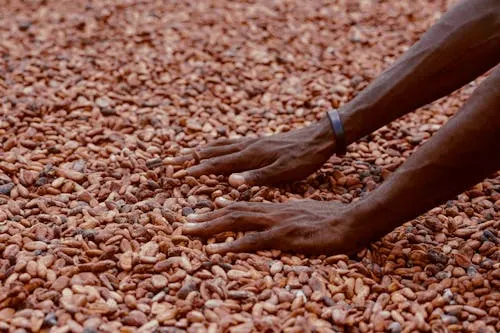
Ghana’s cocoa farming areas follow a geographic pattern shaped by rainfall distribution, forest cover, and soil characteristics that developed over decades of settlement and agricultural expansion.
The Western Region is Ghana’s most productive cocoa zone and accounts for the largest share of national output. Districts including Juaboso, Bia, Wassa Amenfi, and Sefwi Wiawso are among the highest-yielding areas in the country. The Western Region benefits from two distinct rainy seasons, high annual rainfall totals, and forest soils developed under centuries of tree cover that provide the organic matter depth cocoa trees draw on across their productive lifespan.
The Ashanti Region has a long cocoa farming tradition, with production concentrated in districts including Amansie West, Amansie East, Atwima Mponua, and Bekwai. Ashanti cocoa farming communities have multi-generational experience with the crop and established relationships with Licensed Buying Companies that service the region’s dense production network.
The Eastern Region cocoa belt covers the Akyem, Birim, and Kwahu areas. Eastern Region cocoa is historically associated with some of Ghana’s early commercial cocoa expansion and continues to produce significant volumes annually.
The Brong-Ahafo and Bono Regions form an expansion zone where cocoa farming has moved northward into areas that previously grew food crops. The Dormaa, Berekum, and Techiman districts have growing cocoa populations, though rainfall is less reliable in these transitional zones than in the forest belt further south.
Farmers selecting a new cocoa site should lean toward the established cocoa belt areas where COCOBOD extension services, licensed buying company presence, certified seedling distribution, and community knowledge of cocoa management are all most accessible.
Crop Maintenance
The maintenance period between planting and first harvest is when most cocoa farms either establish the agronomic foundation for long-term productivity or accumulate the pest, disease, and structural problems that suppress yields for years afterward.
Pruning
Remove chupons, the vertical suckers that emerge from the main stem, regularly throughout the growing season. Chupons divert the tree’s energy away from pod production. The target canopy architecture is a low, wide-spreading structure with three to five main branches forming at jorquette height, which allows light penetration and air circulation that reduce disease pressure.
Pollination
Cocoa flowers are pollinated by midges, and natural pollination rates in Ghana are often lower than the tree’s production potential. Hand pollination, which involves transferring pollen from one flower to another using a small brush or the finger, can significantly increase the number of pods set per tree. This practice is labor-intensive but produces measurable yield increases on farms where it is applied consistently during the flowering season.
Weed Control
The area around each tree must be kept clear of competing vegetation during the early years. As the canopy closes over three to four years, shading suppresses most weed growth naturally, reducing weeding labor requirements significantly.
Pest and Disease Monitoring
Cocoa Swollen Shoot Virus (CSSVD) and Phytophthora pod rot (Black Pod) are the two most destructive threats to Ghanaian cocoa farms. COCOBOD’s CODAPEC mass spraying program addresses Black Pod through scheduled fungicide application. CSSVD-infected trees must be removed and destroyed under COCOBOD guidelines, as there is no treatment and the virus spreads to neighboring trees through mealybug vectors.
Fertilizer for Cocoa Farming in Ghana
Fertilizer management in cocoa farming is more nuanced than in annual crops because the same trees will be fed across decades and soil health must be maintained, not mined.
NPK 15-15-15 is the standard compound fertilizer recommended for cocoa farms in Ghana during the first two years of establishment. It provides balanced nitrogen, phosphorus, and potassium to support early vegetative growth and root development. COCOBOD distributes subsidized fertilizer to registered farmers, which makes the input more financially accessible than purchasing through open market channels.
Sulphate of Potash or Muriate of Potash is applied to mature bearing trees to support pod filling and improve bean quality. Potassium is the nutrient most directly linked to cocoa bean development in the pod-filling phase and is the fertilizer input with the clearest impact on the weight and quality of your dried beans.
Organic matter management is equally important over the long production lifespan of a cocoa farm. Incorporating cocoa pod husks, which remain after bean extraction, back into the soil around the base of trees recycles nutrients and builds the soil organic matter that sustains long-term fertility. Farms that remove or burn all pod husks after harvest and rely exclusively on synthetic fertilizers show soil quality decline over successive decades.
COCOBOD fertilizer access: Registered cocoa farmers receive subsidized fertilizer allocations through COCOBOD’s input distribution network. Collecting your allocation promptly and applying it on the recommended schedule is one of the most straightforward yield improvement steps available to any Ghanaian cocoa farmer.
Also Read: What is the Cost of Starting a Tomato Farm in Ghana?
Harvesting and Post-Harvest Processing
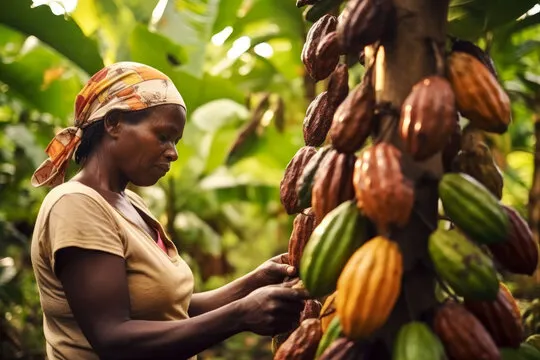
Post-harvest processing is where the quality of your cocoa beans is determined. The difference between well-fermented, well-dried beans and poorly processed ones is measured in grading, price, and buyer acceptance.
Harvest Timing
Harvest pods when they have fully ripened, identified by the color change from green to yellow or red depending on variety. Harvesting immature green pods produces beans with insufficient sugar content for proper fermentation. Leaving overripe pods on the tree leads to bean germination inside the pod, which destroys fermentability.
Fermentation
Pile extracted beans in a wooden fermentation box or heap and cover with banana leaves. Fermentation takes five to six days and must be managed by turning the heap at day two or three to aerate the beans and distribute temperature evenly. Proper fermentation develops the precursors of chocolate flavor and reduces astringency. Under-fermented beans are flat in flavor and are downgraded by buyers. Over-fermented beans are excessively acidic and are also downgraded.
Drying
Spread fermented beans on raised raffia mats or raised wooden platforms for five to seven days of sun drying. Never dry beans on bare earth or on tarpaulins placed directly on the ground. Ground contact allows moisture reabsorption, introduces contamination from soil fungi, and produces the smoky or earthy off-flavors that result in lower grading at the LBC buying point.
Quality Grading
COCOBOD’s LBCs grade beans at the point of purchase based on moisture content, bean count per 100 grams, and defect levels. Grade 1 beans receive the full producer price. Beans that fall below grade standards are discounted. Understanding what the graders look for and producing consistently to that standard protects your per-bag income across every harvest.
Market and Income Realities
COCOBOD sets the producer price for cocoa at the start of each main crop season and the light crop season. This price is the same across Ghana, paid through all Licensed Buying Companies, and does not fluctuate with global market movements in the way that unregulated commodity prices do. The price certainty this provides is a real commercial advantage for cocoa farmers: you know what you will receive per bag before your pods are harvested.
The trade-off is that the producer price is set by government policy and not by the global price of cocoa at the moment you sell. In seasons when global prices are high, Ghanaian farmers receive less than the global price. In seasons when global prices are low, the floor price may offer protection. Most long-term cocoa farmers accept this trade-off as the cost of the stability and input support the COCOBOD system provides.
List Your Cocoa Farm on QuePosts
As your cocoa farm matures and you begin producing consistent seasonal volumes, connecting with buyers, processors, premium chocolate makers, and agri-finance providers becomes commercially relevant. QuePosts is a digital business directory and discovery portal built specifically for Ghanaian brands and entrepreneurs. A listing makes your farm visible to these actors through a platform they can search directly, bypassing the informal referral networks that most farm-to-buyer relationships in Ghana currently flow through.
For staffing, QuePosts gives your farm a direct channel to local candidates for seasonal harvest labor, farm supervisors, fermentation managers, and agronomist roles, without the word-of-mouth hiring process that leaves many cocoa farmers understaffed at peak periods.
Cocoa farming in Ghana asks for patience that most businesses do not. The trees that a farmer plants today will outlast the farmer’s working life and feed the next generation’s income. That time horizon is what makes the decisions at establishment, the land security, the variety selection, the COCOBOD registration, and the commitment to fermentation and drying so consequential. Get them right once, and the farm returns on that foundation for decades.