



Cassava farming in Ghana feeds people in the morning as porridge, holds families together at dinner as fufu, generates industrial starch for food processors, supplies raw material for ethanol production, and still manages to be one of the most undervalued commercial opportunities in the country’s entire agricultural sector.
Ghana is one of Africa’s largest cassava producers, and still a significant portion of what is grown spoils within 72 hours of harvest because the processing and distribution infrastructure has not kept pace with production capacity. That gap between what the crop can do and what the system currently does with it is where the commercial opportunity for a serious cassava farmer sits. Getting the agronomy right, pairing it with a processing plan or a confirmed industrial off-taker, and managing the perishability window is what separates profitable cassava farming from the cycle of farm-gate price collapse that most smallholders experience every season.
Land Selection and Preparation
Cassava is often described as a forgiving crop, and relative to rice or vegetables that description is fair. But commercial cassava farming on poor sites still produces poor yields, and the margins on a low-yield season are painful.
Soil Type
Sandy-loam soil with good drainage is the standard for commercial cassava production. The roots need loose, well-aerated soil to expand without obstruction. Waterlogged or compacted sites cause root rot, stunted bulking, and significantly reduced harvest weight per plant.
Top Production Regions
The Ashanti, Eastern, Brong-Ahafo, and Central regions are Ghana’s primary cassava production zones. These areas combine suitable soil types, reliable seasonal rainfall, and proximity to processing facilities and urban markets.
Land Clearing
Clear land in January or February to be ready for the first rains in March and April. Avoid heavy machinery that compacts the topsoil. Light tractors or manual labor preserve the soil looseness that root expansion needs throughout the crop’s entire growing period.
Land Documentation
Cassava occupies land for a full year or more depending on variety. Secure a clear lease agreement, documented and witnessed, before committing any investment to site preparation. A land dispute mid-season is a total loss scenario.
Variety Selection
The variety you plant determines your market, your timeline, and your processing options. Planting the wrong variety for your intended buyer is a year-long mistake in a crop that occupies land for twelve months or more.
- Bankyehemaa: One of the most widely grown varieties in Ghana, with good fresh market acceptance and moderate starch content. Matures between 9 and 12 months.
- Esam Bankye: A high-yielding variety with solid resistance to cassava mosaic virus, which is one of the most damaging diseases affecting Ghanaian cassava farms. Suited to farmers targeting both fresh market and gari processing.
- Sika Bankye: A high-starch variety specifically suited for industrial buyers including starch processors and breweries. The name itself, which translates loosely to “gold cassava,” reflects the premium it commands in industrial supply chains.
Source all planting material from the CSIR Crops Research Institute (CSIR-CRI) or a certified seed multiplication centre. Uncertified cuttings from the open market carry disease risk that can compromise an entire stand before the canopy closes.
Maturity and market alignment
Varieties that mature in 6 to 9 months serve the fresh root market, where buyers need quick turnover. Varieties that mature in 12 to 15 months develop higher starch concentrations that industrial processors pay a premium for. Confirm your buyer and their specification before selecting a variety, not after.
Planting and Crop Management
Cassava establishment decisions made at planting time affect yield for the entire crop cycle. There are no meaningful corrections available once the cuttings are in the ground and the canopy has closed.
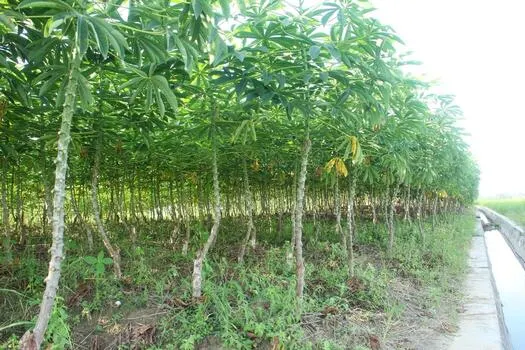
- Cuttings: Use healthy, disease-free stems cut to 20 to 30 centimetres with four to six nodes per cutting. Cuttings from the middle section of mature stems produce more consistent establishment than those from the tip or base. Inspect all material for signs of mosaic virus, bacterial blight, or stem borer damage before planting.
- Spacing: Standard commercial spacing of 1 metre by 1 metre gives about 4,000 plants per acre. Closer spacing increases competition for nutrients and light. Wider spacing reduces your plant population per acre and lowers your total yield potential per harvest.
- Planting Time: Plant at the onset of the rainy season, usually March to April in southern Ghana and May to June in northern production areas. Planting into dry soil produces poor cutting establishment and high replanting rates.
- Weed Control: The first three to four months before canopy closure are the most weed-pressure-intensive period of the crop cycle. Weeds competing with young plants during this window suppress root development in ways that cannot be recovered after canopy closure. Manual hoeing or EPA-approved pre-emergence herbicides applied immediately after planting are the two most effective management approaches.
- Fertilization: Cassava is often grown without fertilizer in Ghana, which is one of the primary reasons smallholder yields average well below the crop’s potential. NPK application at planting and a top-dressing of nitrogen at three months post-planting produces yield gains that more than justify the input cost at commercial scale.
Registration and Regulatory Support
Operating as a registered commercial cassava farmer opens access to government support programs that informal operators cannot touch.
- MoFA District Registration: Register with your local District Department of Agriculture to access subsidized input programs, certified planting material distribution, and technical support from extension officers. MoFA extension officers provide guidance on approved pesticide use, soil health management, and access to mechanization services at district level.
- Tax Identification Number: Register with the Ghana Revenue Authority for your TIN. Industrial off-takers including starch processors, breweries, and flour mills will ask for this before signing any supply contract.
- Farmer Cooperative Membership: Joining a cassava farmer cooperative gives you access to collective input purchasing, shared mechanization, and group supply contracts with processors that individual farms of modest scale cannot negotiate alone.
- PPRSD Compliance: If you intend to supply cassava or cassava products to export markets, registration with the Plant Protection and Regulatory Services Directorate of MoFA is part of the phytosanitary certification process.
Commercial Cassava Farming in Ghana
The commercial cassava market in Ghana operates across three distinct value chains, each with its own buyer profile, price dynamics, and post-harvest requirements.
Fresh root supply to urban markets, chop bars, and household buyers is the most immediate revenue channel but the most perishable. Fresh cassava roots begin to deteriorate within 48 to 72 hours of harvest. Selling fresh means having a buyer confirmed, a transport arrangement in place, and a delivery executed within that window. Farmers who sell fresh without a pre-arranged buyer regularly sell at distressed prices at farm gate instead of losing the entire harvest.
Gari and fufu flour processing is the most widely used buffer against the perishability problem. Processing cassava into gari or dried fufu flour immediately after harvest converts a perishable root into a shelf-stable product that can be stored, transported, and sold over weeks. Gari production adds labor and processing cost but eliminates the 48-hour spoilage pressure entirely and opens the packaged consumer goods market. Most commercially successful cassava farmers in Ghana process at least a portion of their harvest into gari instead of selling all roots fresh.
Industrial supply to starch processors, breweries, ethanol plants, and flour millers is the highest-volume and most contractually stable channel. Companies and local starch processors supply off-take agreements to farmers who can deliver consistent volumes of high-starch varieties meeting moisture content and contamination specifications. Industrial contracts pay lower per-kilogram prices than retail gari, but the volume certainty and removal of perishability pressure make them commercially attractive for large-scale operations.
Harvesting and Post-Harvest Management
Cassava harvest timing directly affects both your yield and your product quality, and the 72-hour perishability window means post-harvest planning must be completed before the first root comes out of the ground.
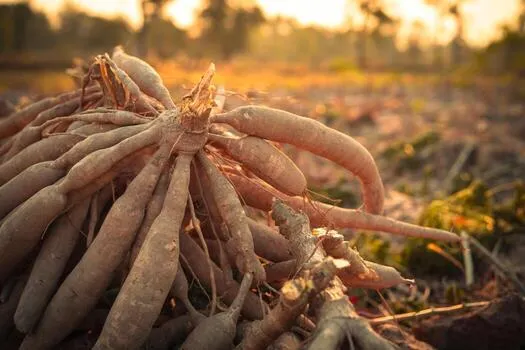
Harvest when roots have reached maximum bulking but before they become fibrous and woody. Visual indicators include yellowing of lower leaves, which signals the plant is completing its productive cycle. Roots that are left in the ground beyond their optimal harvest window develop a hard, woody texture that reduces processing efficiency for gari and starch and makes the product unacceptable to fresh market buyers.
Harvest method affects yield directly. Manual harvesting with hand hoes produces less root breakage than tractor-mounted harvesters on most smallholder field conditions in Ghana. Broken roots deteriorate faster than intact ones and are downgraded by buyers.
Post-harvest options in order of shelf life extension:
- Fresh root sale: must be completed within 48 to 72 hours of harvest.
- Waxing: coating cut roots in food-grade paraffin wax extends fresh shelf life to 3 to 4 weeks and is used by exporters supplying diaspora markets.
- Chipping and drying: cutting roots into chips and sun-drying produces a storable intermediate product sold to flour millers and feed manufacturers.
- Gari processing: frying grated cassava into gari produces a shelf-stable consumer product with weeks of storage life.
- Starch extraction: wet processing of high-starch varieties for industrial buyers produces cassava starch for food, pharmaceutical, and industrial applications.
List Your Cassava Farm on QuePosts
Processors, starch buyers, gari wholesalers, and institutional food buyers are actively looking for reliable cassava suppliers in Ghana who can commit to volume and quality consistency. QuePosts is a digital business directory and discovery portal built specifically for Ghanaian brands and entrepreneurs. It gives your cassava farm a professional online listing where industrial off-takers, market traders, processing companies, and institutional buyers can find your production capacity, variety range, and contact details directly.
QuePosts also integrates job posting features, so when your operation scales and you need to hire harvest laborers, a gari processing team, a tractor operator, or a sales contact for industrial buyer outreach, you can post those vacancies on the same platform where your farm is already listed.
Cassava farming in Ghana is one of the few agricultural businesses where the crop itself is almost never the limiting factor. The land can produce it. The climate supports it. The demand for both food and industrial applications is well-documented and large. What limits most cassava farmers is the post-harvest plan, or more accurately the absence of one. Farmers who solve the perishability problem through processing, industrial contracts, or pre-arranged buyers before harvest convert Ghana’s most productive staple crop into one of its most reliable income-generating businesses.