

Nobody who has ever waited two hours at a government office to collect a missing stamp, or watched their first product batch sit unsold because they had no buyers lined up, would describe starting a small business in Ghana as easy. But here is what that same person usually says twelve months later: it was worth it. The small business in Ghana that survives its first year does so not by accident but because someone made a series of unglamorous decisions about registration, compliance, banking, and customer acquisition long before the signage went up.
Ghana has over 300,000 registered businesses and millions more operating informally, which tells you two things simultaneously: there is enormous appetite for entrepreneurship in this country, and there is an enormous gap between the businesses that get their foundation right and the ones that spend years building on sand. This guide is for the ones who want to build on solid ground.
Strategic Planning
The planning stage is where the majority of small businesses in Ghana are already lost before registration day arrives.
Business Structure
Select a legal form that matches your situation. A Sole Proprietorship is the simplest structure with the lowest setup cost and is suited for individual operators who do not expect to take on partners or outside investors. A Partnership suits two or more people running a business together and must be formalized with a Partnership Agreement that defines each party’s contributions and profit share. A Limited Liability Company separates your personal assets from your business liabilities and is the preferred structure for anyone who expects to grow, bring in investors, or apply for significant financing.
Business Plan
Write a plan that covers your product or service, your target customer, how you will reach them, your startup costs, your revenue projections for the first twelve months, and how you intend to fund the gap between launch and profitability. A business plan does not need to be long to be useful. It needs to be honest.
Funding
Identify your capital sources before you register. Personal savings, soft loans from family, commercial bank loans, microfinance institutions, grants from the Ghana Enterprises Agency, and equity from co-founders are the most common options. Know which you are using, in what amount, and what the repayment or return expectations are before any money moves.
Legal Registration at the Office of the Registrar of Companies
The Office of the Registrar of Companies (ORC) is the statutory body responsible for business incorporation in Ghana. Registration here gives your business its legal identity.
- Name Search and Reservation: Conduct a name search at the ORC to confirm your proposed business name is available and does not infringe on an existing registration.
- TIN Registration: All directors and shareholders must hold a Taxpayer Identification Number issued by the Ghana Revenue Authority before the incorporation process can be completed. The TIN is obtained using a valid Ghana Card.
- Incorporation Documents: For a Limited Liability Company, the mandatory filings include particulars of directors and shareholders, and a registered office address.
- Minimum Requirements for an LLC: You must appoint at least two directors, one of whom must be a Ghanaian resident. A qualified Company Secretary must also be named at the point of incorporation.
- Sole Proprietorship Registration: Sole traders register a business name instead of incorporating a company. The process is simpler and less expensive, but it does not provide the liability protection that a limited company structure offers.
Post-Incorporation Compliance
Receiving your Certificate of Incorporation is not the end of the registration process. Several compliance steps must be completed before you can legally operate in your specific sector.
- Tax Registration: Register formally with the Ghana Revenue Authority (GRA) for Income Tax and Value Added Tax within one month of commencing operations. VAT registration is mandatory once your annual turnover exceeds the GRA’s prescribed threshold. Operating without tax registration exposes you to back-assessments and penalties.
- Business Operating Permit: Your Metropolitan, Municipal, or District Assembly issues an annual Business Operating Permit (BOP) for your trading premises. The application uses your Certificate of Incorporation, TIN, and proof of your business address.
- SSNIT Registration: If your business employs staff, register as an employer with the Social Security and National Insurance Trust. Employer and employee SSNIT contributions are a legal obligation, and non-compliance is an audit liability that grows over time.
- Sector Licenses: Many industries in Ghana have specific regulatory bodies that issue permits beyond the standard ORC and GRA requirements. Food businesses fall under the Food and Drugs Authority. Healthcare providers register with the Health Facilities Regulatory Agency. Financial services businesses are overseen by the Bank of Ghana or the Securities and Exchange Commission. Confirm the licensing requirements for your specific industry before beginning operations.
Operational Setup
The practical infrastructure of your business determines how smoothly day-to-day operations run and how professionally you present to customers and partners.
- Ghana Post Digital Address: Every business location in Ghana can be assigned a digital address through the Ghana Post GPS system. This standardized address is increasingly requested on official documents, delivery apps, and banking forms. Getting yours early removes a recurring friction point.
- Business Bank Account: Open a dedicated business bank account using your Certificate of Incorporation, TIN, and the resolution of directors authorizing the account opening. Mixing personal and business finances is one of the most common financial management failures among Ghanaian small businesses. It makes tax filing inaccurate, obscures your actual profitability, and creates complications if you ever apply for a loan or bring in a partner.
- POS and Payment Systems: Set up a Point of Sale system or a mobile payment solution that accepts Mobile Money from the start. Customers who cannot pay conveniently are customers who may not return. MTN MoMo merchant accounts, card machines, and integrated POS solutions are all accessible to registered Ghanaian businesses.
Funding a Small Business in Ghana
Access to capital is the most commonly cited constraint for Ghanaian small businesses, but the range of funding options has expanded significantly over the past decade.
Personal Savings and Family Capital remain the most common startup sources. The advantage is zero interest cost and maximum flexibility. The risk is that personal finances and business finances become entangled in ways that damage both if the business struggles.
Commercial Bank Loans from institutions are available to registered businesses with a credible business plan, collateral, and a track record. First-time business owners with no credit history find these harder to access, but microfinance institutions serve this segment with smaller loan sizes and less formal collateral expectations.
Ghana Enterprises Agency (GEA) provides business development support, training, and in some cases grant funding specifically for micro and small enterprises. Registered businesses that meet the GEA’s criteria can access these programs at reduced cost.
Microfinance and Small Loans Centre (MASLOC) and Government Programs offer subsidized credit to specific categories of small business owners including women entrepreneurs, youth-led businesses, and businesses in priority sectors. Eligibility and availability change with each administration, so checking the current program terms directly is advisable.
Angel Investment and Equity Funding is a growing option for tech-enabled, scalable businesses. Ghana’s startup ecosystem in Accra has produced several angel investor networks and accelerator programs that provide capital in exchange for equity.
Types of Small Businesses That Thrive in Ghana
Understanding which business models have structural advantages in the Ghanaian market helps new entrepreneurs make sharper decisions about where to focus.
Service businesses tend to have lower startup costs than product businesses because they do not carry inventory. Consulting, cleaning, tutoring, event planning, logistics, and digital services like web design and social media management are all accessible entry points that do not need significant physical infrastructure to begin.
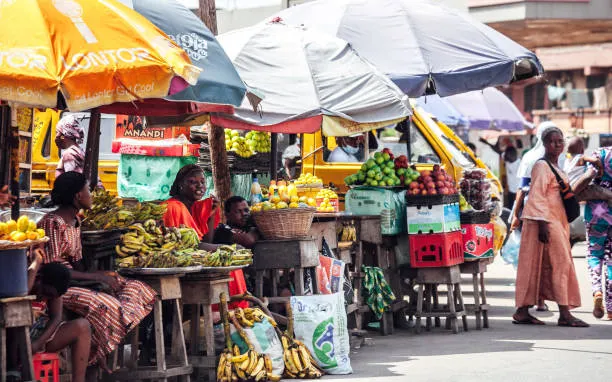
Retail and trading businesses in high-demand product categories including food, fashion, beauty products, and electronics serve the largest consumer markets in Ghana. Margins in retail are thinner than in services, but volume compensates when the location and supplier relationships are solid.
Food and hospitality businesses including chop bars, catering services, restaurants, and food processing operations serve a market that grows with Ghana’s urban population every year. The regulatory requirements are more extensive than for non-food businesses, but the demand is consistent and large.
Digital and tech-enabled businesses including e-commerce stores, apps, SaaS products, and digital content platforms are a growing segment of Ghana’s economy. These businesses access larger markets than geography allows for traditional businesses and attract funding from investors who are comfortable with digital business models.
Marketing Your Small Business in Ghana
A business that is registered, compliant, and operationally ready but invisible to its target customers generates no revenue. Marketing is not a luxury to add after the first few sales. It is part of the operational plan from the beginning.
Social media pages on Facebook, Instagram, and TikTok are the most accessible marketing channels for Ghanaian small businesses and are free to set up. Consistency of content, responsiveness to inquiries, and professional presentation of your products or services convert followers into paying customers over time.
WhatsApp Business is an underutilized but high-conversion tool for Ghanaian SMEs. A well-managed WhatsApp Business account with a product catalog, automated responses, and a broadcast list built from satisfied customers functions as a low-cost CRM and sales channel simultaneously.
Word-of-mouth remains the most powerful acquisition channel in Ghana’s market. Every customer who receives a good experience and tells three people about it is generating the kind of trust-based referral that no advertising spend can fully replicate. Customer service is marketing in a market where personal relationships carry significant commercial weight.
List Your Small Business on QuePosts
A business that is registered, funded, and operational but has no digital presence beyond social media is leaving a significant portion of its potential customer base unreached. QuePosts is a digital business directory and discovery portal built specifically for Ghanaian brands and entrepreneurs. It gives your small business a professional online listing where customers, partners, institutional buyers, and collaborators can find your contact details, understand your offering, and reach out directly.
For small businesses building credibility in a competitive market, a verified listing on a platform dedicated to Ghanaian businesses carries weight with customers who are deciding between an unknown option and one with a professional, findable profile. QuePosts also integrates job posting features, so when your business grows and you need to hire your first employee, a delivery person, a sales representative, or an administrative assistant, you can post that vacancy on the same platform where your business is already listed and reach local job seekers within your operating area.
Starting a small business in Ghana is not a single event. It is a sequence of decisions, each one building on the last, that accumulates over months into an operation with customers, revenue, and momentum. The entrepreneurs who get through the first year are almost always the ones who did the unglamorous work at the beginning: the correct registration, the honest business plan, the dedicated bank account, and the market research that confirmed someone actually wanted what they intended to sell. Start there, and the rest becomes manageable.