


Transport business in Ghana moves millions of people every single day, but the business behind it remains deeply fragmented, largely informal, and wide open for entrepreneurs who are willing to run it properly. Starting a transport business in Ghana means stepping into an industry where demand never disappears, where the population continues to grow, and where the gap between what passengers actually experience and what a well-run operation could offer them is enormous. From trotro routes in Accra to long-distance intercity services connecting Kumasi to Tamale, there are opportunities at every level of the market. You need to decide if you are prepared to manage vehicles, drivers, regulators, unions, and customers all at the same time.
Business Registration and Legal Setup
Operating a transport business without proper registration leaves you exposed to fines, impoundment, and exclusion from formal contracts with corporate clients or institutions.
- Registrar General’s Department: Incorporate your business as a limited liability company or sole proprietorship to receive your Certificate of Incorporation. A limited liability structure protects your personal assets if the business faces legal claims arising from accidents or disputes.
- Transport Operator’s License: Visit the Driver and Vehicle Licensing Authority (DVLA) to register your business as a formal transport provider. This license is what distinguishes a commercial operation from an individual driving arrangement.
- Tax Identification Number: Register with the Ghana Revenue Authority (GRA) for both income tax and Value Added Tax compliance. Corporate clients and government institutions will not engage with an unregistered business.
- District Assembly Permit: Your Metropolitan, Municipal, or District Assembly issues the operational permit for the specific location where your office, station, or loading point will be situated.
How to Register a Transport Business in Ghana
The registration process is straightforward but must be followed in sequence to avoid unnecessary delays.
- Start at the Registrar General’s Department. Prepare your proposed business name, the names and identification documents of all directors or owners, and your initial capital declaration. The Certificate of Incorporation is issued once these are submitted and approved.
- Proceed to the Ghana Revenue Authority with your incorporation certificate to obtain your Tax Identification Number. This is also when you register for VAT if your projected annual turnover exceeds the GRA threshold.
- Visit the DVLA head office or your nearest regional office to apply for your Transport Operator’s License. You will need your incorporation documents, TIN, and details of the vehicles you intend to operate.
- Submit your business certificate and DVLA documentation to your District Assembly to receive your operational permit for the specific location of your station or office.
Keeping certified copies of every document from each stage makes subsequent renewals and compliance checks much faster.
Vehicle Acquisition and Compliance
Your vehicles are your primary revenue-generating assets. Every decision around what you buy, how you register it, and how you maintain it has a direct impact on profitability.
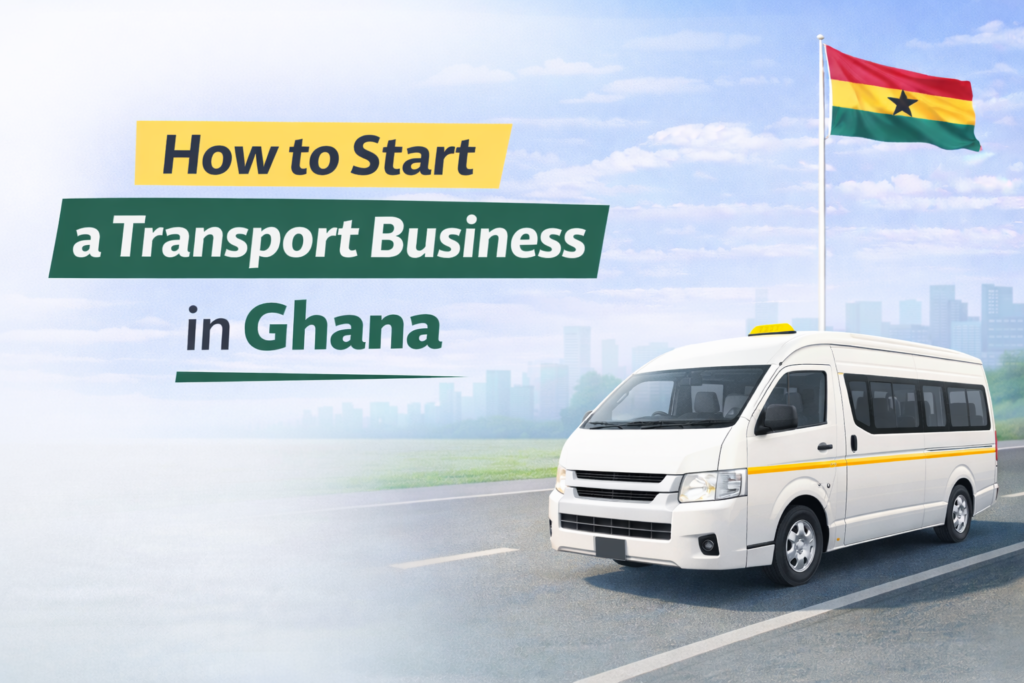
- Vehicle Selection: Prioritize brands with spare parts availability in Ghana. Toyota HiAce, Hyundai H100, and Nissan Urvan are the most common commercial passenger vehicles in the country precisely because mechanics, spare parts dealers, and trained technicians are available in every major city and most district capitals.
- DVLA Registration and Roadworthy Certificate: Every commercial vehicle must carry a valid Roadworthy Certificate and display the correct commercial registration plates. Yellow plates with specific commercial numbering indicate the vehicle’s class and authorized use.
- Commercial Insurance: Secure commercial insurance that covers passengers, drivers, and third parties. Third-party insurance alone is legally insufficient for a commercial transport operation.
- Speed Limiters and GPS Trackers: Installing speed limiting devices and GPS tracking systems is both a safety measure and a business management tool. Trackers allow you to monitor driver behavior, verify route compliance, and recover vehicles in the event of unauthorized use or theft.
Commercial Transport Business in Ghana
Commercial transport in Ghana operates across several distinct segments, each with its own regulatory requirements, customer base, and revenue model.
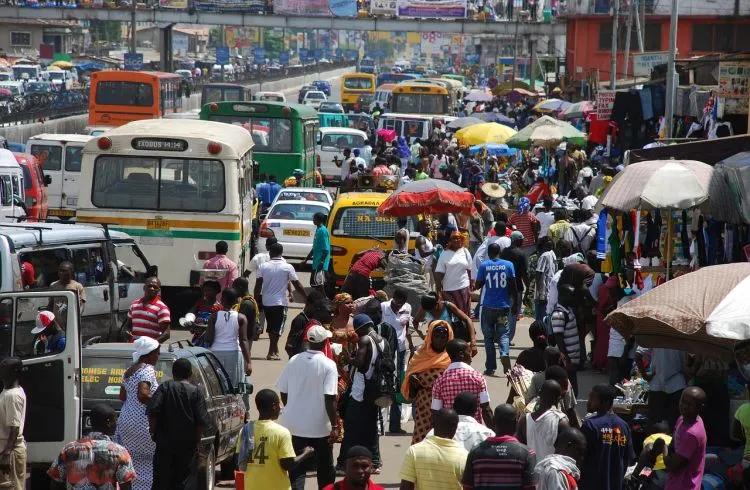
Urban commuter transport covers the trotro and minibus routes that serve cities like Accra, Kumasi, Takoradi, and Cape Coast. These are the highest-volume operations in the country and are managed through union structures that control loading points at lorry parks and roadside stops.
Intercity transport includes operators like VIP Jeoun, OA Travel and Tours, and GPRTU intercity services that connect regional capitals and major towns. This segment requires a private terminal or a designated loading bay and operates on scheduled departure times with fixed ticketing.
Corporate and institutional transport covers employee shuttle services for companies, school bus contracts, and dedicated fleet arrangements for NGOs and government agencies. This segment is less visible but often more predictable in revenue and requires formal contracts, invoicing, and fleet management reporting.
Goods and logistics transport includes cargo trucks, pickups, and delivery vans that move goods between markets, ports, and warehouses. This is a separate licensing category but shares many of the same regulatory and operational principles.
Choosing your segment before purchasing vehicles or signing leases for stations is important. The vehicle type, union affiliation, capital requirement, and daily operating cost vary across these categories.
Union and Station Management
Ghana’s transport sector has a powerful union structure that any operator working within the traditional lorry park ecosystem must understand and engage with.
- GPRTU Membership: The Ghana Private Road Transport Union is the largest transport union in the country. Joining GPRTU gives you access to designated loading points at major lorry parks and protection within the union’s dispute resolution system. Membership fees and levies are part of your ongoing operating costs.
- PROTOA: The Progressive Transport Owners Association is an alternative union body with its own network of stations and loading points. Some operators choose PROTOA based on the specific routes they intend to serve.
- Private Terminal Operations: If you are running an intercity or premium service, leasing or purchasing land for a private terminal with proper passenger waiting facilities separates you from the lorry park environment and allows you to control your own brand experience.
- Branding: Vehicles operating on urban commuter routes must carry the authorized color coding or stripes for the specific route or zone. Private intercity operators paint fleet vehicles in company colors and logos to build brand recognition.

How Profitable Is a Transport Business in Ghana
Transport profitability in Ghana is real but not automatic. The difference between a profitable fleet and a loss-making one often comes down to whether the owner has visibility into daily revenue and if maintenance is treated as a cost to manage rather than a crisis to react to.
A single HiAce minibus on an urban Accra route with a reliable driver can generate GHS 500 to GHS 900 in daily gross revenue during peak periods. After driver commission, fuel, union levies, and daily maintenance contribution, a well-managed vehicle can net GHS 150 to GHS 300 per day.
Over 25 operating days per month, that is GHS 3,750 to GHS 7,500 per vehicle in net monthly income before loan repayments or depreciation. A fleet of five vehicles run with proper systems generates a meaningful monthly income that can service vehicle financing and still return profit to the owner.
The variables that destroy profitability most often are untracked daily revenue, fuel cost leakages, deferred maintenance that leads to large breakdown repair bills, and driver turnover. Each of these is manageable with the right systems in place from the start.
Staffing and Operations
The operational layer of your transport business determines if your vehicles are earning money every day or sitting idle.
- Driver Recruitment: Hire drivers with the correct license class for your vehicle type. Class C covers light commercial vehicles, while Class D and E cover larger buses and articulated trucks. Confirm both the license class and the driving record before any offer is made.
- Driver Training: Regular safety training and customer service orientation reduce accident rates, lower insurance claims, and improve passenger retention. Drivers who treat passengers well generate return ridership and referrals, particularly for intercity and corporate services.
- Maintenance Schedule: Partner with a trusted mechanic or set up an in-house workshop for preventive servicing every 3,000 to 5,000 kilometers. Deferred maintenance on commercial vehicles always costs more in the long run than routine servicing.
- Ticketing and Revenue Tracking: A digital or manual ticketing system that accounts for every passenger and every fare is essential. Revenue leakage through uncollected fares or unreported trips is one of the most common ways transport businesses fail to realize their actual income potential.
- Record Keeping: Daily logs covering vehicle earnings, fuel consumption, driver commission, faults reported, and maintenance carried out give you the data to manage the business rather than simply react to it.
List Your Transport Business on QuePosts
Building a transport company in Ghana is one thing. Making sure the right clients, corporate partners, and job seekers can find you is another matter entirely. QuePosts is a digital business directory and discovery portal built specifically for Ghanaian brands and entrepreneurs. It gives your transport business a professional online listing where corporate clients, event organizers, travel agencies, schools, and individual customers can find your contact details, understand your service offerings, and reach out directly.
For transport operators targeting the corporate shuttle, school bus, or event hire segments, online visibility is essential. Procurement officers and event planners increasingly search for service providers online before making a single call. A well-structured QuePosts listing positions your business as a credible, findable operation rather than a word-of-mouth referral that may or may not reach the right person.
QuePosts also integrates job posting features, so when your fleet grows and you need to hire additional drivers, a fleet manager, a ticketing officer, or an operations supervisor, you can advertise those vacancies on the same platform and connect directly with job seekers already engaged with the Ghanaian business ecosystem.
For any transport entrepreneur serious about long-term growth, QuePosts is a low-cost first step toward building the kind of online presence that converts browsers into paying clients.