



Agriculture remains one of the most important sectors of Nigeria’s economy and a major source of livelihood for millions of people. The sector contributes roughly 24% to Nigeria’s Gross Domestic Product (GDP), making it one of the largest contributors to national economic growth. With vast arable land and favorable climatic conditions, the country has enormous potential for agricultural expansion.
Beyond its economic contribution, agriculture is also one of the largest employers in Nigeria. The sector provides jobs for over 30–35% of the Nigerian workforce, particularly in rural communities where farming remains the primary source of income. This makes agriculture not only an economic pillar but also a key driver of poverty reduction and rural development.
Nigeria’s growing population, which is projected to exceed 400 million people by 2050, continues to increase the demand for food and agricultural products. As food demand rises, farming business ideas are becoming more attractive to entrepreneurs and investors looking for profitable farming business ideas with high returns.
Top Profitable Farming Business Ideas in Nigeria
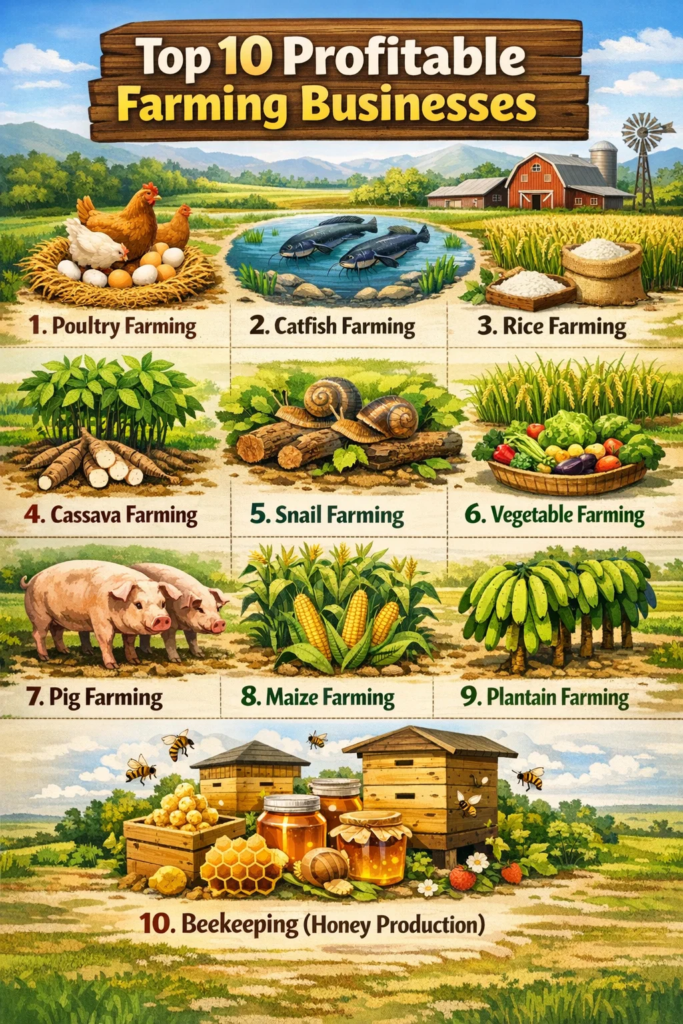
Here are top 10 profitable farming business ideas you should venture into in 2026.
Poultry Farming
Poultry farming is one of the most common and profitable agricultural businesses in Nigeria. The venture involves raising chickens for meat (broilers) or egg production (layers). Because chicken and eggs are widely consumed across the country, poultry farmers often enjoy steady demand throughout the year.
With proper farm management, feeding practices, and disease control, poultry farming can generate returns within a few months. Many entrepreneurs start on a small scale and expand as their profits grow.
Pros
- High demand for eggs and chicken meat
- Quick return on investment
- Can be started with small capital
Cons
- Disease outbreaks can cause losses
- Feed costs can be expensive
- Requires daily monitoring
Catfish Farming
Catfish farming is another lucrative farming business in Nigeria. Fish is widely consumed across the country, especially in restaurants, homes, and pepper soup spots.
Catfish grow quickly and adapt well to different environments, making them suitable for both small and large-scale farming. With proper feeding and water management, farmers can harvest mature fish within four to six months.
Pros
- Strong market demand
- Fast growth rate
- Suitable for small-scale startup
Cons
- Water management is critical
- Feed costs can be high
- Requires technical knowledge
Rice Farming
Rice is one of the most consumed staple foods in Nigeria. Due to its high demand, rice farming has become a profitable agricultural venture for farmers across the country.
With government support programs encouraging local rice production, farmers have opportunities to supply both local markets and processing companies.
Pros
- High national demand
- Government support initiatives
- Potential for large-scale production
Cons
- Requires large farmland
- High irrigation and labor costs
- Vulnerable to flooding and pests
Cassava Farming
Nigeria is the world’s largest producer of cassava, making cassava farming a very profitable business. Cassava is used to produce several staple foods such as garri, fufu, and cassava flour.
In addition to food consumption, cassava is also used in industrial production such as starch and ethanol. This creates multiple revenue opportunities for cassava farmers.
Pros
- High local demand
- Can grow in various soil types
- Multiple product markets
Cons
- Requires significant land for large profit
- Processing can be labor intensive
- Pest infestation risks
Snail Farming
Snail farming is an emerging agricultural venture with growing demand. Snails are considered a nutritious source of protein and are commonly used in Nigerian dishes.
The business requires relatively small space and minimal startup capital, making it attractive for beginners interested in farming.
Pros
- Low startup capital
- Requires little space
- High market demand
Cons
- Slow growth rate
- Requires proper humidity conditions
- Limited awareness in some areas
Vegetable Farming
Vegetable farming is a profitable venture due to the daily demand for fresh produce such as tomatoes, peppers, lettuce, and spinach.
Vegetables grow quickly and can be harvested multiple times within a year, allowing farmers to generate frequent income.
Pros
- Short production cycle
- Constant market demand
- Multiple harvests per year
Cons
- Highly perishable products
- Vulnerable to pests
- Requires irrigation during dry seasons
Pig Farming
Pig farming is a highly profitable livestock business due to the fast reproduction rate of pigs. Pigs grow quickly and can produce large litters, allowing farmers to expand their herds rapidly.
Pig farming is particularly attractive because pigs consume a wide variety of feed, including agricultural by-products.
Pros
- High reproduction rate
- Fast growth
- High meat demand
Cons
- Requires proper waste management
- Initial housing costs
- Disease risks
Maize Farming
Maize farming is one of the most widespread crop farming businesses in Nigeria. Maize is used for human consumption, livestock feed, and industrial processing.
Because maize is used in many food products, farmers enjoy consistent demand in both local markets and agro-processing industries.
Pros
- High market demand
- Short growth period
- Multiple uses
Cons
- Susceptible to pests
- Weather dependent
- Requires proper storage
Plantain Farming
Plantain farming is another profitable agricultural venture due to its popularity in Nigerian cuisine. Plantain is consumed fried, boiled, roasted, or processed into flour.
The crop grows well in tropical climates and can provide steady income for farmers once the plantation becomes productive.
Pros
- High consumer demand
- Long harvesting period
- Suitable for tropical climates
Cons
- Requires patience before harvest
- Vulnerable to pests and diseases
- Requires good soil conditions
Beekeeping (Honey Production)
Beekeeping is a unique farming venture that focuses on honey production. Honey is widely used in food, medicine, and cosmetics, making it a valuable agricultural product.
Beekeeping does not require large farmland, and farmers can produce honey while also supporting crop pollination.
Pros
- High value product
- Requires small land space
- Supports crop pollination
Cons
- Requires technical knowledge
- Bee management can be challenging
- Risk of bee stings
Why Agriculture Is a Profitable Business in Nigeria
Nigeria’s agricultural sector offers numerous opportunities for entrepreneurs because of the country’s growing population and increasing food demand. As more people require food, the need for agricultural production continues to rise.
Another factor driving agricultural profitability is the availability of large areas of arable land across Nigeria. With proper investment and modern farming techniques, farmers can significantly increase productivity and income.
Key reasons agriculture is profitable include:
- Growing population demand
More people mean higher demand for food and agricultural products. - Large agricultural market
Farmers can sell products locally or supply food processing industries. - Diverse farming opportunities
Agriculture includes crop farming, livestock, fisheries, and agro-processing.
Key Factors to Consider Before investing in Farming Business Ideas
Starting a farming business requires careful planning and proper research. Entrepreneurs must understand the financial requirements, environmental conditions, and market demand before investing in agriculture.
Successful farmers often focus on selecting the right farming venture, adopting modern techniques, and building strong market connections.
Important factors include:
- Access to fertile farmland: Good soil quality increases productivity and crop yield.
- Startup capital: Some farming businesses require equipment, seeds, livestock, or irrigation systems.
- Market access: Reliable buyers help farmers sell products quickly and profitably.
- Agricultural knowledge: Training and research improve farming efficiency.
- Climate and weather conditions: Understanding the climate of a region helps farmers choose suitable crops or livestock.
- Availability of water supply: Access to reliable water sources supports irrigation and livestock care.
- Farm location: A farm located close to markets and transportation routes reduces logistics costs.
- Access to farm labor: Reliable labor is important for planting, harvesting, feeding livestock, and general farm maintenance.
- Government regulations and policies: Farmers should understand agricultural regulations, permits, and government support programs.
- Availability of storage facilities: Proper storage helps preserve harvested crops and reduces post-harvest losses.
- Access to farming equipment: Modern farm tools and machinery improve efficiency and increase production capacity.
- Pest and disease control measures: Farmers must have strategies to prevent and manage pests and livestock diseases.
- Access to agricultural extension services: Extension services provide farmers with updated knowledge, technical guidance, and best farming practices.
Common Challenges in Nigerian Farming
Despite its profitability, agriculture in Nigeria still faces several challenges that can affect productivity and income. Farmers often struggle with poor infrastructure, limited funding, and lack of modern equipment, which can reduce efficiency and limit production capacity.
Environmental factors such as climate change, pests, and poor storage facilities also cause significant post-harvest losses. Addressing these issues is essential for improving agricultural productivity and ensuring long-term sustainability in the sector.
Common farming challenges include:
- High cost of farm inputs: Fertilizers, animal feed, improved seeds, and farming equipment can be expensive for many farmers. These high costs often limit production capacity, especially for small-scale farmers. As a result, some farmers are forced to reduce the size of their operations.
- Poor storage and transportation: Many farmers lose a significant portion of their harvest due to inadequate storage facilities. Poor road networks and transportation systems also make it difficult to move farm produce to markets. This leads to increased spoilage and reduced profits.
- Climate risks: Flooding, drought, and irregular rainfall patterns can damage crops and reduce yields. Climate change has made weather patterns less predictable, making farming more risky. Farmers who rely solely on rainfall often face unpredictable production cycles.
- Limited access to finance: Many farmers struggle to obtain loans or financial support to expand their businesses. Financial institutions often consider farming a high-risk investment. This lack of funding prevents farmers from investing in better equipment or expanding production.
- Pest and disease outbreaks: Pests and diseases can quickly destroy crops and livestock if not properly managed. Without access to effective pesticides, veterinary services, or proper farm management practices, farmers can suffer major losses.
- Lack of modern farming technology: Many farmers still rely on traditional farming tools and outdated practices. The absence of mechanized equipment such as tractors and irrigation systems reduces productivity. Modern technology could significantly improve efficiency and output.
- Inadequate agricultural training: Some farmers lack access to proper agricultural education and training. Without updated knowledge of farming techniques, pest control, and soil management, productivity may remain low. Training programs can help farmers adopt better practices.
- Land ownership and access issues: Access to farmland can be difficult due to land ownership disputes and complex land tenure systems. Some farmers are unable to secure large areas of land needed for commercial farming. This limits expansion opportunities.
- Market price fluctuations: Agricultural product prices can change rapidly due to supply and demand factors. When prices drop unexpectedly, farmers may struggle to recover production costs. This makes income from farming less predictable.
- Post-harvest losses: A large percentage of agricultural produce in Nigeria is lost after harvest due to poor handling, storage, and processing. Perishable products such as vegetables and fruits are especially vulnerable. Improving post-harvest systems could significantly increase farmers’ profits.
Tips for Starting a Successful Farming Business
Starting a successful farming business requires strategic planning and effective management. Farmers who adopt improved agricultural practices and stay informed about market trends are more likely to succeed.
New farmers are encouraged to begin on a small scale, gain practical experience, and gradually expand their operations as they gain confidence and profits.
Helpful tips include:
Start small and scale gradually
Starting with a small farm allows beginners to learn the practical aspects of farming without taking major financial risks. It gives farmers the opportunity to understand production cycles, costs, and market demands. As experience and profits grow, the farm can be expanded gradually for higher returns.
Use improved seeds and farming methods
Improved seeds and modern farming techniques significantly increase crop yields and livestock productivity. Farmers who adopt better irrigation systems, fertilizers, and pest control methods often achieve higher profits. Using improved inputs also helps farmers withstand environmental challenges such as drought or pests.
Develop strong market relationships
Having reliable buyers is essential for the success of any farming business. Farmers should build relationships with wholesalers, retailers, restaurants, and food processing companies. Strong market connections ensure consistent sales and reduce the risk of unsold farm produce.
Conduct proper market research
Understanding market demand helps farmers choose the right crops or livestock to produce. Market research also helps identify profitable seasons, pricing trends, and consumer preferences. This information allows farmers to plan production strategically.
Invest in proper farm infrastructure
Good farm infrastructure such as storage facilities, irrigation systems, and animal housing improves productivity. Proper infrastructure also helps reduce post-harvest losses and protects farm products. Investing in the right equipment makes farm operations more efficient.
Learn from experienced farmers and experts
Seeking advice from experienced farmers can help beginners avoid common mistakes. Agricultural training programs, workshops, and extension services provide valuable knowledge. Learning from experts improves farming skills and increases the chances of success.
Maintain proper farm records
Keeping records of expenses, production, and sales helps farmers monitor the performance of their business. Good record keeping makes it easier to calculate profits and identify areas that need improvement. It also helps farmers make better financial decisions.
Focus on quality production
Producing high-quality crops or livestock increases customer satisfaction and market demand. Buyers are more likely to return when farm products are fresh, healthy, and well processed. Quality production also allows farmers to charge better prices.
Diversify farming activities
Farm diversification helps reduce financial risk. Farmers can combine different activities such as crop farming, livestock production, or fish farming. This approach ensures that income continues even if one venture faces challenges.
Plan for risk and farm sustainability
Farming involves several risks such as pests, diseases, and weather changes. Farmers should prepare contingency plans such as insurance, irrigation systems, or alternative crops. Sustainable farming practices also help maintain soil health and long-term productivity.
Conclusion
Agriculture continues to be one of the most profitable business sectors in Nigeria due to rising food demand, increasing population, and expanding market opportunities. With the right strategy, farming can provide sustainable income and long-term financial growth for entrepreneurs.
Profitable farming business ideas such as poultry farming, catfish farming, rice farming, cassava cultivation, snail farming, vegetable farming, pig farming, maize farming, plantain farming, and beekeeping offer multiple entry points into the agricultural industry. By conducting proper research, adopting modern farming techniques, and managing resources effectively, individuals can build successful and high-return agricultural businesses in Nigeria.