


Getting funding is one of the biggest challenges entrepreneurs face in Nigeria. You may have a brilliant business idea, a ready market, and even some experience but without capital, growth can feel impossible. The reality is simple: access to finance is one of the strongest drivers of business success, and understanding how to secure a loan can completely change your entrepreneurial journey.
Nigeria has over 40 million micro, small, and medium enterprises (MSMEs), yet a significant percentage of these businesses still rely on personal savings or informal borrowing. Why? Many entrepreneurs either don’t understand the loan process or assume it’s too difficult. But things are changing. Banks, microfinance institutions, and government-backed programs are increasingly providing funding opportunities tailored to small businesses.
This guide breaks everything down in a clear, practical way from the exact requirements you need to the step-by-step process of getting a business loan in Nigeria. Whether you’re just starting out or looking to expand your operations, this article will help you move from “I need funding” to “I just got approved.”
Understanding Business Loans in Nigeria
Before diving into the details, it’s important to understand that there are rarely any “easy” processes in Nigeria. However, with persistence and the right documentation, securing a business loan becomes much more achievable.
That said, before applying, it’s essential to understand what a business loan really is and how it works within the Nigerian context.
A business loan is money borrowed from a financial institution to fund business activities, with the agreement that it will be repaid over time with interest. In Nigeria, business loans are offered by:
- Commercial banks
- Microfinance banks
- Fintech/digital lenders
- Government-backed institutions
Loan amounts can range from as little as ₦50,000 to over ₦100 million, depending on your business capacity and the lender. Interest rates vary widely:
- Single-digit rates (5%–9%) for government-backed loans
- 15%–28% for most commercial banks
- Higher for microfinance and digital lenders
Repayment periods can be anywhere from a few months to several years, depending on the type of loan.
Types of Business Loans Available in Nigeria
Understanding the type of loan you need will improve your chances of approval.
1. Working Capital Loans
Working capital loans are designed to support the day-to-day operations of a business. These include expenses like rent, staff salaries, utility bills, and inventory restocking. This type of loan is especially useful for businesses that experience seasonal fluctuations or temporary cash flow gaps. Instead of disrupting operations, working capital loans help keep your business running smoothly.
2. Asset Financing
Asset financing is used to purchase essential business equipment such as machinery, vehicles, or tools. Instead of paying a large sum upfront, the loan allows you to spread the cost over time while already using the asset to generate income. In many cases, the asset itself serves as collateral.
3. Overdraft Facilities
An overdraft allows you to withdraw more money than you currently have in your business account, up to a pre-approved limit. It acts as a financial cushion, helping you manage short-term cash flow issues without applying for a full loan.
4. Invoice Financing (LPO Financing)
This type of loan is ideal for businesses that supply goods or services on credit. Instead of waiting weeks or months for payment, you can access funds upfront based on your unpaid invoices or Local Purchase Orders (LPOs). This helps maintain liquidity and ensures business continuity.
5. Government-Backed Loans
These are loan programs supported by the government to encourage small and medium-sized enterprises (SMEs). They usually come with lower interest rates and more flexible requirements, making them one of the most accessible funding options for entrepreneurs in Nigeria.
Requirements for Getting a Business Loan in Nigeria
To get approved, you need to meet certain criteria. While requirements vary by lender, most Nigerian banks expect the following:
1. Business Registration
You must register your business with the Corporate Affairs Commission.
Why it matters:
- Confirms your business is legitimate
- Required for opening a business account
- Mandatory for most formal loan applications
2. A Functional Business Bank Account
Banks want to see how money flows in and out of your business.
What they look for:
- Consistent inflow of funds
- Active transactions over time
- Financial discipline
Most lenders will request 6–12 months of bank statements.
3. Valid Identification and Documentation
You’ll typically need:
- Valid ID (NIN, voter’s card, or international passport)
- Utility bill or proof of address
- Passport photographs
4. Business Plan
A solid business plan is crucial, especially for startups.
It should clearly explain:
- What your business does
- Your target market
- How you generate revenue
- Why you need the loan
- How you plan to repay it
5. Financial Records
This is where many entrepreneurs struggle, but it’s extremely important.
Required records may include:
- Profit and loss statements
- Cash flow statements
- Sales records
- Tax filings
These documents help lenders assess your financial health.
6. Collateral (For Some Loans)
Many banks require collateral, especially for large loans.
Examples:
- Land or buildings
- Vehicles
- Equipment
- Fixed deposits
However, some lenders offer collateral-free loans, especially for smaller amounts.
7. Credit History
Your credit history reflects how well you’ve managed previous loans.
A good credit profile:
- Increases your chances of approval
- Helps you get better interest rates
Step-by-Step Process of Getting a Business Loan in Nigeria
Now that you know the requirements, let’s walk through the actual process.
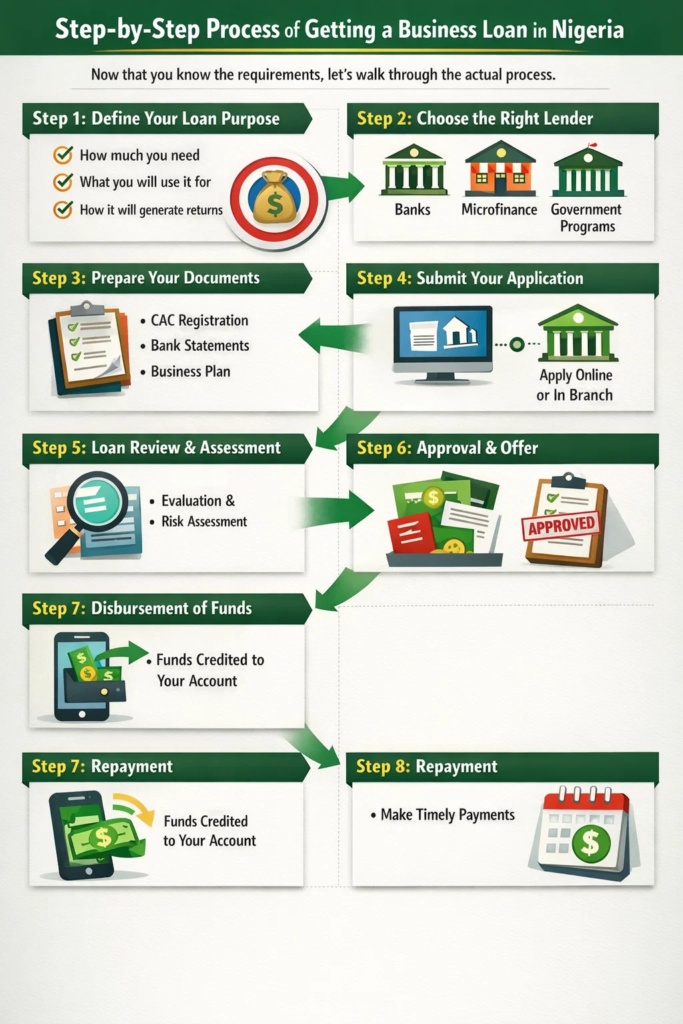
Step 1: Define Your Loan Purpose
Before approaching any lender, be clear about:
- How much you need
- What you will use it for
- How it will generate returns
Clarity increases your credibility.
Step 2: Choose the Right Lender
Different lenders serve different needs:
- Banks – Larger loans, stricter requirements
- Microfinance – Easier access, smaller amounts
- Government programs – Lower interest rates
Choose based on your business stage and needs.
Step 3: Prepare Your Documents
Gather all required documents in advance:
- CAC registration documents
- Bank statements
- Business plan
- Financial records
Being prepared speeds up the process.
Step 4: Submit Your Application
You can apply:
- Online (through bank websites or apps)
- In person at a bank branch
Ensure all information is accurate and complete.
Step 5: Loan Review and Assessment
The bank will evaluate:
- Your business performance
- Your repayment ability
- Your risk level
This stage may include interviews or additional documentation requests.
Step 6: Approval and Offer
If approved, you’ll receive:
- Loan amount
- Interest rate
- Repayment terms
- Conditions
Read everything carefully before accepting.
Step 7: Disbursement of Funds
Once you accept the offer, the loan is credited to your account.
Step 8: Repayment
Repay according to the agreed schedule:
- Monthly or quarterly payments
- Automated deductions in some cases
Timely repayment builds your credibility for future loans.
Common Mistakes to Avoid When Applying for a Business Loan in Nigeria
The applications of Many business loan in Nigeria are rejected not because the businesses are bad, but because of avoidable mistakes that raise red flags for lenders. Banks are primarily concerned with one thing: risk. If your application suggests uncertainty, inconsistency, or poor planning, your chances of approval drop significantly.
Let’s break down these common mistakes and understand how to avoid them:
1. Applying Without a Clear Business Plan
One of the biggest mistakes entrepreneurs make is applying for a loan without a well-structured business plan. Saying you need money “to grow your business” is simply not enough.
Why this is a problem:
Banks want to know:
- What exactly you will use the money for
- How that investment will generate income
- How you plan to repay the loan
Without this clarity, your application appears risky and unstructured.
How to avoid it:
Create a detailed but simple business plan that includes:
- Your business model
- Target market
- Revenue strategy
- Specific use of funds (e.g., “buying 3 industrial sewing machines”)
- Clear repayment plan
A strong business plan shows that you are not just passionate you are prepared.
2. Mixing Personal and Business Finances
This is extremely common among small business owners in Nigeria, and it’s a major red flag for lenders.
Why this is a problem:
When your personal and business transactions are mixed:
- It becomes difficult to track actual business performance
- Banks cannot accurately assess your cash flow
- It suggests poor financial discipline
How to avoid it:
- Open a dedicated business account
- Route all business income and expenses through that account
- Avoid withdrawing money randomly without records
Clear financial separation makes your business look organized, transparent, and credible.
3. Providing Incomplete or Inaccurate Information
Some applicants rush their loan applications or even provide incorrect details—either intentionally or by mistake.
Why this is a problem:
- Banks verify the information you provide
- Inconsistencies can delay or completely cancel your application
- It damages trust between you and the lender
How to avoid it:
- Double-check all documents before submission
- Ensure names, figures, and dates match across all records
- Be honest about your business performance—even if it’s not perfect
Accuracy builds trust, and trust increases your chances of approval.
4. Borrowing More Than You Can Repay
It’s tempting to request a large loan, especially when you have big plans for your business. But over-borrowing is one of the fastest ways to get into trouble.
Why this is a problem:
- Higher loan amounts mean higher repayment obligations
- If your cash flow cannot support repayments, you risk default
- Banks may reject your application if the amount seems unrealistic
How to avoid it:
- Borrow based on your actual needs not your ambitions alone
- Calculate how much your business can comfortably repay monthly
- Start small if you’re unsure, and build up over time
Smart entrepreneurs focus on sustainability, not just expansion.
5. Ignoring Loan Terms and Conditions
Many borrowers are so focused on getting the loan that they don’t carefully review the terms attached to it.
Why this is a problem:
- You may overlook high interest rates or hidden charges
- You might agree to unrealistic repayment timelines
- Default penalties can be severe
How to avoid it:
Before accepting any loan:
- Read all terms carefully
- Ask questions if anything is unclear
- Understand the interest rate, repayment schedule, and penalties
Remember: A loan you don’t understand can become a burden instead of a solution.
6. Poor Financial Record Keeping
Even if your business is doing well, poor record keeping can make it look unreliable.
Why this is a problem:
- Banks rely on financial data to make decisions
- Lack of records makes your business appear disorganized
- It reduces your credibility
How to avoid it:
- Keep track of all sales and expenses
- Maintain basic financial statements
- Use simple accounting tools or hire an accountant if possible
Good records tell a powerful story about your business make sure it’s a positive one.
7. Applying to the Wrong Lender
Not all lenders are suitable for every business. Applying to the wrong one can lead to unnecessary rejections.
Why this is a problem:
- Some banks prefer established businesses.
- Others are more startup-friendly.
- Requirements vary widely.
How to avoid it:
- Research lenders before applying.
- Match your business stage with the right institution.
- Consider microfinance banks or government programs if you’re just starting out.
Choosing the right lender can make the difference between rejection and approval.
Insider Tips to Get Approved Faster
- Start with a smaller loan if you’re new
- Build a strong relationship with your bank
- Maintain consistent cash flow
- Keep your records clean and updated
- Apply to lenders that match your business size
Frequently Asked Questions (FAQs)
1. Can I get a business loan without collateral in Nigeria?
Yes, some banks and microfinance institutions offer collateral-free loans, especially for smaller amounts.
2. How long does it take to get a business loan?
- Traditional banks: 1–4 weeks
- Digital lenders: 24–72 hours
3. What is the minimum amount I can borrow?
Some lenders offer loans as low as ₦50,000, while banks may start from higher amounts.
4. Do I need a business plan to get a loan?
Yes, especially for startups. It helps lenders understand your business and repayment strategy.
5. What happens if I can’t repay the loan?
You may face:
- Penalties and increased interest
- Loss of collateral
- Negative credit record
Conclusion
Getting a business loan in Nigeria may seem complicated at first, but once you understand the requirements and follow the right process, it becomes much more manageable. The key is preparation having your documents ready, maintaining financial discipline, and presenting your business as a credible investment.
More importantly, access to funding is no longer as limited as it used to be. With multiple banks, fintech platforms, and government-backed programs available, entrepreneurs now have more opportunities than ever to secure the capital they need to grow.
At the end of the day, a loan is not just money it’s a tool. When used wisely, it can help you expand your business, increase your income, and achieve long-term success. So take that step, prepare properly, and position your business for the growth it deserves.