


Picture this. It is 11pm on a Tuesday night. Your shop is closed, your staff has gone home, and you are relaxing at home after a long day. Meanwhile, somewhere in Abuja, a customer who just saw your Instagram page is trying to buy one of your products. They want it now. They are ready to pay right now.
But there is nowhere to send them. No link to click. No checkout to complete. No order to place. So they close the app, forget about you by morning, and buy from someone else who has an online shop ready and waiting.
That scenario plays out thousands of times every day across Nigeria, and it represents real money leaving the pockets of business owners who have not yet taken the step of creating an online shop.
The good news is that creating an online shop for your Nigerian business in 2026 is not the complicated, expensive, technical undertaking it used to be. You do not need to hire a web developer. You do not need to understand code. You do not need a big budget. What you need is clarity about what you are selling, the right platform for your business, and the willingness to set things up properly.
This guide walks you through how to create an online shop, step by step, in plain language that makes sense whether you are a fashion seller in Lagos, a food business owner in Enugu, a cosmetics brand in Abuja, or a service provider in Port Harcourt.
Let us get your business online and selling.
Why Every Nigerian Business Needs an Online Shop in 2026
Before we get into the how, a quick word on the why. Because some Nigerian business owners still wonder whether an online shop is really necessary for them specifically, whether their customers actually shop online, and whether the effort is worth it.
Here are the numbers that answer that question.
Nigeria had over 84 million internet users in 2025, and the number continues to grow every year. E-commerce transactions in Nigeria were valued at over $12 billion and growing. More than 60 percent of Nigerian consumers research products online before making a purchase decision, even if they eventually buy in a physical store.
Your customers are online. They are searching for what you sell. The question is whether they find you or your competitor when they look.
An online shop does four things for your Nigerian business that a physical shop or a social media page alone cannot do.
It keeps your business open and earning twenty-four hours a day, seven days a week, including nights, weekends, and public holidays. It gives customers across Nigeria, not just those in your immediate neighbourhood, the ability to buy from you. It builds credibility because a business with a proper online shop looks significantly more established and trustworthy than one with only a WhatsApp number. And it creates a sales system that works even when you are not actively selling.
How to Create an Online Shop
Step 1: Get Clear on What You Are Selling and Who You Are Selling To
This sounds obvious, but skipping this step is one of the most common reasons Nigerian online shops underperform after launch. Before you choose a platform or upload a single product, get absolutely clear on two things.
What are you selling? Not just the category, but specifically the products or services, the price points, the variants (sizes, colours, flavours, and so on), and what makes your offering different from what is already available online. The clearer you are on this, the better your product listings will be, and the more confidently your customers will buy.
Who is your ideal customer? Be specific. A fashion shop targeting young professional women in Lagos aged 25 to 35 who earn ₦150,000 to ₦400,000 per month and follow lifestyle content on Instagram has a much clearer marketing target than one targeting women generally. Knowing your customer determines everything from how you write your product descriptions to which platform you choose to which payment methods you offer.
For service-based businesses, this step is equally important. A legal consulting firm in Abuja setting up an online shop to sell document templates and consultation bookings needs to know which clients it is targeting and what specific problems it is solving before it can build a shop that converts visitors into buyers.
Step 2: Choose the Right Platform for Your Online Shop
This is the most consequential decision in the entire process. Different platforms suit different types of Nigerian businesses, and choosing the wrong one creates unnecessary complexity and limits your ability to grow.
Here is an honest breakdown of the main options available to Nigerian business owners.
Option 1: Your Own Website Using Shopify or WooCommerce
Best for: Businesses that want full control, a professional branded experience, and long-term scalability.
Shopify is the world’s most popular e-commerce platform, and it works in Nigeria. It gives you a fully functional online shop with payment processing, inventory management, shipping integration, and a professional storefront under your own domain name. Monthly plans start from approximately $29 per month, which at current exchange rates represents a meaningful but justifiable investment for a business generating consistent sales.
WooCommerce is a free e-commerce plugin for WordPress websites. It is free to install but requires a WordPress hosting subscription and more technical setup than Shopify. For businesses that already have a WordPress website or want maximum customisation control, WooCommerce is worth considering.
The advantage of both platforms is that your shop is completely yours. No marketplace fees, no competition from other sellers on the same page, and a branded experience that builds your business identity with every customer interaction.
Option 2: Bumpa
Best for: Nigerian small and medium businesses that want a fully functional, locally built online shop designed specifically for how Nigerian businesses operate.
If there is one platform on this list that was built with the Nigerian business owner in mind from the ground up, it is Bumpa. And that distinction matters more than it might initially seem.
Bumpa is a Nigerian e-commerce platform that allows business owners to create a professional online shop, manage their inventory, track their sales, process orders, and communicate with customers, all from a single app on their smartphone. No laptop required. No web developer needed. No complicated setup process. Just a Nigerian business tool built for the way Nigerian entrepreneurs actually work.
What makes Bumpa particularly compelling for Nigerian small businesses is the combination of features it packs into a genuinely accessible experience.
- Your own branded online shop link that you can share on Instagram, WhatsApp, TikTok, and anywhere else your customers find you, directing them straight to a professional storefront with your name, your logo, and your products presented cleanly
- Inventory management that tracks your stock in real time, so you always know what you have available and never accidentally sell something you cannot fulfil
- Order management that keeps every customer order organised in one place, from the moment it is placed to the moment it is delivered
- Payment processing through integrated Nigerian payment gateways, so your customers can pay by card, bank transfer, or USSD without leaving your shop
- Sales records and business reports that give you a clear picture of your revenue, your best-selling products, and your business performance over time
- Customer management that keeps your buyer information organised and accessible for follow-up marketing and relationship building
For fashion sellers in Lagos, beauty product businesses in Abuja, food vendors in Port Harcourt, and small retail businesses across Nigeria, Bumpa removes the technical barriers that have historically made creating an online shop feel out of reach. If you can use WhatsApp, you can use Bumpa.
Bumpa offers a free plan that gives new businesses enough functionality to start selling online immediately, with paid plans available as your business grows and your needs expand. For Nigerian businesses evaluating their options, Bumpa deserves serious consideration, particularly if you want a platform that understands the Nigerian market, supports naira natively, and was designed by people who know what it means to run a small business in this country.
Option 3: Selar
Best for: Nigerian digital product sellers, course creators, coaches, and service providers.
Selar is a Nigerian platform built specifically for creators and businesses selling digital products, online courses, memberships, and bookings. It handles naira payments natively through Paystack, delivers digital products automatically, and requires no technical knowledge to set up.
If you sell e-books, templates, online courses, consultation sessions, or any digital service, Selar is arguably the best platform available for reaching Nigerian buyers without the friction of international payment gateways that do not support naira well.
Option 4: Flutterwave Store
Best for: Nigerian small businesses that want a simple, quick online shop with reliable payment processing.
Flutterwave Store allows any Nigerian business to set up a basic online shop quickly using Flutterwave’s payment infrastructure. The setup is straightforward, Naira payments work seamlessly, and the platform is free to use, with Flutterwave’s standard transaction fees applying.
The limitation is that Flutterwave Store is relatively basic in terms of design and features compared to Shopify, WooCommerce, or Bumpa. But for a Nigerian small business that needs to start selling online quickly without significant investment, it is a practical and trusted starting point.
Option 5: Sell on Jumia or Konga as a Third-Party Seller
Best for: Product-based businesses that want immediate access to a large existing customer base.
Rather than building your own online shop from scratch, you can register as a seller on Jumia or Konga and list your products on their existing marketplace. The advantage is immediate access to their millions of active shoppers without having to build your own traffic from scratch. The trade-off is marketplace fees (typically 5 to 15 percent commission per sale), competition from other sellers of similar products, and limited ability to build your own brand identity within the marketplace.
For most serious businesses, the long-term goal should be your own online shop, but listing on Jumia or Konga simultaneously can generate sales while you build your own platform.
Option 6: Queposts
Best for: Nigerian businesses that want to combine a professional business listing with product discovery in one place.
Queposts is a next-generation business portal designed to help businesses, professionals, and consumers discover each other with ease. From company listings and classified ads to jobs, events, and industry content, Queposts connects people to opportunities locally and globally.
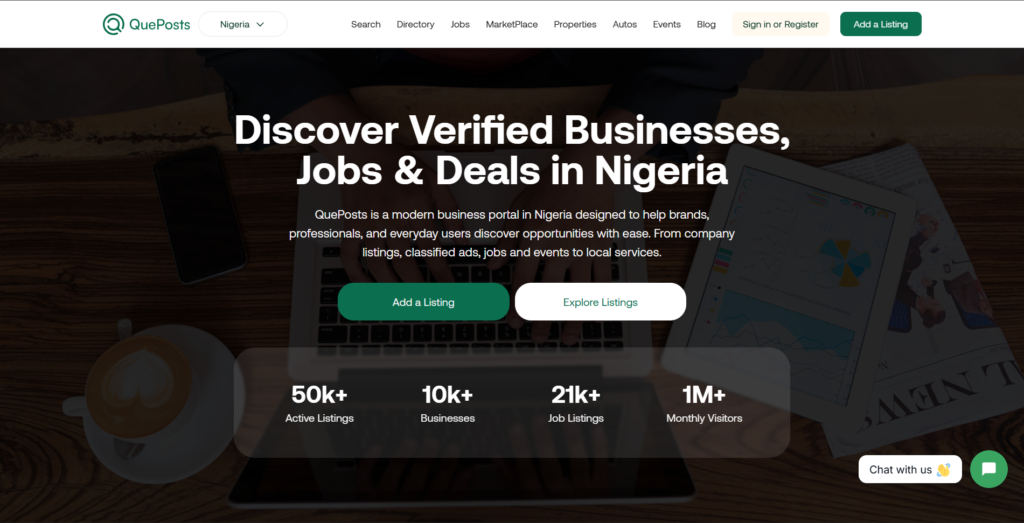
For Nigerian businesses creating their online presence, Queposts offers something that traditional e-commerce platforms do not. It is not just a product listing platform. It is a business discovery platform where potential customers find your business, understand what you do, and explore your products or services all in one place. Your Queposts listing works as both a professional business profile and a product showcase, making it particularly powerful for businesses that want to be discoverable locally and nationally without the complexity of building a full e-commerce website from scratch.
Getting listed on Queposts alongside your primary online shop creates an additional discovery channel that drives customers to your business from searches they are already making. Think of it as having your business and your products visible in one more place where motivated buyers are actively looking.
Step 3: Register Your Business and Set Up Payments
Before you launch your online shop to the Nigerian public, two foundational things need to be in place: your business registration and your payment processing.
Register Your Business With the CAC
Selling online in Nigeria as a business requires registration with the Corporate Affairs Commission. A registered business name or limited liability company gives your online shop legal standing, enables you to open a business bank account, and signals to customers that you are a legitimate, accountable operation.
Business name registration with the CAC can now be completed entirely online through the CAC portal and costs between ₦10,000 and ₦30,000, depending on your business type. It is one of the most worthwhile investments you will make in your online shop’s credibility.
Set Up Your Payment Processing
For Nigerian online shops, the two most widely trusted and technically reliable payment gateways are Paystack and Flutterwave. Both integrate seamlessly with major e-commerce platforms, including Shopify and WooCommerce, both support naira transactions, and both have strong buyer and seller protection mechanisms.
When setting up payments, consider offering multiple payment options because Nigerian customers have different preferences. Card payments through Paystack or Flutterwave, bank transfers, and USSD payments cover the widest range of customers and remove friction from the checkout process.
For businesses that sell internationally, ensure your payment gateway supports foreign currency transactions if you want to accept payments from Nigerian diaspora customers or international buyers.
Step 4: Build Your Online Shop
With your platform chosen and your payment setup in place, it is time to actually build your shop. Here is what you need to do at this stage.
Choose and Customise Your Shop Design
Most e-commerce platforms offer pre-built templates that you can customise with your brand colours, logo, and fonts without any design or coding knowledge. Choose a clean, professional template that puts your products front and centre and works well on mobile devices, because the majority of Nigerian online shoppers browse and buy on their smartphones.
If you chose Bumpa, this step is particularly straightforward. The app walks you through setting up your shop profile, uploading your logo, choosing your brand colours, and configuring your shop link in a process that takes most Nigerian business owners less than thirty minutes to complete. Everything is optimised for mobile from the start because Bumpa was built with the understanding that most Nigerian business owners manage their entire operation from a smartphone.
For Shopify or WooCommerce users, browse the available templates and choose one that suits your product type and brand personality. Avoid templates that are overly complex or heavy with animations, as these can slow down your page load speed significantly on Nigerian mobile data connections.
Keep your design clean and uncluttered regardless of which platform you use. Nigerian online shoppers, like shoppers everywhere, make fast judgements about credibility based on visual presentation. A clean, professional-looking shop signals that your business is trustworthy. An overcrowded, confusing layout drives visitors away before they even look at your products.
Write Product Listings That Actually Sell
This is where most Nigerian online shops lose sales they should be making. Poor product listings with minimal descriptions, bad photos, and vague pricing create doubt and friction that prevent customers from completing purchases.
A strong product listing for your Nigerian online shop includes:
A clear, specific product name. Not just “Bag” but “Handwoven Ankara Tote Bag, Medium Size, Available in 5 Colours.” Specificity reduces confusion and improves your shop’s searchability.
High-quality photos from multiple angles. You do not need a professional photographer. A clean background, good natural light, and a decent smartphone camera are enough to take product photos that convert. Show the product being used or worn where relevant. Nigerian customers want to visualise how a product looks in real life. Bumpa users can upload product photos directly from their phone camera within the app, making this step seamless for businesses managing everything on mobile.
A detailed, honest description. Tell the customer exactly what they are getting. Dimensions, materials, weight, colour options, what is included in the package, and anything else that helps them make a confident buying decision. Address the questions a buyer would ask before paying.
Clear pricing in naira. Never make customers calculate or guess. State the price prominently and include any delivery costs, or make it clear that delivery is calculated at checkout.
Stock availability. Let customers know if an item is in stock, available to order, or temporarily out of stock. Uncertainty about availability creates abandonment. Bumpa’s built-in inventory tracking automatically updates your stock levels as orders come in, removing the manual work of keeping this information current across your shop.
Set Up Your Delivery and Shipping Options
Decide how you will fulfil orders before you launch, not after you start receiving them. For Nigerian online shops, the main fulfilment options are:
- Self-delivery within your city using a motorcycle or car
- Third-party logistics companies like GIG Logistics, Kwik Delivery, or Sendbox for within-city and intercity delivery
- Pickup from your physical location or a designated pickup point
- For digital products, automatic delivery through your platform
Bumpa integrates with Nigerian logistics providers, allowing you to manage delivery bookings and order tracking directly within the app rather than juggling multiple platforms simultaneously. For businesses managing high order volumes from a smartphone, this integration is a genuine operational advantage.
Display your delivery areas, timelines, and costs clearly on your shop. One of the most common reasons Nigerian online shoppers abandon carts is uncertainty about whether the seller delivers to their location and how long it will take.
Step 5: Launch Your Online Shop
Before you announce your shop to the world, run through a pre-launch checklist to make sure everything works properly.
Go through the entire purchase process yourself as if you were a customer. Add a product to the cart, proceed to checkout, enter payment details using a test card if your platform supports it, and confirm that the order confirmation process works correctly. Check that your payment gateway is receiving funds properly by making a small real transaction if necessary.
Test your shop on both desktop and mobile. Since most of your Nigerian customers will visit on a smartphone, the mobile experience matters more than the desktop version for most businesses.
Check all your product photos load correctly and quickly. Slow-loading images frustrate Nigerian shoppers on mobile data connections and increase the chance they abandon your shop.
Confirm your delivery settings are configured correctly and that the right delivery fees are being calculated for the right locations.
Once everything checks out, you are ready to launch.
Step 6: Drive Traffic to Your Online Shop
Creating your online shop is only half the work. The other half is getting the right people to visit it. An online shop that nobody visits generates zero sales regardless of how good the products are.
Here are the most effective traffic strategies for Nigerian online shops in 2026.
Social media content marketing. Instagram, TikTok, and Facebook remain the primary discovery channels for Nigerian e-commerce. Post consistently, showcase your products compellingly, share customer testimonials, and always include a link to your online shop in your bio and in every relevant post caption. Your social media presence is the front door that leads customers to your online shop.
WhatsApp marketing. Build a broadcast list of existing and potential customers and update your WhatsApp Status daily with products, promotions, and your shop link. Nigerian buyers who trust you enough to have your number saved are among your most valuable sales opportunities.
Google Business Profile. A free Google Business Profile listing that links to your online shop helps local Nigerian customers find you when they search for products or services in your category. For businesses with a physical location alongside their online shop, this is particularly powerful.
Queposts listing. As mentioned earlier, a complete Queposts business and product listing creates an additional discovery channel that drives motivated buyers to your online shop from searches they are already making on the platform.
Paid social media advertising. Once your shop is generating some organic sales and you understand which products resonate most with your audience, investing in targeted Facebook and Instagram ads can significantly accelerate your growth. Even a modest budget of ₦5,000 to ₦20,000 per week on well-targeted ads can drive meaningful traffic to a well-optimised Nigerian online shop.
For a deeper dive into cost-effective marketing strategies that work specifically for Nigerian small businesses, our comprehensive guide on Smart Ways to Advertise Your Small Business on a Tight Budget covers everything from free digital channels to low-budget paid strategies in detail.
Step 7: Manage and Grow Your Online Shop
Launching your shop is the beginning, not the finish line. The Nigerian online shops that generate consistent, growing income are the ones whose owners treat management and growth as ongoing priorities rather than occasional activities.
Manage Your Inventory Actively
Nothing damages customer trust faster than placing an order for a product that is out of stock. Keep your inventory updated in real time. When a product sells out, update your shop immediately. When new stock arrives, add it promptly. Customers who find a well-stocked, up-to-date shop return more frequently than those who discover outdated listings on their first visit.
Respond to Customer Enquiries Quickly
Nigerian online shoppers often have questions before they buy, and the speed and quality of your response directly affect whether they complete a purchase or go elsewhere. Check your shop’s messaging system, your Instagram DMs, and your WhatsApp regularly throughout the day and aim to respond to every enquiry within a few hours at most.
Collect and Display Customer Reviews
Social proof is enormously powerful in the Nigerian market. A potential customer who sees genuine positive reviews from previous buyers is significantly more likely to complete their purchase than one who finds a shop with no reviews at all. After every successful order, follow up with the customer and ask them to leave a review on your shop or your social media pages.
Track Your Sales and Understand Your Data
Most e-commerce platforms provide basic analytics showing you which products are selling best, where your traffic is coming from, what your conversion rate is, and where in the purchase process customers are dropping off. Review these numbers regularly and use them to make better decisions about your product selection, your pricing, and your marketing.
Keep Improving Your Shop
The best Nigerian online shops are constantly evolving. Better photos, clearer descriptions, more competitive pricing, faster delivery options, improved customer service, and smarter marketing all compound over time into a significantly better customer experience and higher sales volume. Treat your online shop as a living business asset that rewards ongoing investment and attention.
Final Thoughts
Creating an online shop for your Nigerian business is one of the highest-return investments you can make in 2026. It extends your reach beyond your immediate neighbourhood, keeps your business earning around the clock, builds credibility with new customers who find you online, and creates a sales system that grows as your marketing grows.
The process is more straightforward than most Nigerian business owners expect. Choose the right platform for your business type. Set up your payments properly. Build product listings that make customers want to buy. Launch when everything is tested and working. Market consistently and track your results.
And make sure you are visible everywhere your customers are looking, on social media, on Google, and on platforms like Queposts where Nigerian businesses and consumers are actively discovering each other every day.
Your online shop is not just a website. It is your business working for you every hour of every day, serving customers you have never met, in cities you have never visited, while you sleep.
Start building it today.