


There is a temptation, when studying how the world’s most successful companies market themselves, to conclude that their strategies are too sophisticated, too expensive, or too dependent on resources that Nigerian businesses simply do not have. That conclusion is almost always wrong.
The best marketing strategies in the world are not built on unlimited budgets. They are built on clear thinking about customers, disciplined execution across the right channels, and a consistency that most businesses, regardless of size, find difficult to sustain. What Apple, Coca-Cola, Amazon, and Dangote have in common is not money. It is clarity. They know exactly who they are selling to, what those people care about, what their brand stands for, and how to communicate it in a way that feels consistent across every touchpoint.
That kind of clarity is available to every Nigerian business owner willing to think carefully and act intentionally. This guide breaks down the best marketing strategies that have built some of the world’s most successful companies and shows specifically how Nigerian businesses can adapt and apply them in a market that rewards authenticity, relationships, and smart digital execution.
Content Marketing: Teach First, Sell Second
If there is one marketing strategy that has produced the most dramatic and sustainable results for companies across every industry globally, it is content marketing. The principle is deceptively simple: create and share information that is genuinely useful to your target customer, build trust and authority through that usefulness, and allow that trust to convert into sales over time.
HubSpot, the American software company, built a business worth billions of dollars largely on the back of this strategy. Rather than spending its early years primarily on traditional advertising, HubSpot invested in creating some of the most useful marketing and sales educational content on the internet. Business owners came for the free guides, templates, and articles. They stayed because the content made them better at their jobs. And when they were ready to buy software that could help them execute what they had learned, HubSpot was the company they already trusted.
The application for Nigerian businesses is direct. An accountant in Lagos who publishes practical articles about tax planning for Nigerian SMEs becomes the accountant those SME owners think of when they need one. A furniture manufacturer in Ibadan that creates content about how to choose durable furniture for Nigerian weather conditions and how to care for different wood types builds authority in a market crowded with generic social media promotions. A logistics company that publishes guides about customs clearance, e-commerce shipping, and documentation requirements for Nigerian exports earns the trust of exactly the kind of businesses it wants as clients.
Content marketing in Nigeria does not require a large team or expensive tools. It requires that you know your customer well enough to know what questions they are asking before they buy, and that you are willing to answer those questions clearly and consistently. Written blog articles, short videos, practical guides, and even well-considered social media posts are all forms of content marketing when they prioritise the audience’s needs over the business’s immediate promotional goals.
The formats that perform best for Nigerian businesses depend on the audience. Short videos on Instagram and TikTok reach younger, more urban consumers. Written content on a website supports SEO and reaches buyers who research thoroughly. YouTube builds depth and trust with audiences who want to understand a product or service before committing. The format matters less than the consistency and the genuine usefulness of what you create.
Brand Consistency: The Strategy That Most Nigerian Businesses Undervalue
Walk into any McDonald’s anywhere in the world, and you already know what to expect before you see the menu. The colours are the same. The experience follows a familiar pattern. The brand communicates the same things whether you encounter it on a billboard in New York, a delivery box in Lagos, or a TV commercial in Dubai. That consistency is not accidental. It is one of the most deliberate and valuable marketing investments a company can make.
Brand consistency means that every touchpoint a customer has with your business, your social media pages, your packaging, your office or shop front, your invoices, your staff uniforms, your website, your WhatsApp profile, all of them communicate the same visual identity and the same brand personality. When a customer encounters your business across multiple channels, and it looks and feels the same everywhere, it builds familiarity. Familiarity builds trust. Trust accelerates purchase decisions.
The practical implication for Nigerian businesses is simple and often overlooked. Decide on your brand colours and use them consistently. Develop a logo that works across digital and print applications, and do not casually redesign it every year. Establish a tone of voice for your communications, whether formal and professional or warm and conversational, and train everyone who communicates on behalf of your business to use it. Create a simple brand guide, even a one-page document, that ensures consistency across all materials.
Many Nigerian small businesses have excellent products and genuinely satisfied customers, but their marketing materials look different every week because they are designed on the fly in response to each immediate need. The cumulative effect of that inconsistency is that customers do not build a strong mental picture of the brand, and without that picture, referrals are harder, recall is lower, and the business has to reintroduce itself every time rather than building on familiarity.
Customer Retention: The Strategy Most Companies Get Right That Most Businesses Ignore
Amazon did not become the world’s largest e-commerce company by continuously chasing new customers. It became that company largely by making existing customers so satisfied with the experience that they bought more frequently, spent more per transaction, and referred their friends and colleagues.
Research consistently shows that selling to an existing customer costs between five and seven times less than acquiring a new one, and that existing customers are more likely to try new products and to forgive occasional service failures than new customers are. The businesses that grow most efficiently are those that have built strong retention strategies alongside their acquisition marketing.
For Nigerian businesses, customer retention is both a commercial priority and a cultural one. In a relationship-driven market like Nigeria, satisfied customers who feel genuinely valued are among your most powerful marketing assets. They refer people. They advocate for you in conversations you are not part of. They give you the benefit of the doubt when something goes wrong because the relationship you have built earns that goodwill.
Practical retention strategies for Nigerian businesses include personalised follow-up after purchases, whether by phone, WhatsApp, or email, to confirm that the customer is satisfied. Loyalty programmes that reward repeat business with discounts, early access, or exclusive benefits. Regular communication that provides value rather than only asking for sales. And a genuine commitment to resolving complaints quickly and generously when they arise.
The business owner who calls a customer two weeks after a purchase to check that everything is well does something that almost no competitor does and creates a lasting impression that no advertising campaign can replicate at the same cost.
Influencer and Word-of-Mouth Marketing: The Strategy That Built Gymshark
Gymshark, the British fitness apparel brand, grew from a teenager’s bedroom in Birmingham to a billion-dollar company without a single penny of traditional advertising in its early years. Its entire growth engine was built on relationships with fitness influencers and content creators who wore and promoted the brand to audiences that trusted them completely.
The Nigerian equivalent of this strategy is both accessible and exceptionally effective in a market where personal trust and recommendation carry enormous weight. Nigerian consumers, particularly in fashion, beauty, food, lifestyle, and entertainment, are heavily influenced by the people they follow and respect online. A genuine endorsement from a creator whose audience aligns with your target market often converts at rates that paid advertising cannot match, precisely because it carries the weight of a personal recommendation rather than the transparent motivation of a commercial transaction.
The most important word in that last sentence is genuine. Influencer marketing works in Nigeria when the partnership is authentic and the creator actually uses and believes in the product. It becomes expensive noise when it is clearly a paid promotion with a creator who has no real connection to what they are endorsing.
For most Nigerian SMEs, the highest-return influencer partnerships are not with celebrities or mega-influencers but with micro and nano influencers, creators with between one thousand and fifty thousand followers who have built deeply engaged communities in specific niches. A beauty brand partnering with a skincare educator who has fifteen thousand highly engaged Instagram followers will often see better conversion rates than the same brand partnering with a celebrity who has two million followers but a predominantly passive audience.
Beyond paid influencer partnerships, the broader word-of-mouth strategy involves systematically creating conditions in which your customers want to talk about your business. Remarkable packaging that people photograph and share. Customer service that genuinely surprises people with its warmth and attentiveness. A product that delivers more than it promises. These are not accidental outcomes. They are marketing decisions made at the product and service design stage.
Data-Driven Marketing: Making Decisions Based on Evidence
One of the clearest differences between companies that consistently grow and those that plateau is how they make marketing decisions. Growing companies use data. Plateauing companies use guesswork dressed up as instinct.
Netflix decides what content to produce based on detailed analysis of what its subscribers watch, when they watch it, and what makes them continue watching rather than cancelling. Coca-Cola tracks brand sentiment, purchase frequency, and market share across dozens of metrics to guide its marketing investments. These are not approaches available only to large corporations. The underlying principle, making decisions based on evidence rather than assumptions, is available to every business with access to a smartphone and a free analytics platform.
For Nigerian small businesses, data-driven marketing starts with Google Analytics on your website, which shows you where your traffic comes from, what pages people visit, and what they do before they leave. It includes the insights tools inside your Instagram and Facebook pages, which show you which posts generate the most reach, engagement, and website clicks. It includes tracking which WhatsApp broadcasts generate the most responses. And it includes the simple discipline of asking every new customer how they heard about your business and recording that answer.
These data points, gathered consistently and reviewed regularly, tell you what is working and what is not. They tell you which marketing channels are generating customers and which are generating only vanity metrics. They allow you to cut spending on what is not working and increase it on what is, a discipline that consistently improves marketing ROI over time, regardless of the size of the budget.
According to HubSpot’s State of Marketing Report, businesses that prioritise data-driven decision-making are more than twice as likely to report strong ROI from their marketing investments than those that do not. The tools to do this are largely free. The discipline is the only investment required.
Emotional Marketing: Why People Buy Feelings, Not Features
Apple does not sell computers. It sells the feeling of being creative, original, and different from the crowd. Nike does not sell shoes. It sells the feeling of athletic achievement and personal ambition. Coca-Cola does not sell soft drinks. It sells moments of happiness shared with people you love.
The most successful marketing campaigns in history are not built around features and specifications. They are built around how a product or service makes people feel, how it connects to their identity, their aspirations, and their values. This is not manipulation. It is a recognition of the basic truth that human purchasing decisions are fundamentally emotional and that rational justification usually comes after the emotional decision has already been made.
For Nigerian businesses, emotional marketing is not a foreign concept. It is embedded in how the market already works. Nigerians buy from people they like and trust. They pay more for products that signal quality and status to their peers. They respond strongly to brands that acknowledge their cultural identity, speak their language, celebrate their traditions, and reflect their aspirations.
A Nigerian food brand that anchors its marketing in the pride and joy of gathering family around a meal speaks to something far deeper than the taste of its product. A fashion brand that celebrates traditional textiles and the craftsmanship of Nigerian artisans connects with an identity that its target customers hold deeply. A financial services company that frames its products around providing security for the people you love taps into a motivator that drives purchasing decisions far more effectively than interest rates and fee structures.
The emotional core of your marketing does not replace clear communication about what you offer and why it is good. It amplifies it. A product that is genuinely excellent and marketed to the emotional motivations of its buyer is close to unstoppable.
Omnichannel Marketing: Meeting Customers Wherever They Are
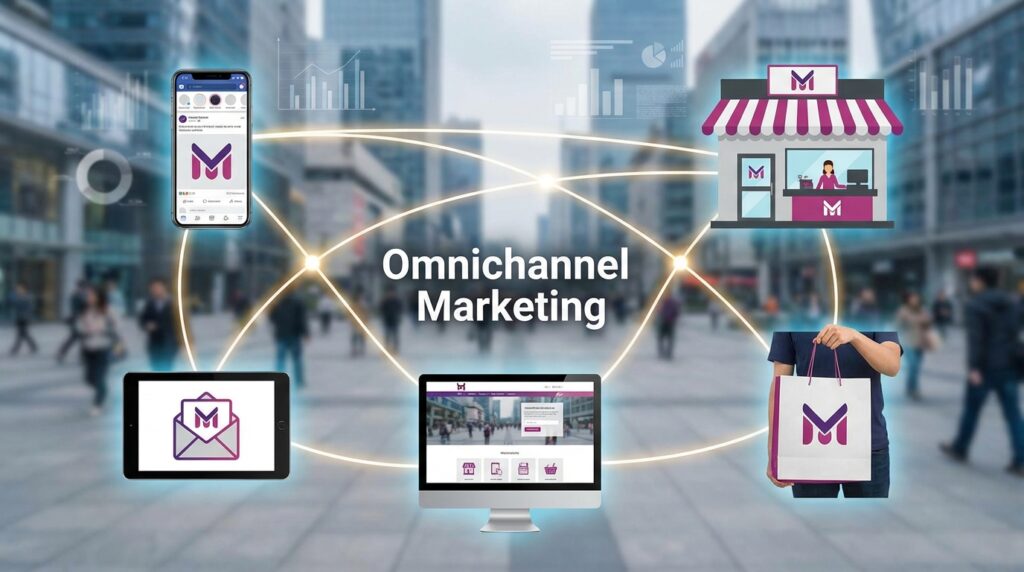
The companies that dominate their markets in 2026 are not present on one channel. They are present everywhere their customers are, and they create a consistent experience across all of those channels. This is called omnichannel marketing, and it is one of the most important strategic shifts in how successful companies think about reaching and retaining customers.
For Nigerian businesses, omnichannel marketing means recognising that a potential customer might first encounter your brand on TikTok, visit your Instagram page to learn more, search for your business name on Google, find your listing on a discovery platform, and then send you a WhatsApp message before finally making a purchase. Each of those touchpoints needs to be present, consistent, and well-maintained, because a break in that chain at any stage loses the customer.
The practical implication is not that every Nigerian business needs to be equally active on every platform. It means identifying the three to five channels where your target customers are most likely to encounter you, and ensuring that each of those channels presents a consistent, professional, and complete picture of your business.
For most Nigerian small businesses, that combination includes a well-maintained social media presence on one or two primary platforms, a functional and mobile-optimised website, a Google Business Profile, a WhatsApp Business account, and a listing on a discovery platform that gives your business an additional layer of online visibility.
How Queposts Helps Nigerian Businesses Gain Visibility
Every marketing strategy in this guide works better when your business is easy to find and credible when found. This is the gap that Queposts fills for Nigerian businesses at every stage of growth.
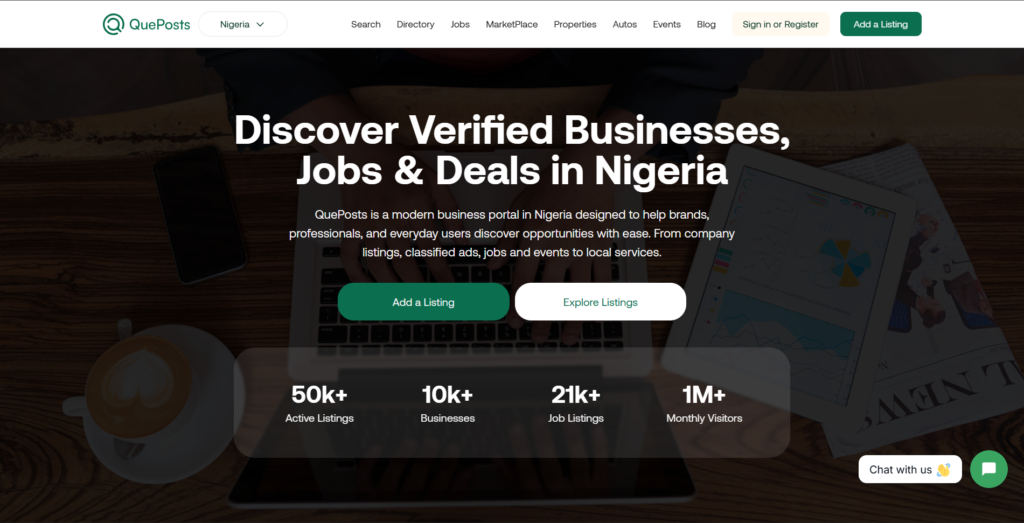
Queposts is a modern business portal built for local and global discovery. For Nigerian businesses investing in marketing, it serves as a permanent, professional online presence that complements everything else you are doing to attract customers.
Think about how the best marketing strategies described in this guide send people toward your business. Your content marketing brings people from Google searches. Your social media builds awareness and sends curious followers to learn more. Your influencer partnerships drive traffic from recommendations. In every case, some portion of those interested people will search your business name directly before making a decision to reach out or buy. What they find in that moment determines whether your marketing investment converts into a customer or loses them to a competitor who appears more established and credible.
A well-optimised Queposts listing gives those searchers exactly what they need. A professional business profile that confirms your legitimacy, communicates what you offer, provides your contact details, and signals that your business is real, active, and worth engaging with. In a market like Nigeria, where consumer trust is foundational to purchase decisions, that third-party validation carries genuine commercial weight.
For businesses targeting the diaspora market or international clients, Queposts’ reach across local and global audiences adds a dimension of visibility that most Nigerian businesses cannot achieve through local directories alone. A professional service firm, a property developer, or a manufacturing company listed on Queposts is accessible to potential clients searching for Nigerian businesses from anywhere in the world.
Unlike paid advertising that requires continuous spend to maintain visibility, your Queposts listing works for your business permanently. For small businesses building their marketing ecosystem with limited budgets, this kind of always-on visibility at a one-time investment is genuinely valuable.
The most successful companies in the world understand that marketing is not a single action but an ecosystem of touchpoints that work together to build trust and drive decisions. Queposts is one of those touchpoints, and for Nigerian businesses serious about visibility, it belongs in that ecosystem.
List your business on Queposts today and ensure that every customer your marketing reaches finds a business presence that matches the quality of the marketing that brought them there.
Putting These Strategies to Work for Your Nigerian Business
Reading about marketing strategies is the easy part. The harder part, and the part that actually produces results, is choosing the strategies that fit your business right now and executing them with enough consistency to see them work.
The temptation is to try everything at once. The reality is that most Nigerian businesses grow their marketing most effectively by doing one or two things very well before adding more. Choose the strategy that best matches where your business is right now. If you are early-stage and budget-constrained, content marketing and social media consistency are your highest-return starting points. If you have a growing customer base, investing in retention and referral systems will compound that growth efficiently. If you have a marketing budget to deploy, paid advertising guided by the data-driven discipline described in this guide will accelerate results across whatever organic foundation you have built.
For a comprehensive look at the digital channels and tactics that are producing results for Nigerian businesses across every budget level, the guides below cover both the strategic and the practical in detail.
Also Read:
Digital Marketing Strategies for Small Businesses in Nigeria: What Actually Works in 2026 — a channel-by-channel breakdown of the digital marketing approaches that are generating real results for Nigerian small businesses right now, from SEO and social media to WhatsApp marketing and paid advertising, with specific guidance on where to start based on your budget and business type.
How to Advertise Your Business for Maximum Exposure in Nigeria: A Complete Guide — if you are ready to invest in advertising your business across both digital and traditional channels, this guide covers every available option in the Nigerian market, from Facebook and Google ads to radio, influencer partnerships, and out-of-home advertising, with practical advice on budgeting and measuring results.
The Common Thread
Look carefully at every successful marketing strategy described in this guide, and you will find the same thing underneath all of them. Whether it is Apple’s emotional marketing, HubSpot’s content strategy, Amazon’s obsession with customer retention, or Gymshark’s influencer approach, the common thread is a deep and genuine understanding of the customer.
Not a demographic profile. Not a target market segment. A real understanding of what a specific person cares about, what problems they are trying to solve, what makes them feel confident enough to buy, and what kind of experience makes them want to come back and tell others.
Every marketing strategy is ultimately a vehicle for communicating that understanding back to the customer. The businesses that do it best make their customers feel seen, understood, and well-served. In Nigeria, as everywhere else, that feeling is what drives the decisions that build lasting businesses.
According to Nielsen’s Global Trust in Advertising Report, 88 percent of consumers worldwide trust recommendations from people they know above all other forms of advertising. In Nigeria, where personal trust is the foundation of commercial relationships, that number likely runs even higher. Build the kind of business that earns those recommendations, market it across the right channels with consistency and clarity, and the growth follows.
The strategies are available to you. The question is simply whether you are ready to apply them with the discipline they deserve.