

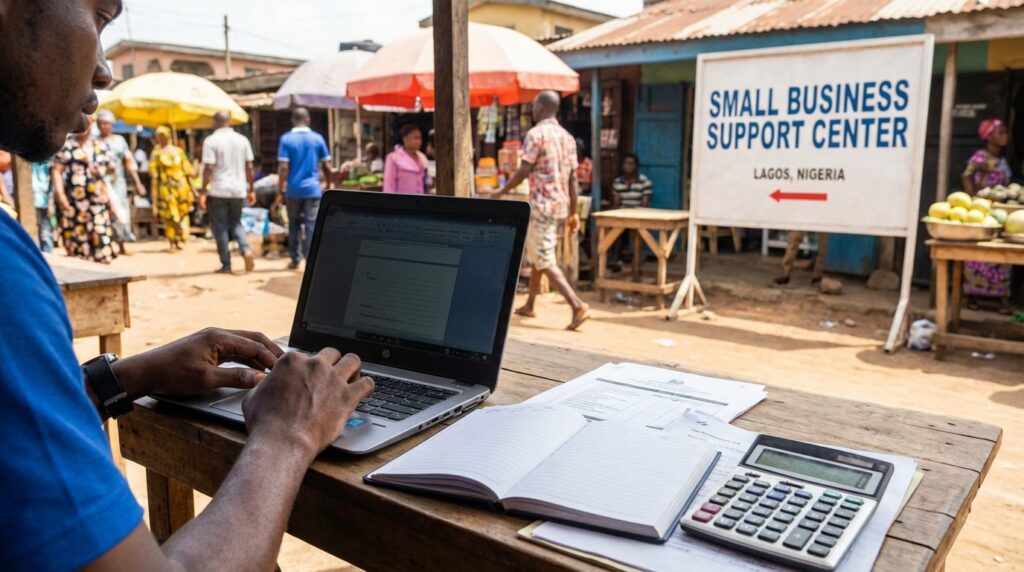

Let us be honest about something. Most Nigerian entrepreneurs have heard the word “grant” and felt one of two things: either quiet excitement at the idea of free funding or quiet scepticism that it is too complicated, too competitive, or simply not meant for someone like them.
Both reactions are understandable. Grants are real, they are available, and businesses across Nigeria receive them every year. But they do not come to those who wait. They come to those who understand the process, put in the work, and submit proposals that actually make a compelling case for funding.
This guide is about exactly that — how to write a grant proposal that gives your Nigerian business a genuine shot at winning. Not a template you copy and paste. Not vague advice about “being clear and concise.” A real, practical walkthrough of what grant committees look for, how to structure your proposal, what mistakes to avoid, and where to actually apply.
What a Grant Actually Is — and What It Is Not
Before writing a single word of your proposal, you need to understand what a grant is and what it demands of you.
A grant is funding given to a business, individual, or organisation to achieve a specific purpose, and unlike a loan, it does not need to be repaid. That makes it extraordinarily valuable. But it also means the organisations giving grants are highly selective. They are not giving away money out of generosity alone. They are investing in outcomes, social impact, economic development, job creation, innovation, and they want to fund businesses they believe will deliver those outcomes.
This is the mindset shift that changes everything about how you approach your proposal. You are not begging for money. You are presenting a compelling case that your business is the best vehicle for achieving results that the grant organisation already cares about. The moment you internalise that, your writing will change.
A grant is also not a magic solution for a business without a foundation. Grant committees, whether they are government bodies, development banks, NGOs, or corporate foundations, look for businesses that already show signs of viability. A strong idea, demonstrated commitment, a clear market, and at least some evidence of activity will always strengthen your application.
How to Write a Grant Proposal
Step One — Find the Right Grant Before You Write Anything
The most common mistake Nigerian entrepreneurs make is writing a generic proposal and sending it to every grant opportunity they find. This approach rarely works, and it is exhausting.
The right approach is the opposite: find a grant that genuinely fits your business, then write a proposal specifically designed for that grant’s stated goals and criteria.
Every grant has a mandate: a specific purpose it exists to serve. Some grants focus on women-owned businesses. Others prioritise agribusinesses, tech startups, youth entrepreneurs, or businesses in underserved states. Some require you to be registered with the CAC. Others have minimum or maximum revenue requirements. Read the eligibility criteria carefully before investing time in a proposal. If your business does not meet the criteria, no amount of good writing will save your application.
We will cover where to find Nigerian grants in detail later in this guide. For now, understand that the research phase, finding the right grant, reading the guidelines thoroughly, and confirming your eligibility, is not preparation for the work. It is the work.
Step Two — Understand Your Business Deeply Before You Write
Grant proposals ask you to describe your business, its impact, its financials, and its future. If you cannot answer these questions clearly and specifically, you are not ready to apply, and, more importantly, your business may not yet be ready either.
Before you open a blank document, sit with these questions and write out honest, detailed answers:
What problem does your business solve, and for whom? Not in abstract terms, but specifically. “I sell furniture” is not an answer. “I manufacture affordable, locally sourced wooden furniture for middle-income households in Ogun State who currently spend more on imported alternatives” is an answer.
What have you achieved so far? Customers served, revenue generated, jobs created, communities impacted, whatever evidence of traction you have, know it and quantify it.
What will this funding specifically enable? Grant committees are deeply suspicious of vague answers here. “Grow the business” is not an answer. “Purchase two additional sewing machines to increase monthly production capacity from 200 to 500 units and hire three additional tailors from our local community” is an answer.
What happens after the grant period? Funders want to know their investment leads to something sustainable. They are not interested in funding a business that will need another grant in six months to survive. Show them your path to self-sufficiency.
If working through these questions reveals gaps in your business, incomplete financial records, unclear impact data, or an uncertain growth plan, address those gaps before applying. A well-prepared business that applies for fewer grants tends to outperform an underprepared business that applies for many.
Step Three — The Structure of a Winning Grant Proposal
Most grant proposals follow a recognisable structure, though the exact format varies by funder. When guidelines are provided, follow them exactly. Deviating from the requested format is one of the fastest ways to have your application disqualified without being read.
When guidelines give you flexibility, the following structure represents the current best practice for Nigerian small business grant proposals.
The Executive Summary
Write this last, even though it appears first. Your executive summary should be a compelling one-page overview of everything in your proposal, your business, the problem you solve, what you are requesting, and what impact the funding will create. Many evaluators read the executive summary first and use it to decide whether the full proposal is worth their time. Make it count.
A strong executive summary answers five questions in as few words as possible: Who are you? What do you do and why does it matter? What do you need? What will you do with it? And what will change as a result?
Business Description
This section introduces your business to someone who knows nothing about it. Cover your business name, CAC registration status, location, industry, what you sell or provide, who your customers are, how long you have been operating, and your current size (staff, revenue range, reach).
Be specific and confident. Avoid the temptation to make your business sound bigger or more successful than it is; grant committees are experienced at spotting exaggeration, and it destroys credibility. An honest, clear description of a small but growing business is far more compelling than an inflated portrait of a business that does not match your supporting documents.
Problem Statement
This is where you establish why your business matters beyond just making money. What problem exists in your community, your industry, or your market that your business addresses? Why is that problem significant? What is the cost of leaving it unsolved?
The strongest problem statements are specific, evidence-based, and local. If you can cite statistics about unemployment in your state, the cost of imported goods your business replaces, or the number of people in your community without access to a service you provide, use them. Data does not just strengthen your argument; it signals that you have done your research and understand your environment.
Proposed Project or Business Plan
This is the heart of your proposal. Here, you explain exactly what you plan to do with the grant funding, step by step, with a timeline.
Be precise. If you are requesting ₦5 million to expand production, break down exactly what that money buys: equipment, labour, raw materials, logistics, working capital. Show that you have thought through the practicalities. A proposal that asks for a round number with no clear breakdown raises immediate red flags about whether the applicant actually understands their own business needs.
Include a timeline with clear milestones. “Month 1–2: Procure equipment. Month 3: Install and test. Month 4: Begin expanded production. Month 6: First revenue from expanded capacity.” This kind of specificity demonstrates planning rigour and makes evaluators feel confident that the money will be managed well.
Impact and Expected Outcomes
Grant funders are not investing in your business; they are investing in outcomes. This distinction should shape everything you write in this section.
Be specific about what you will deliver. How many jobs will be created? How many people will be served? How much local supply will be increased? How much will revenue grow? If the grant has social impact criteria, such as empowering women, reducing poverty, and supporting rural communities, show explicitly how your project addresses those criteria.
Wherever possible, express outcomes in numbers. “We expect to create employment for 12 people” is stronger than “we will create employment.” “We will serve an additional 300 households in Benue State” is stronger than “we will expand our customer base.” Specificity is credibility.
Financial Information
Many Nigerian small business owners feel anxious about this section because their financial records are not as formal as they should be. If that describes you, the most important thing you can do before applying for a grant is get your books in order, even if that means working with an accountant for a month to reconstruct and formalise your records.
Most grant applications ask for some combination of: your most recent financial statements (profit and loss, balance sheet), a project budget showing exactly how the grant funds will be used, and sometimes a sustainability plan showing how the business generates revenue beyond the grant period.
Your project budget should be detailed, realistic, and internally consistent. If your narrative says you will hire five people but your budget only includes salaries for three, that inconsistency will be noticed. Have someone who was not involved in writing the proposal review it for exactly these kinds of errors.
About You and Your Team
Funders back people as much as they back ideas. Your background, experience, and commitment to the business matter. Include a brief profile of yourself as the business owner — your relevant experience, your qualifications, and anything in your personal story that demonstrates a genuine connection to the problem your business solves.
If you have a team, introduce key members briefly. Even a small, dedicated team inspires more confidence than a solo founder with no support structure.
Step Four — Writing That Actually Persuades
Structure gets you through the door. Writing quality determines whether you walk through it.
Grant proposals are read by human beings, evaluators who read dozens or hundreds of applications and are looking for the ones that stand out. Yours will stand out if the writing is clear, honest, specific, and compelling. It will blend in, or be rejected, if it is vague, jargon-heavy, or generic.
Write in plain language. Avoid business school jargon, buzzwords, and abstract phrases. “We leverage synergistic frameworks to optimise stakeholder value” says nothing and signals that you are not comfortable with your own business. “We connect smallholder farmers in Plateau State directly to hotel buyers in Abuja, cutting out middlemen and increasing farmer income by an average of 40%” says everything.
Be specific at every turn. The word “significant” is almost always a sign that you should replace it with a number. “Significant growth” becomes “a projected 60% increase in monthly revenue.” “Many communities” becomes “17 communities across three local government areas in Ekiti State.”
Tell a story where it helps. Not every section needs a narrative, but the problem statement and the impact section benefit from a brief, vivid illustration of the real human situation your business addresses. If you run a school supplies business in a rural area, a single sentence about the reality of children going to school without basic materials lands harder than three paragraphs of statistics.
Proofread obsessively. Spelling errors, grammatical mistakes, and inconsistent numbers in a grant proposal are not minor; they signal carelessness, and carelessness is the quality grant committees are most afraid to fund. Read your proposal aloud. Have someone else read it. Fix every error before you submit.
Step Five — The Supporting Documents That Complete Your Application
A well-written proposal supported by weak documentation will not win. Most grant applications in Nigeria require some combination of the following:
Your CAC registration certificate: if you are not registered, many grants will not consider you. Registration is a basic signal of seriousness, and it is not expensive or complicated to complete.
Tax identification documents: your Tax Identification Number (TIN) from the Federal Inland Revenue Service (FIRS) is increasingly required for government and development bank grants.
Financial statements: profit and loss statements, bank statements, or audited accounts, depending on the grant’s requirements.
Proof of address: utility bills, lease agreements, or official correspondence addressed to your business location.
Passport photographs and valid ID: for the business owner and sometimes key team members.
Letters of support: Some grants, particularly those with community impact criteria, are strengthened by letters from local government officials, community leaders, or partner organisations confirming the need your business addresses.
Gather these documents before you begin writing your proposal, not after. Nothing is more frustrating than completing a strong proposal only to discover that a required document is missing or will take three weeks to obtain.
Where Nigerian Small Businesses Can Apply for Grants
Now to the part you came for. Here are the most credible and active grant opportunities available to Nigerian small businesses.
The Bank of Industry (BOI) runs multiple grant and loan programmes targeting SMEs across sectors, including manufacturing, agriculture, creative industries, and technology. Their Youth Entrepreneurship Support (YES) Programme and the Nigerian Youth Investment Fund (NYIF) are worth researching directly on their website.
The Tony Elumelu Foundation (TEF) runs one of the most well-known entrepreneurship programmes on the continent, offering seed funding of $5,000 alongside business training and mentorship to African entrepreneurs. Applications open annually, and Nigerian businesses have historically been among the strongest beneficiaries.
The Central Bank of Nigeria (CBN) administers several intervention funds, including the Agri-Business/Small and Medium Enterprise Investment Scheme (AGSMEIS) and the Creative Industry Financing Initiative (CIFI), which targets businesses in film, fashion, information technology, and music.
The Nigeria Export Promotion Council (NEPC) supports businesses with export potential through grants and capacity building programmes, particularly relevant if your business produces goods that could be sold internationally.
SMEDAN (Small and Medium Enterprises Development Agency of Nigeria) works with state governments and development partners to support SMEs with grants, training, and access to markets. Their programmes vary by state, so check what is available in your specific location.
The Development Bank of Nigeria (DBN) offers financing solutions for SMEs through participating financial institutions. While primarily a lending institution, some of their programmes include grant components for qualifying businesses.
State government grant programmes vary enormously by state. Lagos State, for example, has historically offered SME grants through the Lagos State Employment Trust Fund (LSETF). Anambra, Kaduna, and Rivers States have also run SME support programmes. Check your state’s Ministry of Commerce or Economic Planning for current opportunities.
International development organisations such as the United States Agency for International Development (USAID), the British Council, the European Union, and the Gates Foundation periodically run grant programmes targeting Nigerian businesses, particularly those in agriculture, health, education, and women’s empowerment.
Corporate grant programmes from companies like Dangote Foundation, Access Bank, GTBank, and Guaranty Trust Holding Company also exist and are worth tracking on their respective websites and social media pages.
A practical tip: follow these organisations on social media and sign up for their newsletters. Grant windows open and close quickly, and the businesses that apply are usually the ones paying attention.
A Word on Realistic Expectations
Grants are competitive. Depending on the programme, acceptance rates can be as low as 1% to 5%. That is not a reason to give up; it is a reason to apply well, apply consistently, and treat each rejection as feedback rather than a verdict on your business.
Many of Nigeria’s most successful SME owners were rejected multiple times before winning their first grant. They used each application process to sharpen their understanding of their own business, improve their documentation, and refine their storytelling. By the time they won, they could articulate their business’s value clearly and confidently, a skill that served them well beyond grant applications, in investor pitches, bank loan applications, and partnership negotiations.
If you are building a business in one of Nigeria’s most promising growth sectors, the opportunity landscape extends well beyond grants. Knowing which sectors are attracting the most investment, support, and market activity can help you position your business more strategically, not just for funding, but for sustainable long-term growth.
Also Read: Fast-Growing Local Businesses in Nigeria: 10 Profitable Opportunities to Explore — a detailed look at the business sectors in Nigeria that are seeing the strongest growth right now, the opportunities available within each, and what it takes to build something sustainable in a market that is moving fast.