



Most productivity advice is written for people who already have their lives together. The Second Brain System is not that.
It is not for the person color-coding a Notion database at 6am. It is for the person with seventeen browser tabs open, a Notes app full of half-finished thoughts, and a nagging feeling that they are dropping important things without quite knowing what those things are.
If that sounds familiar, keep reading.
What Is a Second Brain System, Actually?
The term comes from Tiago Forte, who built a whole methodology around it. But the core idea is older and simpler than any framework: your brain is not a good place to store things. It is a good place to think. Those are different jobs.
Your brain holds information the way a kitchen counter holds stuff. Everything lands there, it gets piled up, and finding the thing you actually need becomes harder the more you add. A second brain system is the equivalent of giving everything a drawer. Receipts go here, tools go there, the thing you need on Tuesday goes somewhere you will actually find it. Your counter stays clear. Your thinking stays clean.
That is it. Everything else is an implementation detail.
Why Your Brain Is Failing You (And It Is Not Your Fault)
Here is something worth sitting with: the average person consumes around 34 gigabytes of information per day. That number is from a 2009 study and has almost certainly gone up since. We are reading, scrolling, listening, watching, constantly taking in more than we can possibly process or retain.
Your brain was not built for this. It evolved for a world where the biggest cognitive challenge was remembering where the water source was and whether that berry was poisonous. Not for managing 200 unread emails, a podcast backlog, and three projects with overlapping deadlines.
The forgetfulness you feel, the sense that ideas slip away before you can use them, the frustration of knowing you read something relevant six months ago but having no idea where to find it — none of that is a personal failing. It is a structural mismatch between the demands of modern life and the hardware we are running on.
A second brain system bridges that gap. It takes the storage job away from your brain so your brain can do what it is actually good at: connecting ideas, solving problems, and making things.
The Four Things a Second Brain Actually Does
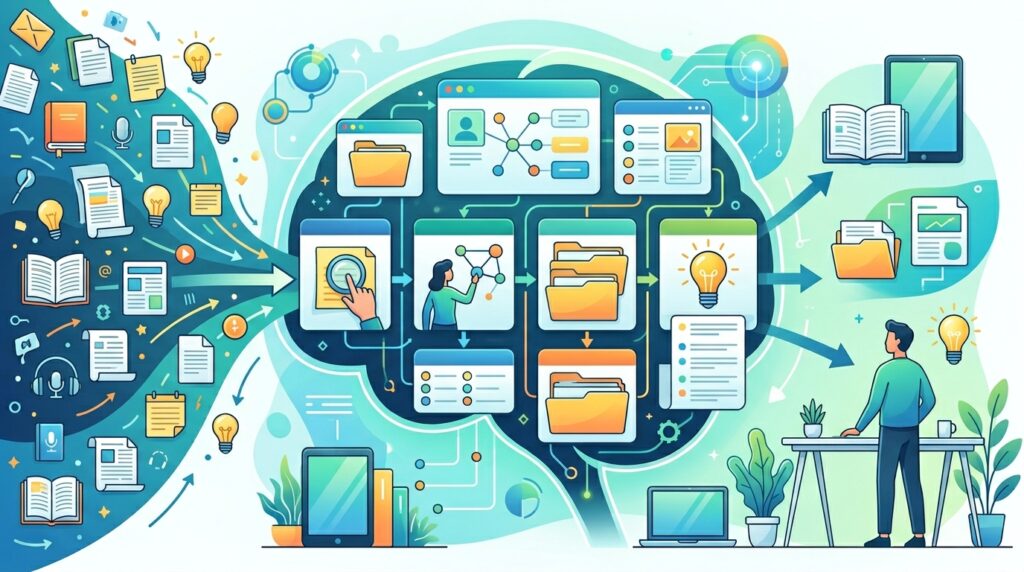
Tiago Forte’s framework uses the acronym CODE: Capture, Organize, Distill, Express. It is a useful skeleton. Here is what each piece looks like in practice for a normal person who is not a full-time productivity nerd.
Capture is the habit of catching things before they disappear. An idea in the shower. An article that seems useful. A quote that hit you differently. You do not need to do anything with it yet. You just need to get it out of your head and somewhere specific.
Organize is giving things a home so you can find them later. Forte uses a system called PARA: Projects, Areas, Resources, Archive. You do not have to use his system. You just need a system. The specifics matter less than the consistency.
Distill is where most people skip a step. It is not enough to save things. You have to process them, pull out the part that actually matters to you, in your own words. A highlighted article you never returned to is not a second brain. It is a digital pile.
Express is using what you have built. Writing something, making something, sharing something, deciding something. The whole point of capturing and organizing information is that it becomes useful. If your second brain is just a very organized graveyard of saved links, something has gone wrong.
Who This Is Actually For
Here is the honest version: a second brain system is not for everyone in the same way. It is most useful if you generate or consume a lot of information and need to actually do something with it.
That covers a lot of people. Writers, students, freelancers, managers, anyone running a business or a side project, anyone who reads a lot and wants to do more than passively absorb. Anyone who has ever thought, “I know I saved something about this,” and spent twenty minutes failing to find it.
It is less immediately useful if your life is mostly operational: showing up, doing the same tasks, going home. Though even then, the capture habit alone tends to reduce mental clutter in ways people find valuable.
The key thing to understand is that building a second brain system is not about becoming a different kind of person. It is about giving the person you already are a better set of tools.
Building the Habit Without the Overwhelm
This is where most people get stuck. They read about second brain systems and immediately try to import everything they have ever saved, build an elaborate tagging structure, and design the perfect workflow. Two weeks later, they have abandoned it.
The system does not work if you do not use it. And you will not use it if building it feels like a project in itself.
Start with just one thing: the capture habit.
Pick one place where things go. One notes app, one notebook, one document. What matters is that when something is worth keeping, you have a reflex to put it somewhere specific instead of letting it drift.
Once the capture habit is solid, organizing becomes easier because you have material to organize. Once you have organized material, distilling becomes natural because you are returning to things. Once you are returning to things, expressing and actually using what you have built starts to happen on its own.
The sequence matters. Do not try to build the whole thing at once.
This is the same logic behind building any sustainable habit. Start smaller than feels necessary. Make it easier than it feels challenging. Let momentum do the work. The same principles that make a workout habit stick apply directly here. How to Build a Workout Habit You’ll Actually Keep goes into this logic in detail, and most of it maps cleanly onto building a second brain practice. Consistency beats intensity, in fitness and in note-taking alike.
The Tools People Actually Use
You will find very strong opinions about tools in the productivity space. Ignore most of them. The right tool is the one you will open.
That said, here is an honest breakdown:
Notion is powerful and flexible. It can do almost anything, which is also its problem. Too much flexibility early on leads to elaborate systems that collapse under their own weight. Better once you know what you actually need.
Obsidian is the favorite of people who want to see how their ideas connect. It builds a visual map of linked notes. Genuinely interesting if you are a writer or researcher. Overkill for most people starting out.
Apple Notes or Google Keep are underrated. They are fast, they are always there, and they sync everywhere. For capture, especially, low-friction beats a feature list every time.
Readwise is specifically for highlights: things you have underlined in books or articles. If you read a lot and want to actually remember what you read, it is probably the highest-value tool in this space.
The most common mistake is choosing a tool because it looks impressive, then spending more time maintaining it than doing anything with the information inside. Simpler is almost always better when you are starting out.
The Distillation Problem (And Why It Matters More Than You Think)
Most people who try to build a second brain system get stuck in the same place: they have a lot of saved information and no sense of what to do with it.
This is the distillation problem. Saving things is easy. Processing them is where the work actually is.
The fix is a habit called progressive summarization, which Forte describes in detail. Short version: when you save something, put it in your system. When you return to it, highlight the most important parts. When you return again, highlight the highlights. Over time, what remains is the distilled version of why this thing mattered to you.
It sounds tedious. In practice, it is the thing that makes a second brain feel like an actual brain rather than a filing cabinet.
The other thing that helps: write notes to your future self. Not “article about sleep research” but something like “this research suggests consistency of bedtime matters more than total hours slept. Worth referencing when I write about daily rhythms.” The context is the value. Without it, you are just hoarding.
What Happens to Your Mental Health When You Offload Your Brain
This does not get talked about enough in the productivity world, but it should.
Cognitive overload, the state of holding too many things in working memory, is genuinely stressful. It creates a low-level anxiety that is easy to normalize because it is constant. You do not notice it the way you would notice a sudden stressor. It is just the background noise of modern life.
When you start offloading information to a system you trust, something shifts. Not dramatically, not overnight. The mental weight of “I need to remember this” starts to lift. You finish conversations without immediately worrying about whether you will forget what was said. You stop waking up at 3am because something you needed to do surfaced in your sleep.
This connects to something David Allen talks about in Getting Things Done: the brain uses energy to hold open loops. Every task you have not captured, every idea you have not written down, every commitment you are tracking mentally is using resources. Close the loops and the energy comes back.
There is a wider conversation worth having about mental load and the way modern life quietly taxes us in ways we do not always name. The piece on Breaking the Silence: Powerful Quotes About Mental Health Stigma touches on something connected: the importance of taking your inner experience seriously rather than assuming you should just cope better. A second brain system is, in its own small way, an act of taking yourself seriously. What you think matters. What you notice matters. Giving those things a home is not a productivity hack. It is a form of self-respect.
Common Mistakes (And How to Avoid Them)
Trying to organize before you capture. You need raw material before you need categories. Do not build the filing system before you have files.
Making it too complicated. Every new tag, every new category, every new rule you add is something you have to maintain. Start with less structure than you think you need.
Treating it as a dumping ground. A second brain is not a place to put everything. It is a place to put things worth keeping and using. If you are saving things you know you will never return to, you are creating noise.
Never reviewing it. The system only pays off if you go back to it. A weekly review, even fifteen minutes, where you look at what you have captured and connect it to what you are working on — that is what separates an active second brain from a digital junk drawer.
Switching tools constantly. Every time you switch, you lose momentum and usually import a bunch of things you never actually needed. Pick something good enough and stick with it long enough to know whether it works for you.
The Real Goal
At the end of it, a second brain system is not really about productivity. Productivity is just the surface.
The real goal is having a relationship with your own ideas. Being the kind of person who has thoughts, catches them, returns to them, builds on them, and eventually does something with them. Most people have more good ideas than they think. They just do not have a system for catching them before they disappear.
You do not need to be organized by nature. You do not need to love systems or apps or frameworks. You just need to be a person who wants to use their mind more fully.
The second brain system is the infrastructure for that. Everything else grows from it.