



Micro-enterprises form the foundation of Nigeria’s economic structure. According to national MSME survey data, Nigeria has over 39 million Micro, Small and Medium Enterprises (MSMEs), with micro-enterprises accounting for more than 90% of businesses in the country. The sector contributes nearly 50% to Nigeria’s Gross Domestic Product (GDP) and provides about 84% of total employment nationwide. Despite this significant contribution, micro-enterprises continue to face severe financial constraints, limited access to formal credit, and operational challenges.
To address these challenges, the Small and Medium Enterprises Development Agency of Nigeria (SMEDAN) introduced the SMEDAN Conditional Grant Scheme (CGS); a targeted intervention designed to support micro-enterprises with non-repayable financial assistance under specific performance conditions.
This comprehensive guide explains everything you need to know about the SMEDAN Conditional Grant Scheme, including eligibility requirements, step-by-step application process, benefits, documentation, common mistakes, and what to expect under the SMEDAN Conditional Grant Scheme 2025 phase.
What is the SMEDAN Conditional Grant Scheme (CGS)?
The SMEDAN Conditional Grant Scheme (CGS) is a government-backed financial support initiative targeted specifically at micro-enterprises across Nigeria. Unlike loans, grants provided under the scheme are typically non-repayable, provided beneficiaries meet specific conditions such as maintaining business operations or employing at least one additional staff member.
The scheme was first implemented in phases including the SMEDAN Conditional Grant Scheme 2020, with ongoing discussions and budgetary provisions supporting new cycles such as the anticipated SMEDAN Conditional Grant Scheme 2025.
The primary objectives of the scheme include:
- Supporting micro-enterprises with capital injection
- Reducing business mortality rates
- Encouraging job creation
- Promoting financial inclusion
- Strengthening grassroots entrepreneurship
Why the Conditional Grant Scheme Was Introduced
Micro-enterprises often operate informally with limited access to credit. Traditional bank loans require collateral, structured financial statements, and credit history — criteria many micro-business owners cannot meet.
Data from national financial inclusion surveys indicate that a significant percentage of micro-business operators rely on personal savings or informal borrowing for startup capital. High interest rates in commercial lending further discourage borrowing.
The SMEDAN Conditional Grant Scheme Nigeria was therefore designed to:
- Provide immediate capital relief
- Stimulate local economic activity
- Encourage formal registration
- Promote job creation at community level
- Improve business sustainability
How the SMEDAN Conditional Grant Scheme Works
The scheme typically operates through the following structure:
- Federal government allocates funding to SMEDAN.
- Micro-enterprises apply through designated portals.
- Eligible businesses are screened and verified.
- Successful applicants receive grants.
- Beneficiaries must meet specific conditions (e.g., job retention or creation).
The “conditional” aspect means beneficiaries may be required to:
- Employ at least one additional staff member
- Maintain business operations for a minimum period
- Use funds strictly for business purposes
- Provide evidence of business activity
Failure to meet these conditions may disqualify future participation.
Eligibility for SMEDAN Conditional Grant Scheme Micro-Enterprises
To qualify for the SMEDAN Conditional Grant Scheme micro-enterprises, applicants typically must:
- Operate a micro-enterprise in Nigeria
- Have valid identification
- Provide proof of business activity
- Be registered with SMEDAN (recommended)
- Have CAC registration (in some phases mandatory)
- Operate within approved sectors
Priority is often given to:
- Youth entrepreneurs
- Women-owned businesses
- Rural enterprises
- Informal businesses transitioning to formal status
Step-by-Step Process: How to Apply for SMEDAN Conditional Grant Scheme
Below is a detailed, practical step-by-step guide for the SMEDAN Conditional Grant Scheme application process.
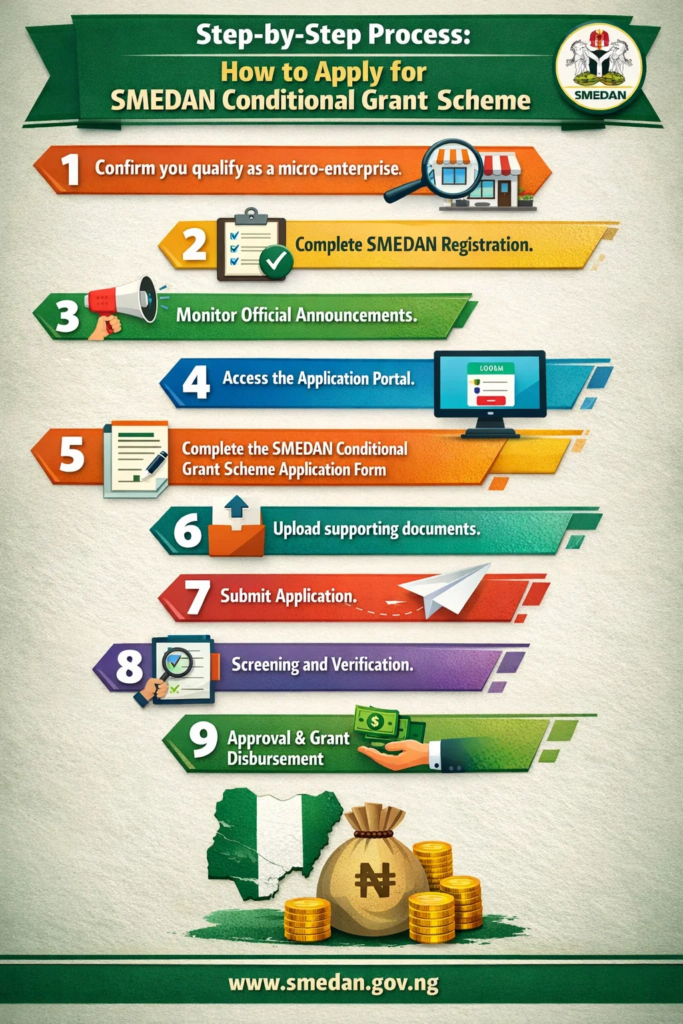
Step 1: Confirm Eligibility
Before applying, ensure that:
- Your business qualifies as a micro-enterprise
- You operate within Nigeria
- You meet registration and documentation requirements
Micro-enterprises are typically defined by:
- Small workforce (often fewer than 10 employees)
- Limited annual turnover
- Small-scale operations
Step 2: Complete SMEDAN Registration
Although not always mandatory in early phases, SMEDAN registration significantly improves eligibility.
Registration provides:
- SMEDAN Unique Identification Number (SUIN)
- Inclusion in MSME database
- Official recognition
This strengthens your application profile.
Step 3: Monitor Official Announcements
When a new cycle (e.g., SMEDAN Conditional Grant Scheme 2025) is launched:
- Official announcements are made via SMEDAN channels
- Application windows are specified
- Eligibility criteria are updated
Applicants must apply within the specified timeframe.
Step 4: Access the Application Portal
When active, applicants can:
- Visit the official SMEDAN Conditional Grant Scheme apply online portal
- Create an account
- Begin digital application
Always verify the authenticity of the portal to avoid scams.
Step 5: Complete the SMEDAN Conditional Grant Scheme Application Form
Applicants must provide:
- Personal details
- Business information
- Nature of enterprise
- Number of employees
- Years of operation
- Business location
- Revenue estimate
Accuracy is crucial. False information may result in disqualification.
Step 6: Upload Supporting Documents
Required documents may include:
- Valid ID card
- Passport photograph
- CAC certificate (if applicable)
- SMEDAN certificate
- Business address proof
- Bank account details
Ensure uploaded documents are clear and legible.
Step 7: Submit Application
After reviewing all information:
- Submit the form
- Save confirmation details
- Await screening and verification
Step 8: Screening and Verification
SMEDAN conducts:
- Data validation
- Business verification
- Cross-checking against eligibility criteria
Shortlisted applicants may be contacted for further confirmation.
Step 9: Approval and Grant Disbursement
Successful beneficiaries receive:
- Notification of approval
- Conditions attached to the grant
- Funds disbursed into registered account
Beneficiaries must comply with grant conditions.
Key Benefits of SMEDAN Conditional Grant Scheme
The SMEDAN Conditional Grant Scheme (CGS) is designed to provide practical, targeted support to micro-enterprises that often struggle with limited access to formal financing. Below is a detailed explanation of the major benefits of the program and how they positively impact small business owners across Nigeria.
1. Non-Repayable Financial Support
One of the most significant advantages of the SMEDAN Conditional Grant Scheme is that it offers non-repayable funding, provided beneficiaries meet the attached conditions. Unlike traditional bank loans that require collateral, interest payments, and strict repayment schedules, this grant reduces financial pressure on small business owners.
Micro-enterprises often operate on tight margins. Taking loans can increase financial risk, especially when business cash flow is unstable. A conditional grant eliminates the burden of monthly repayment, allowing entrepreneurs to focus on stabilizing and growing their operations.
This type of funding is particularly valuable for:
- Startups with limited capital
- Informal businesses transitioning into formal operations
- Rural enterprises without access to bank credit
- Women and youth-led businesses
By removing repayment stress, the scheme improves business survival rates and reduces the likelihood of early closure.
2. Job Creation Incentive
The “conditional” nature of the grant typically requires beneficiaries to employ at least one additional staff member. This creates a direct link between business support and employment generation.
Nigeria faces ongoing unemployment challenges, particularly among youth. By tying financial support to job creation, the scheme ensures that funding does not only benefit business owners but also contributes to wider economic inclusion.
This structure encourages businesses to:
- Expand production capacity
- Increase service delivery
- Hire apprentices or junior staff
- Improve operational efficiency
Over time, this multiplier effect contributes to reduced unemployment and improved household income at the community level.
3. Capital Injection for Business Growth
Many micro-enterprises struggle with inadequate working capital. Limited funds often restrict inventory purchases, equipment upgrades, marketing efforts, and daily operational expenses.
The SMEDAN Conditional Grant Scheme provides an immediate capital injection that can be used for:
- Purchasing raw materials
- Expanding product lines
- Acquiring small equipment or tools
- Renting or upgrading workspace
- Improving packaging and branding
Access to even modest funding can significantly increase productivity and revenue potential. For small businesses operating at minimal capacity, this injection can be the turning point between stagnation and sustainable growth.
4. Encouragement of Business Formalization
A key indirect benefit of the scheme is the promotion of formal business registration and compliance. Many micro-enterprises operate informally without proper documentation or official recognition.
Participation in the scheme often requires:
- Registration with SMEDAN
- Business identification details
- In some cases, CAC registration
- Bank account verification
These requirements motivate entrepreneurs to formalize their operations, which opens access to:
- Government programs
- Bank financing
- Business partnerships
- Tax identification systems
- Structured growth opportunities
Formalization enhances credibility and positions businesses for long-term sustainability.
5. Community-Level Economic Growth
Micro-enterprises play a critical role in grassroots economic activity. When small businesses receive funding and expand, the benefits extend beyond individual owners.
The scheme contributes to:
- Increased local employment
- Stronger local supply chains
- Improved household incomes
- Reduced poverty levels
- Enhanced community productivity
As more micro-businesses stabilize and grow, communities experience increased commercial activity. Markets expand, service delivery improves, and local economies become more resilient.
This bottom-up economic development model strengthens national productivity and supports inclusive economic growth.
Overall Impact
The SMEDAN Conditional Grant Scheme goes beyond simple financial assistance. It combines economic empowerment, employment stimulation, and business formalization into a single structured intervention.
For micro-entrepreneurs seeking capital without the burden of debt, the scheme offers:
- Financial relief
- Growth opportunity
- Increased credibility
- Greater economic participation
When properly implemented and accessed by eligible businesses, the program serves as a powerful catalyst for sustainable micro-enterprise development in Nigeria.
Common Mistakes to Avoid
- Applying through unofficial websites
- Submitting incomplete forms
- Providing inaccurate business details
- Missing application deadlines
- Ignoring attached conditions
Challenges of the Scheme
While the SMEDAN Conditional Grant Scheme has provided meaningful support to micro-enterprises across Nigeria, it is not without its challenges. Understanding these limitations can help applicants prepare more effectively and improve their chances of success.
• Limited Funding Relative to High Demand
Nigeria has over 39 million MSMEs, with micro-enterprises making up the overwhelming majority. However, grant allocations are limited by annual federal budget provisions. As a result, the number of applicants often far exceeds the number of available grants. Many qualified businesses may not be selected simply due to funding constraints rather than lack of merit.
• Short Application Windows
Application periods are sometimes brief, giving entrepreneurs limited time to gather documents and complete submissions. Businesses that are not already prepared with registration details, financial records, and required documentation may miss the opportunity entirely.
• Verification Delays
Due to the large volume of applications, screening and verification processes can take time. Delays may occur during data validation, business confirmation, or bank detail checks. Applicants are often required to remain patient while awaiting official communication.
• High Competition
Because the scheme offers non-repayable financial support, it naturally attracts significant interest nationwide. This high competition means applicants must ensure their information is accurate, complete, and aligned with eligibility criteria to stand out.
SMEDAN Conditional Grant Scheme 2026 – What to Expect
Although final details of the SMEDAN Conditional Grant Scheme 2026 will depend on federal budget approvals and policy direction, several improvements are widely anticipated based on previous program cycles and Nigeria’s broader MSME development strategy.
1. Fully Digital Application Systems
One of the expected upgrades is a more streamlined and fully digital application process. Earlier phases experienced heavy traffic and manual verification bottlenecks. In 2026, applicants may see:
- Improved online portals with real-time status tracking
- Automated eligibility screening
- Faster document uploads and verification
- Reduced paperwork and physical submissions
A fully digital system would improve transparency, reduce fraud, and allow more micro-entrepreneurs especially in rural areas, to apply conveniently.
2. Expanded Sector Coverage
Previous grant cycles often prioritized specific sectors such as agriculture, manufacturing, trade, and services. The 2026 phase may expand eligibility to include:
- Creative and digital enterprises
- Technology-enabled micro-businesses
- Green and sustainable ventures
- Informal rural businesses transitioning to formal status
With MSMEs contributing nearly 50% to Nigeria’s GDP, broader sector inclusion would ensure more equitable access to funding across industries.
3. Stronger Verification Mechanisms
To improve accountability and ensure funds reach genuine micro-enterprises, stronger verification processes are expected. These may include:
- Data cross-checking with CAC and tax records
- Geo-location verification of business premises
- Bank account validation systems
- Post-disbursement monitoring
Enhanced verification would help minimize duplicate applications and ensure compliance with grant conditions, particularly job creation requirements.
4. Increased Funding Allocation
Given Nigeria’s large MSME base over 39 million enterprises nationwide demand for grants continues to exceed supply. If federal allocations increase in 2026, this could mean:
- Higher grant amounts per beneficiary
- Larger number of approved applicants
- Broader geographic distribution across states
An expanded funding pool would significantly boost grassroots economic activity and support micro-business sustainability.
Frequently Asked Questions (FAQ)
Is the SMEDAN Conditional Grant Scheme a loan?
No. It is a conditional grant, not a repayable loan.
Who qualifies as a micro-enterprise?
Typically businesses with small workforce and limited turnover.
Is CAC registration mandatory?
It may be required depending on program phase.
How much is the grant amount?
Amounts vary by cycle and budget allocation.
Can I apply online?
Yes, when active, the SMEDAN Conditional Grant Scheme apply online portal is used.
Is the scheme still active?
Activation depends on government budget releases and official announcements.
Final Thoughts
The SMEDAN Conditional Grant Scheme for Micro-Enterprises represents a strategic intervention aimed at strengthening Nigeria’s vast micro-business sector. By providing non-repayable funding tied to employment and operational conditions, the program supports grassroots economic growth and reduces business vulnerability.
For micro-entrepreneurs seeking capital without traditional loan burdens, participating in the SMEDAN Conditional Grant Scheme Nigeria can be transformative — provided applicants prepare properly, meet eligibility requirements, and follow the step-by-step application process carefully.